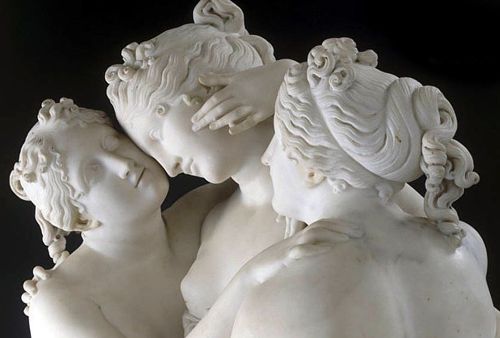


Long before the word "sanctuary" meant what it means to us today, the Greeks already had a sacred place devoted to water and to those who inhabited it. It wasn't just a beautiful space: it was the earthly home of minor divinities who, it was believed, could bless or punish anyone who dared disturb them. They were the nymphs, and the place where they were honored was called a nymphaeum.
What the nymphs were in Greek mythology
Nymphs were minor nature divinities, almost always depicted as eternally beautiful young women. They weren't immortal in the same sense as the great Olympian gods: many traditions granted them extraordinarily long lives, tied to the fate of the place they protected. They were divided into several groups according to their territory: the Naiads inhabited rivers and springs; the Dryads and Hamadryads, trees and forests; the Oceanids, the seas; and the Oreads, the mountains.
They formed part of the retinue of several gods, especially Artemis, goddess of the hunt, and Pan, god of wild nature and rustic music. They were believed capable of inspiring, driving mad, healing, or prophesying, and for this reason the places they inhabited — springs, grottoes, groves — became sites of active worship for centuries.
Sacred caves: the cult of the nymphs in the mountains
One of the best-documented nymph sanctuaries in all of Greece is the Corycian Cave, on the slopes of Mount Parnassus, near Delphi. It was considered sacred since the Neolithic period and was dedicated to the Corycian nymphs and the god Pan. Twentieth-century archaeological excavations found tens of thousands of pieces of votive pottery and astragali — small bones used as dice or for divination — inside it, proof that generations of worshippers made pilgrimages there for over a thousand years to leave offerings.
The myth of Arethusa: the nymph who became a spring
If there's one myth that explains why the Greeks considered the water of a spring sacred, it's that of Arethusa. According to the version recorded by Ovid in his Metamorphoses, Arethusa was a huntress nymph, part of Artemis's retinue, who one day decided to bathe in the waters of the river Alpheus, in the Peloponnese. The river god, seeing her, fell in love with her and began to pursue her.
Terrified, Arethusa ran without rest and called on Artemis for help, who wrapped her in a cloud and carried her to the island of Ortygia, off Syracuse, in Sicily. There, to save her once and for all, the goddess transformed her into a freshwater spring. But not even that stopped Alpheus: the god found an underground path beneath the sea and mingled his waters with hers, joining together forever. That spring, known as the Fountain of Arethusa, still exists today in Ortygia and for centuries was considered a sacred place, associated with the cult of Artemis.
What a nymphaeum was
With that kind of story as a backdrop, it's easier to understand what a nymphaeum was: a Greek and Roman sanctuary consecrated to water nymphs. The name originally designated a natural grotto with springs and streams, traditionally considered the habitat of these spirits. Over time, the term also came to refer to artificial grottoes or buildings filled with plants, flowers, sculptures, fountains, and paintings, built to imitate that sacred habitat. It functioned as a sanctuary, a water reservoir, and a gathering chamber where weddings were held.
The word also had other curious uses: in ancient Rome it was also used to refer to a brothel, and centuries later it was used to name the fountain located in the atrium of Christian basilicas.
From sacred sanctuary to Renaissance garden
In the 16th century, the nymphaeum resurfaced as a prominent feature of Italian gardens, this time stripped of its religious cult but keeping its character as a space of wonder. A notable example is the nymphaeum of Villa Giulia, in Rome, built between 1551 and 1555 for Pope Julius III, with fountains designed by Vasari and Bartolomeo Ammannati. This type of space was always associated with fresh water and springs, and was usually enclosed within a formal structure, designed to surprise whoever visited it.
William-Adolphe Bouguereau, the painter of nymphs
William-Adolphe Bouguereau was a French academic painter who returned again and again to mythological subjects, offering modern interpretations of classical scenes with particular emphasis on the female human body. During his lifetime he enjoyed great popularity in France and the United States, though as the quintessential salon painter of his generation he was harshly criticized by the Impressionist avant-garde, and by the early 20th century his work had fallen out of public favor. It wasn't until the 1980s that a revival of interest in figure painting led to his rediscovery. Over the course of his life he completed 822 known finished paintings, and nymphs were one of his most recurring subjects.
Bouguereau's Nymphaeum
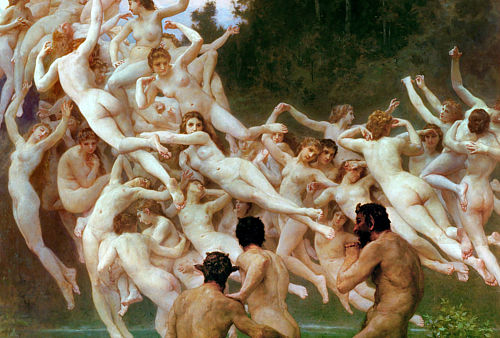
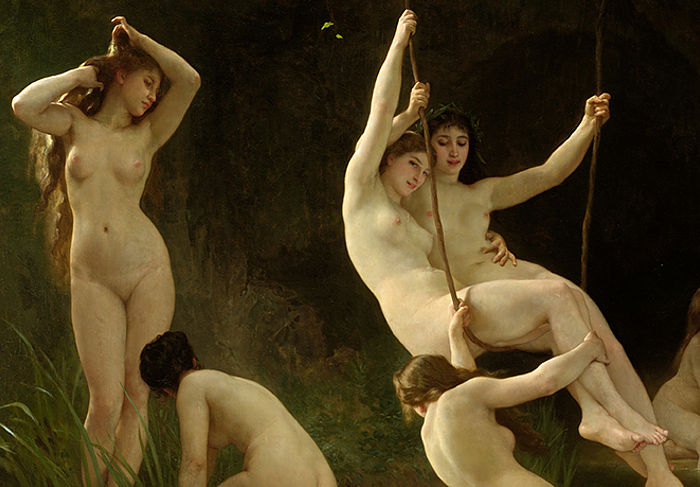
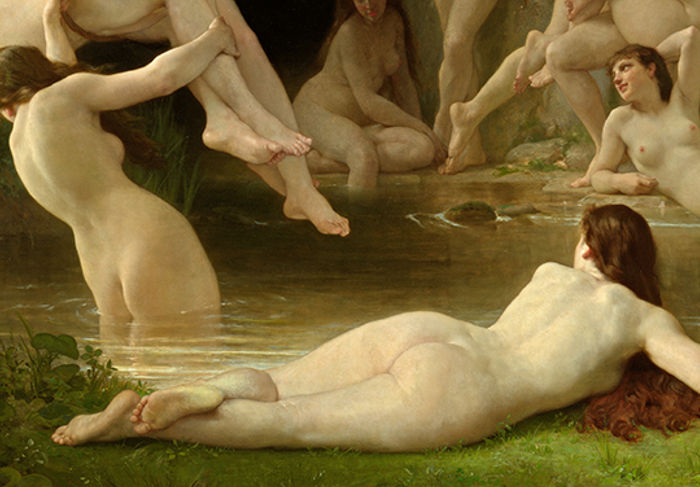
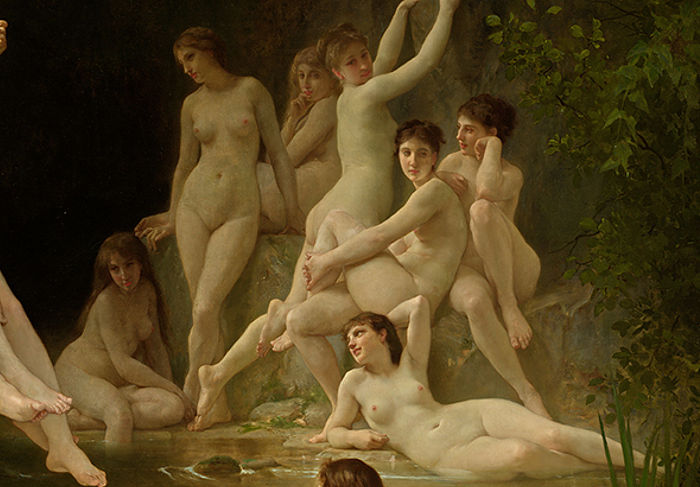
Drawing on classical nymphaea, Bouguereau transposes that idea of a sacred sanctuary into a forest populated by female figures in an idyllic setting, evoking the harmony and mystery that ancient civilizations attributed to these places. The use of chiaroscuro and the delicate poses of the nymphs reflect Neoclassical influence, as well as his mastery of anatomical realism.
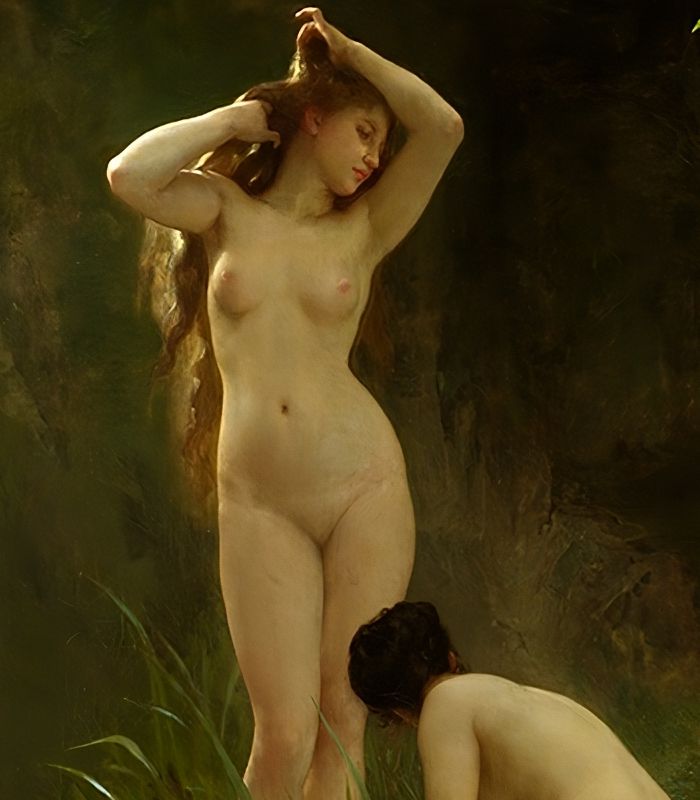
Bouguereau lets us spy on this sacred forest, where thirteen nude nymphs enjoy themselves, charming and carefree, unaware that a satyr and another male figure are hiding among the bushes, watching them. That detail turns us, as we look at the painting, into accomplices of a brazen act of voyeurism: by crossing, without permission, the invisible wall of the canvas, we become witnesses to this serene daydream.
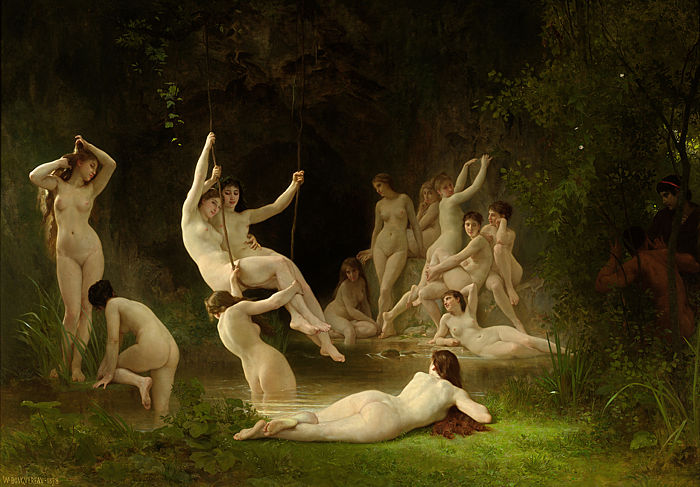
Bouguereau painted The Nymphaeum in 1878 to present it at that year's Paris Universal Exposition, where he exhibited it alongside twelve other works of his — allegorical pieces, genre scenes, portraits, and religious subjects. The effort earned him a medal of honor. Today the painting is held at the Haggin Museum, in Stockton, California, far from the major European museums where Bouguereau is usually found.
THE ARTWORK
The Nymphaeum
William-Adolphe Bouguereau
Date: 1878
Style: Neoclassicism
Genre: Mythological painting
Medium: Oil on canvas
Dimensions: 144.78 x 209.55 cm
Location: Haggin Museum, Stockton, CA, USA