
Select your language

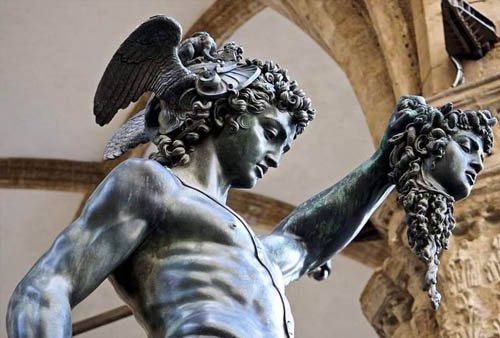
There is a sculpture in the heart of Florence that seems to breathe. A young man cast in bronze holds aloft a severed head, crowned with serpents, its eyes still half-open as if the instant of decapitation had not yet ended. Legend has it that whoever dares look into those stone eyes meets the same fate as its victims.
Read more … Perseus and Medusa | The Curse That Turned Flesh to Stone

Some sculptures impress by their size. Others, by the beauty of their figures. And then there's Disillusion, a work that produces a reaction much harder to explain: it's hard to believe that what we're looking at is really marble.
Francesco Queirolo finished this sculpture in 1753-1754 for the Cappella Sansevero in Naples.
Read more … The Disillusionment by Francesco Queirolo: The Impossible Knot

Hercules and Deianira undertook the challenge of crossing the Evenus River. However, Nessus, the centaur tasked with guiding them, had dark intentions. In a despicable act, Nessus first crossed with Hercules and his supplies, leaving Deianira alone on the opposite bank. Taking advantage of this opportunity, he attempted to kidnap and violate the defenseless woman.
Read more … Hercules and the Centaur Nessus: The Tragedy of Poisoned Love

The story of the abduction of Persephone is more a story about Demeter than about her daughter Persephone. The violation of Persephone had terrible family precedents, beginning with the relationship of her mother Demeter with one of her brothers, the father of her daughter, Zeus, king of the gods, who also refused to intervene to help the girl, at least in a timely manner. Demeter, goddess of the earth and grain, as we have already told in La Vida es Arte, was the sister of Zeus, as well as of Poseidon and Hades.
Read more … The Day the Earth Opened and Took Her Away | The Rape of Proserpina
Page 1 of 5
Estamos ahi, igual que tu !


 Sumérgete en un viaje emocionante donde la creatividad y la belleza artística se fusionan para dar vida a narraciones atemporales que siguen cautivando al mundo moderno. Desentrañamos los secretos ocultos detrás de estas obras icónicas y te llevamos en un recorrido único por la intersección entre mitología y genialidad artística.¡Déjate inspirar por la riqueza cultural que perdura a través de los siglos !