

A young woman is reading. Perhaps the room is silent. Then someone appears, and everything changes. The visitor is the Archangel Gabriel, and the news he brings will transform Mary's life forever: she will become the mother of Jesus. The story occupies only a few lines in the Gospel of Luke, but it gave artists an irresistible scene. How do you paint the moment when someone receives news like this? What would Mary's expression look like? Would she be surprised, frightened, serene? Would Gabriel burst into the room, or would he approach gently?
For centuries, some of the greatest masters of painting returned again and again to that moment. The story remained essentially the same, but each of them imagined a different Annunciation.
The Angel Has Just Arrived
In 1333, Simone Martini and Lippo Memmi painted one of the most extraordinary versions. Everything takes place against a radiant golden background. Gabriel has just appeared: his wings are still spread, his cloak seems to be moving from the force of his arrival, and the words of his greeting can be read between him and Mary. She, however, recoils. Her body moves slightly backward and she wraps herself in her cloak, as if this presence had suddenly interrupted her privacy. This is not a Mary who simply listens; she seems to need a moment to understand what has just happened.
Almost a century later, Fra Angelico imagined the scene differently. The encounter takes place beneath clear, orderly architecture. Gabriel bows before Mary, and she responds with her hands crossed over her chest. The surprise of Simone Martini has given way to almost absolute calm.
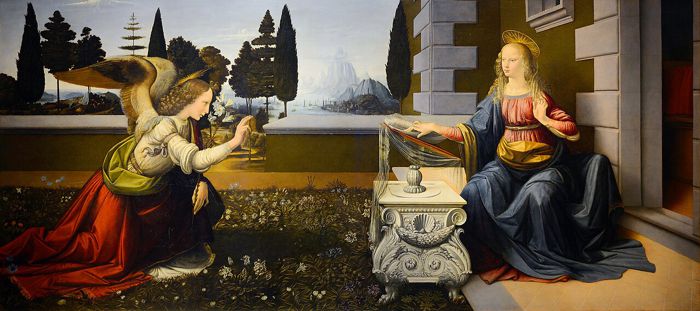
Leonardo's version
Nothing seems hurried. Even the light participates in the silence. In the background, Adam and Eve are being expelled from Paradise, visually connecting two moments separated by a vast distance in Christian history: loss and the promise of a new salvation.
But while Italian painters surrounded the scene with solemn spaces, something fascinating was happening in Northern Europe. Around 1427, the workshop of Robert Campin brought the Annunciation into a home. In the central panel of the Mérode Altarpiece, Mary is seated on the floor, absorbed in her reading. Everyday objects rest on the table, and in the adjoining room Joseph works in his workshop. Gabriel has already entered, but Mary seems not to have noticed his presence yet. The extraordinary has arrived without leaving the world of everyday life.
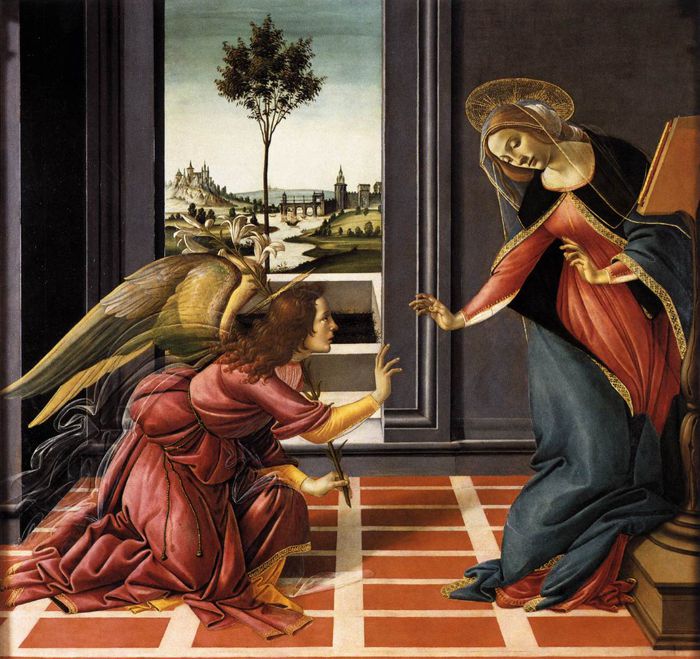
Botticelli's version
When Every Object Begins to Speak
Jan van Eyck transformed the scene once again a few years later. His Annunciation takes place inside a church and is filled with details that seem to demand a second look. Gabriel wears a magnificent robe, Mary raises her hands, and the words of both figures appear written in the space around them. The angel's greeting can be read normally; Mary's response is painted upside down, directed upward, as if it were meant to be read from heaven. The architecture, the scenes depicted on the floor, the windows, and the light all become part of the story.
Rogier van der Weyden returned to a more intimate room. Filippo Lippi preferred delicacy and a Mary with a gentle, elegant presence. Piero della Francesca constructed the encounter with the monumental serenity that characterizes so many of his figures. The same story was still there, but something had changed: there was no longer a single way to imagine it. Each painter had to decide where to place the angel, what Mary had been doing before his arrival, and above all, what expression could contain a moment like this.
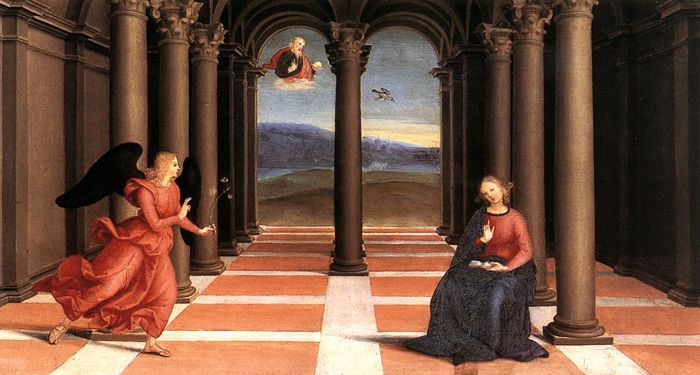
Raphael's version
Leonardo da Vinci, still very young, found his own answer. In his Annunciation, Mary is seated at a lectern with an open book while Gabriel kneels before her in a garden. It does not feel like a violent apparition. The angel has descended, and his wings still suggest that journey, but between them there is a strange calm, almost like a silent conversation. The landscape stretches into the distance, and the sacred scene begins to feel like an encounter between two real presences within a recognizable world.
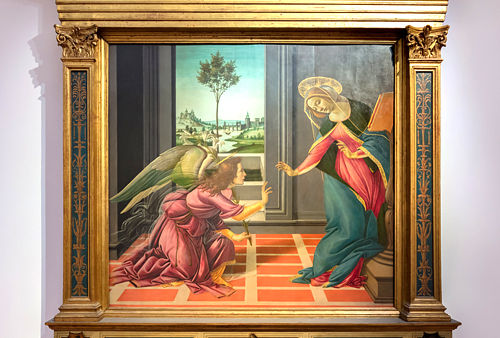
Sandro Botticelli chose greater movement. In the Cestello Annunciation, Gabriel advances while Mary recoils. Their hands seem to reach toward each other and stop at the same time. There is no contact between them, but the distance itself becomes part of the story. Mary leans, turns her body, and seems to react physically to what she has just heard. Botticelli transformed a few words into a suspended moment of tension.
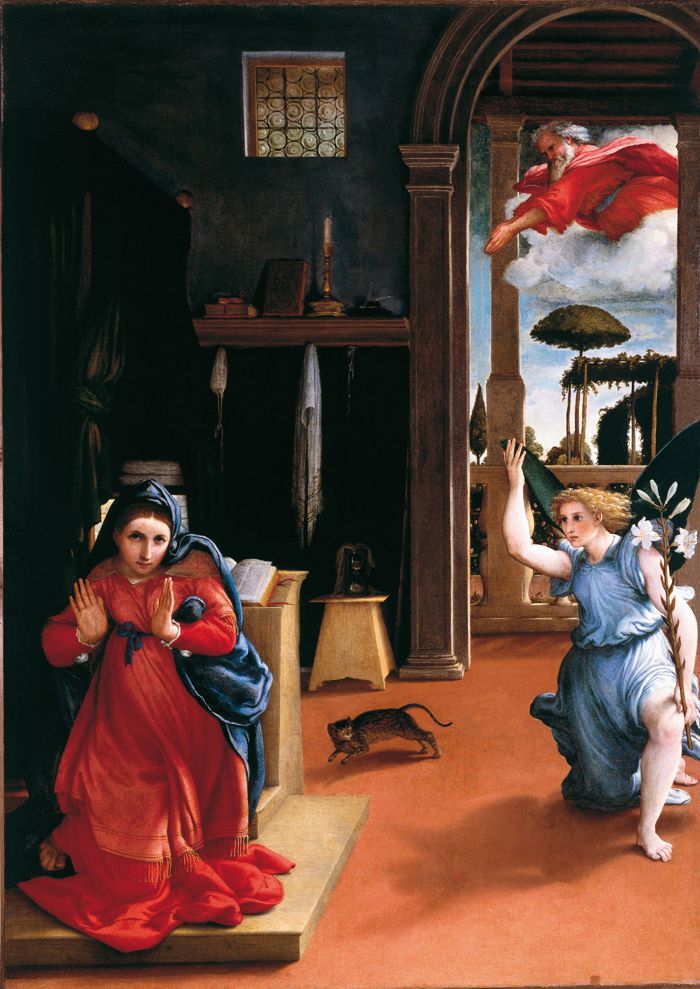
Lotto's version
A Story That Changes With Every Gaze
Raphael included the Annunciation among the scenes of the predella of the Oddi Altarpiece. Everything is more balanced and luminous. Gabriel approaches from one side while Mary receives the message within a perfectly ordered composition. But a few decades later, Lorenzo Lotto introduced something much more unexpected. In his Annunciation in Recanati, Gabriel seems to have burst into an actual room. Mary turns toward us with a startled expression, while a cat, surprised by the apparition, arches its back and runs away. Suddenly, this scene repeated for centuries becomes deeply ordinary again: someone has entered without warning, and even the household animal has noticed.
With Titian, the Annunciation acquired a new intensity. Color and light became protagonists, and the heavens seemed to open above the figures. Tintoretto went even further.
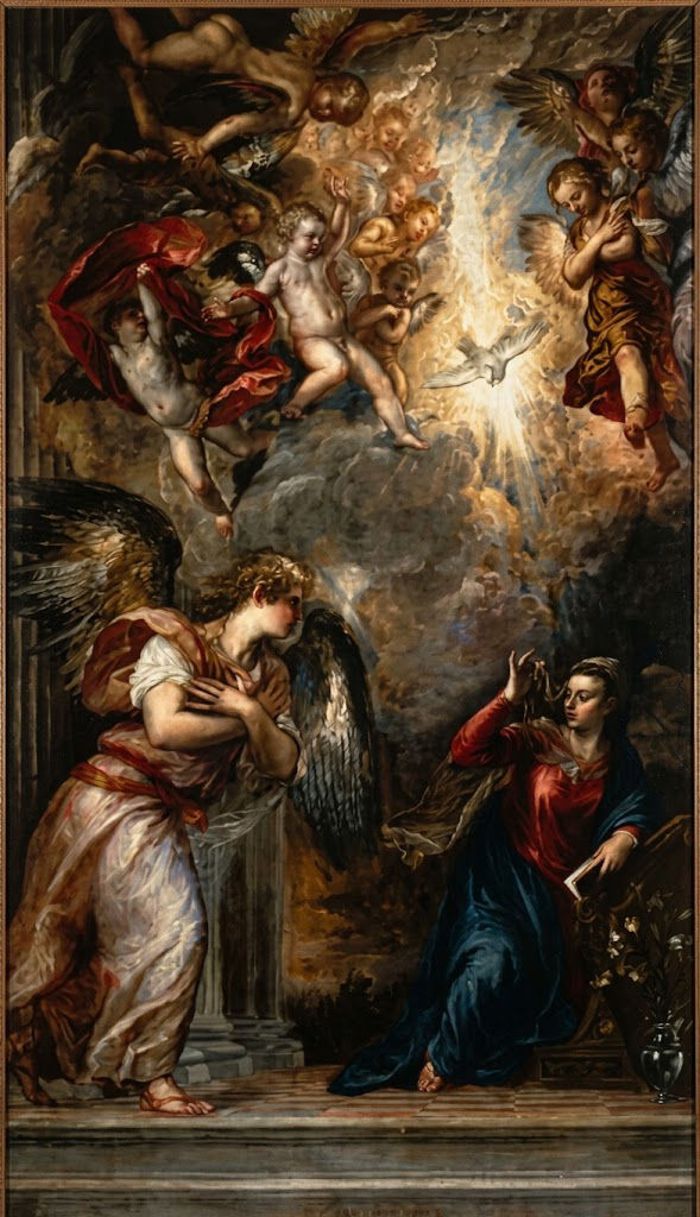
Titian's version
In his version for the Scuola Grande di San Rocco, the tranquility of many earlier Annunciations disappears. Gabriel enters accompanied by a true eruption of angels, and the scene fills with diagonals, movement, and energy. We no longer feel that we are watching a quiet conversation; it seems as though heaven itself has just burst through the room.
El Greco transformed the same episode into an almost supernatural vision. The figures become elongated, the space loses much of its stability, and the light seems to come from a place that does not belong to the everyday world. Mary and Gabriel occupy the lower part of the composition, while above them unfolds a celestial realm filled with angels. The Annunciation that began centuries earlier in rooms and gardens now seems suspended between earth and heaven.
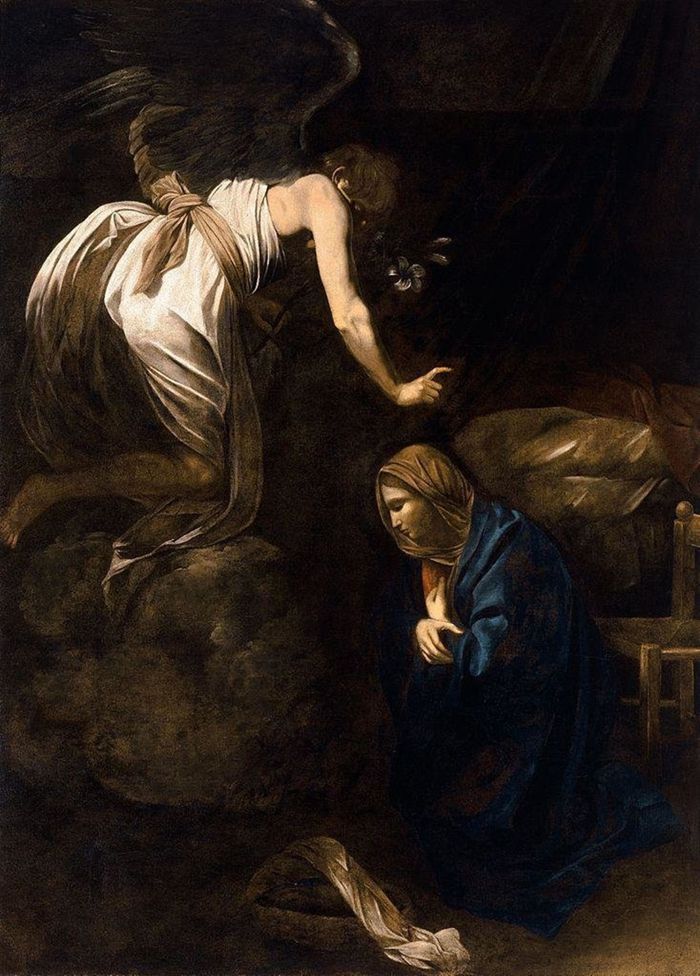
Caravaggio's version
Darkness Enters the Room
Caravaggio took the story in the opposite direction. In his Annunciation, darkness dominates much of the composition. Mary is no longer surrounded by perfect architecture or a luminous garden. She bends humbly as Gabriel descends toward her. The scene has weight, shadow, and an immediate humanity. The miracle does not need gold or grand palaces; it can happen in a dark and silent room.
Rubens brought back movement, agitated folds, and the energy of an extraordinary event. Orazio Gentileschi, by contrast, could transform these religious scenes into much more restrained encounters, built through precise light and figures of enormous presence.
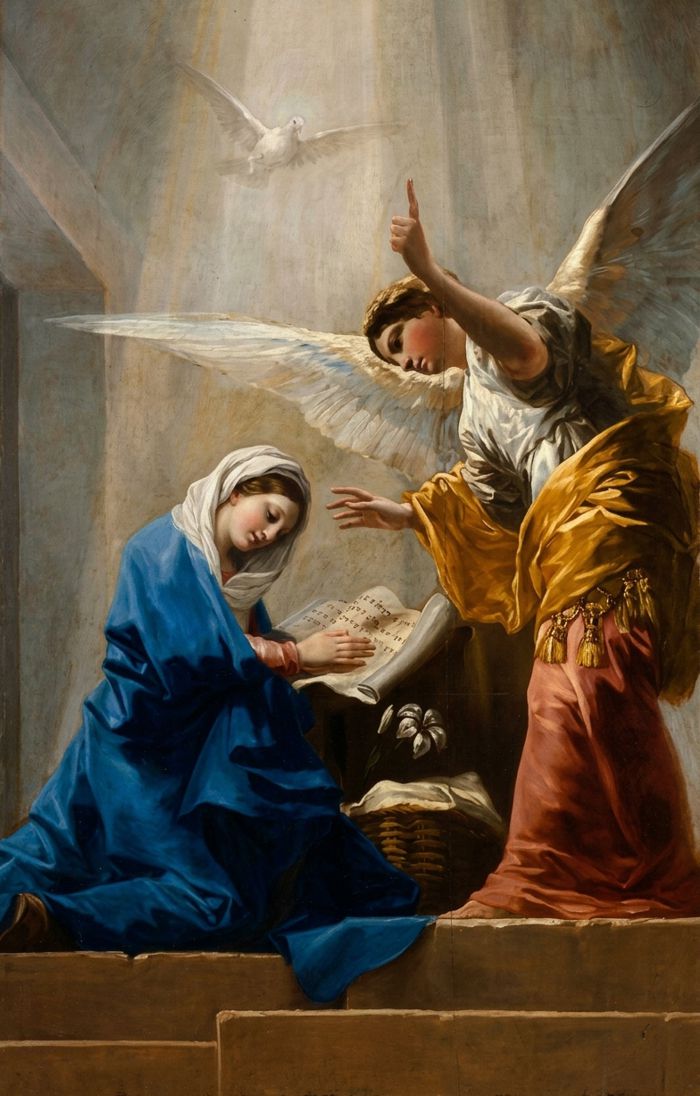
Goya's version
His daughter Artemisia Gentileschi also painted the Annunciation, placing Gabriel and Mary face to face with a different kind of monumentality. In her version, Mary does not disappear into the scene: she occupies her space, receives the announcement, and retains a powerful presence before the angel.
Nicolas Poussin returned to balance and order. Murillo brought to the subject the luminous softness that characterizes much of his religious painting, making the figures seem enveloped in a delicate atmosphere. And much later, Goya received a commission to paint a large Annunciation intended for an altar. In his hands, this ancient scene was transformed once again. The figures acquire monumentality and an intense light organizes the encounter, proving that it was still possible to return to the same episode and find another way of seeing it.
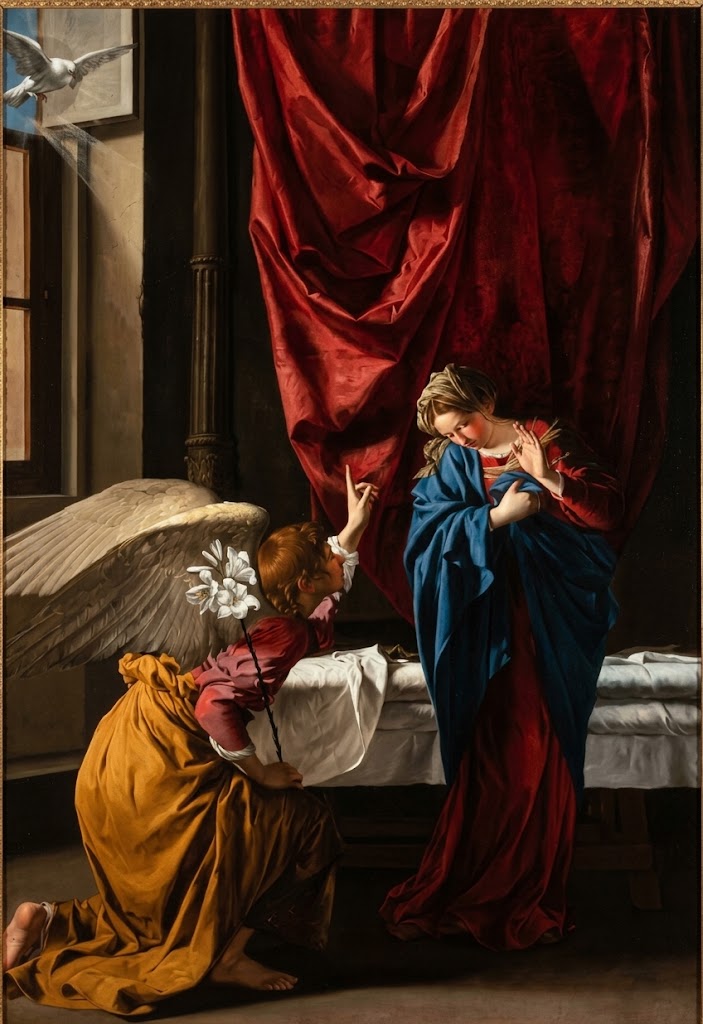
Orazio Gentileschi's version
The Same Moment, Never the Same Painting
That is perhaps the most fascinating thing about looking at all these versions. The artists knew the story. They also knew many of the images that had been created before them. And yet none of them could avoid facing the same question again: what really happened in that room?
Some imagined Mary startled and recoiling from Gabriel. Others showed her serene, reading, praying, or quietly accepting his words. Some made the angel enter so gently that he seems barely to disturb the air; others allowed his arrival to shake the entire composition. There were humble rooms, monumental churches, gardens, columns, books, lilies, rays of light, doves, and skies suddenly opening above them. Even a small cat found its way into the story.
And yet, beneath all those differences, the same moment remains: a life before hearing certain words, and that same life immediately afterward.
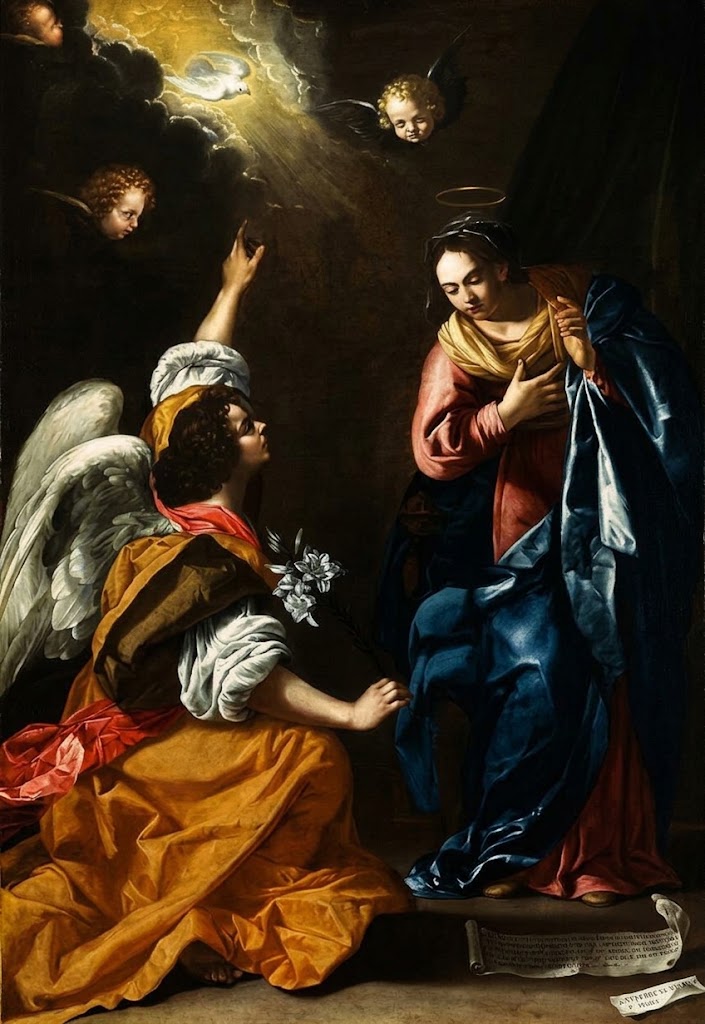
Artemisia Gentileschi's version
Perhaps that is why the Annunciation never became exhausted as a subject. It was not simply about representing the Archangel Gabriel standing before Mary. The artists had to paint something much more difficult: the exact moment when a person realizes that her life has just changed.
Simone Martini imagined it as a dazzling interruption. Fra Angelico as silence. Campin brought it into a home. Van Eyck filled the moment with symbols. Leonardo turned it into a serene encounter. Botticelli made the bodies react. Lotto allowed even a cat to be startled. Tintoretto opened the doors to heaven. El Greco transformed the scene into a vision. Caravaggio brought it into darkness. And every master who returned to it afterward added another possibility.
The story was always the same.
But no one had been there to see it.
And perhaps that is why every painter had to imagine it again.