

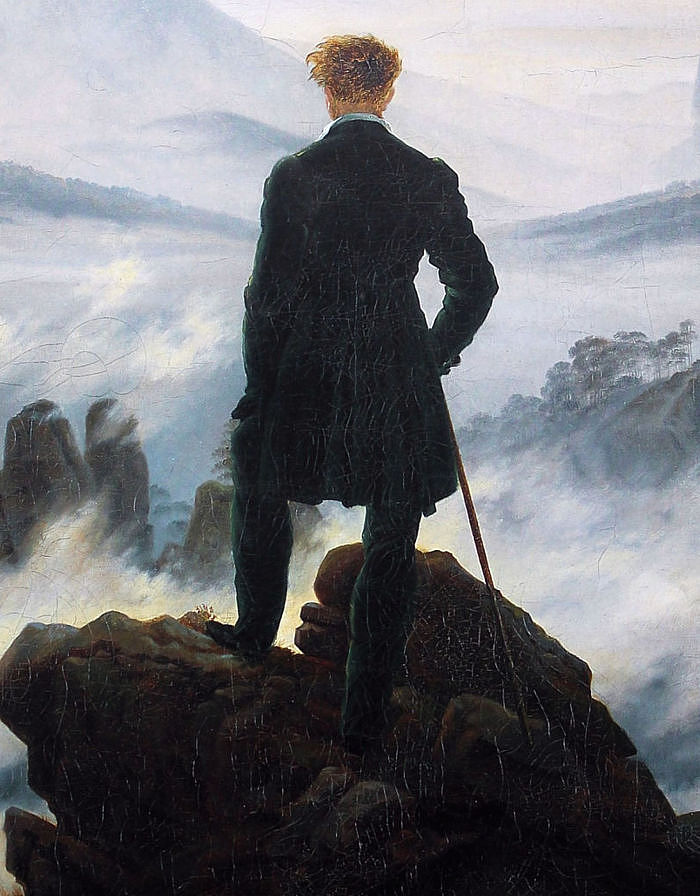
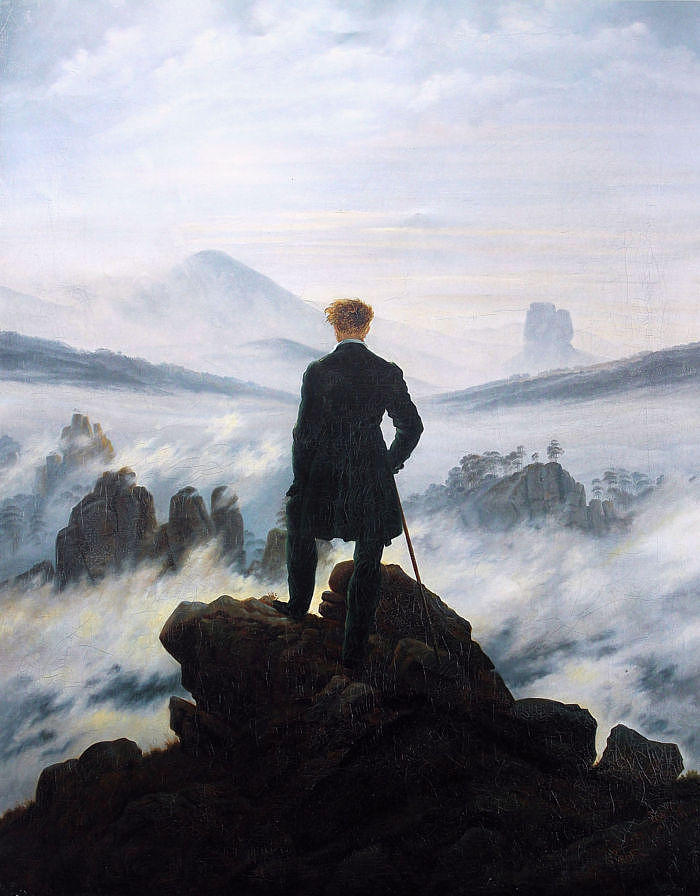
Imagine for a moment that you are standing at the edge of an abyss. You cannot see the ground below, only a silent, white ocean stretching as far as the eye can see. A solitary figure, standing atop a rocky crag, gazes out at that same horizon. You have likely seen this image before. It is Wanderer above the Sea of Fog, painted in 1818 by the German master Caspar David Friedrich.
It is considered by art historians and critics to be the crowning masterpiece of Romanticism. Yet, if we look beyond the pigments, the oil, and the compositional technique, what we are truly contemplating is a fascinating and overwhelming mirror of the human psyche.
This painting was neither born by chance nor created solely out of an aesthetic desire to depict the majesty of nature. Behind its brushstrokes lies a deeply melancholic echo and a web of philosophical, psychological, and political intentions. Although the most widely accepted theory among researchers suggests that the man standing atop the peak is a tribute to Friedrich Gotthard von Brincken, a young Saxon forestry officer who died during the Napoleonic Wars, the surrounding environment hides a key secret. Friedrich did not paint a real location that you can pinpoint identically on a geographical map.
The landscape is, in essence, a true jigsaw puzzle. Friedrich walked tirelessly through the Elbe Sandstone Mountains in Saxony and Bohemia, making meticulous pencil sketches of the topography. However, upon returning to the quiet solitude of his Dresden studio, he combined disparate fragments: the rocks beneath the figure's feet belong to the Kaiserkrone formation, the mountainous silhouette to the right is the Zirkelstein, and the distant peaks outline the Gamrig hill and the Rosenberg. The artist created an artificial scenery by assembling reality. For what reason? Because his goal was not to produce a simple, picturesque postcard of nature, but to construct a mental landscape. He wanted to capture that exact, stirring, and awe-inspiring sensation we experience when we freeze in our tracks before the vastness of the unknown.
The Abyss of the Sublime and the Commotion of the Mind
To grasp the true scale of this canvas, we must immerse ourselves in an aesthetic and philosophical concept that obsessed 19th-century thinkers and artists: the Sublime. Unlike classical movements that sought symmetry, peaceful beauty, and reassuring order in art, the Romantic movement embraced the overwhelming, the uncontrollable, and that which challenges the boundaries of human comprehension itself. Philosophers like Edmund Burke and Immanuel Kant defined the Sublime not as a physical object, but as a mental state: that strange and awe-inspiring mixture of reverent wonder, admiration, and slight terror experienced when confronting something infinitely larger, older, or more powerful than one's own existence.
From a psychological perspective, contemplating this infinite sea of fog from a craggy peak triggers a dual cognitive and emotional process. On one hand, it confronts us abruptly with our own insignificance. Before the vastness of the mountains and the unpredictable fury of the elements, human fragility is completely exposed; we perceive ourselves as fleeting and tiny in the immensity of the cosmos. Yet, on the other hand, that very contemplation elevates the mind. Standing before the abyss and processing the grandeur of the surroundings grants us a higher consciousness: the individual is not swallowed by the landscape, but becomes the conscious witness who gives meaning to the scene.
This experience transcends mere observation of nature to become a metaphor for the mind's inner journey. The fog, dense and enigmatic, conceals the valleys and paths carved by man. It functions as a graphic representation of uncertainty, of life-defining decisions, and of the unconscious thoughts stirring beneath our daily awareness. Standing on the summit is equivalent to standing on the threshold between what we know of ourselves and the vast, unexplored territory of the psyche that we have not yet dared to decipher.

Rückenfigur: The Mirror Where the Spectator Loses the Ego
The wanderer rests his arms on a walking cane, dressed in a green patriotic coat with his hair gently stirred by the icy mountain wind. Yet, there is a decisive detail in the structure of the painting: he turns his back to us entirely. In art history, this compositional technique is known as the Rückenfigur. Although Friedrich did not invent this device, he elevated it to its highest aesthetic and psychological expression, turning it into the indispensable signature of his pictorial work.
By denying us a view of the character's face, Friedrich achieves something technically brilliant and emotionally unsettling: he strips away the subject's own identity. There are no facial features to analyze, no expressions of grief, joy, or tension to tell us how we should feel. By neutralizing the ego of the depicted figure, the wanderer ceases to be a specific individual and becomes a universal vessel. The absence of a face acts as an unforgiving mirror: the artist removes the character so that you become the focal point. By turning his back to the viewer, the painting forces us to step forward, put on the figure's boots, and gaze out at the horizon through his eyes.
It is impossible to determine with certainty what the wanderer is feeling at that precise moment. Is he experiencing the majestic triumph of someone who has conquered an unreachable peak after a grueling climb, or is he feeling the paralyzing vertigo of standing at the edge of an unfathomable void? This emotional ambiguity is not an oversight, but the very beating heart of the artwork. Friedrich invites us to project our own light and shadows onto the canvas. Anyone experiencing a moment of personal fulfillment will see a victorious conqueror in the wanderer; anyone navigating moments of crisis, doubt, or loss will identify a lonely soul drifting in the currents of fate.
Friedrich himself recorded revealing reflections on the atmosphere he sought to immortalize with his brushes. To him, fog was not merely a dramatic device or a technical excuse to create atmospheric depth: “When a landscape is enveloped in fog, it appears larger and more sublime; it elevates the imagination and awakens expectations like a veiled maiden.” The fog wraps around the material world, blurs the boundaries of the everyday, and forces us to rely not on the eyes of the body, but on the vision of the soul. Just as the future remains hidden from our eyes, the mist on the canvas conceals clear answers, demanding that the viewer's imagination complete the picture.
Symbolism, Spirituality, and the Echo of Science
Analyzed through the lens of 19th-century medicine and biology, the painting also resonates in a singular way. In the early 1800s, the connection between climate, crisp mountain air, and mental health began to gain significant prominence. Ascending into the mountains was not merely a physical adventure, but a therapy against what was then diagnosed as melancholy—a state of profound sadness and despondency that we now associate with depression. The clean, rarefied air of the peaks promised to purify the lungs and clear the mind of the urban and industrial pressures of the modern era.
Furthermore, the figure's attire carries an undeniable political and historical weight. The dark coat he wears, known as the Altdeutsche Tracht (traditional German costume), had been adopted by students and volunteers who fought against Napoleonic occupation. At the time Friedrich painted the work, this type of clothing had been banned by the Restoration government as a symbol of freedom, radical patriotism, and the desire for national unification. Thus, placing this wanderer atop the mountain in that outfit was not merely an act of aesthetic contemplation, but a subtle and courageous declaration of political resistance and historical memory.
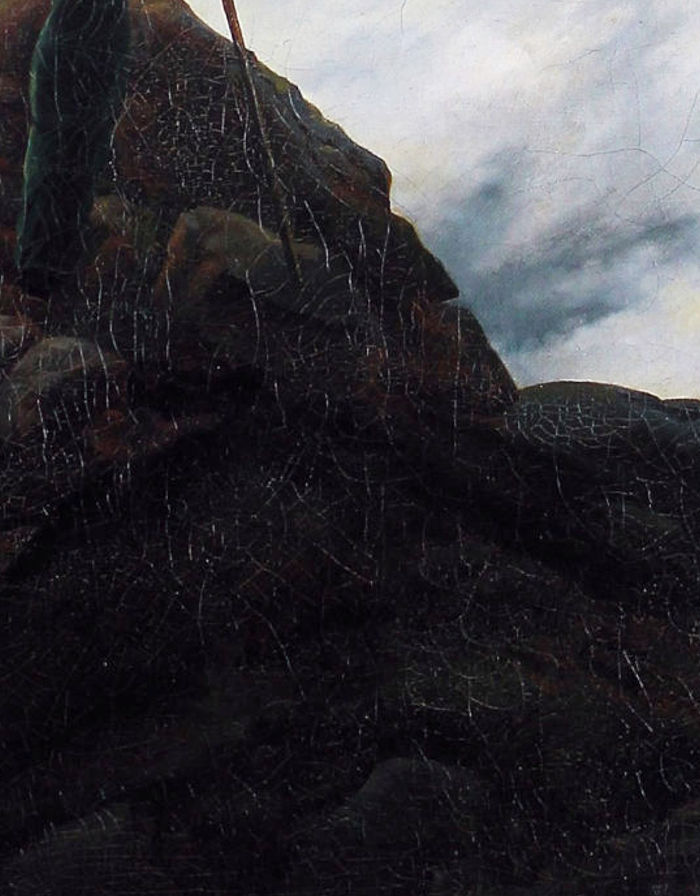
On a purely spiritual level, the painting functions as a secular temple. Deeply influenced by Protestant thought and philosophical pantheism, Friedrich did not need to paint angels, saints, or traditional biblical scenes to convey the sacred. To him, nature itself was God's ultimate cathedral. The solid rock upon which the wanderer rests represents irreplaceable faith and earthly certainty, while the sea of fog and the distant peaks rising timidly in the distance evoke eternity, the divine, and the transcendence that eludes intellectual understanding.
Curiously, despite its undeniable global significance today, Wanderer above the Sea of Fog did not enjoy immediate success upon its creation. Throughout the 19th century and the early decades of the 20th century, the painting remained virtually ignored by the general public, passing through private collections without attracting the attention of major galleries. It was not until the mid-20th century that international critics reevaluated Friedrich's body of work, discovering within it the genesis of modern existentialist art. In 1970, the prestigious Hamburger Kunsthalle in Germany acquired the canvas, granting it the place of honor where thousands of visitors stop to contemplate it every day.
A Canvas That Defies Time
Wanderer above the Sea of Fog is not just a painting of a man gazing at a mountainous landscape at dawn. It is a timeless reminder that, at some point in our lives, every single one of us has stood at the edge of the summit, with the world stretching beneath our feet and our gaze lost in an abyss of fog, uncertain of what lies beyond the next step.
It speaks to us of the courage to stand tall in solitude, of the inherent beauty of uncertainty, and of the human need to seek purpose amidst vastness. A solitary figure over the mist, a decision at the edge of the abyss, and an unanswered question that has echoed through art history for over two hundred years. Caspar David Friedrich invited us to look into the unknown, but the ultimate mystery—the final lesson of his art—is what you discover when you dare to look within yourself.
THE ARTWORK
Wanderer above the Sea of Fog (Der Wanderer über dem Nebelmeer)
Caspar David Friedrich (1774–1840)
Year: Circa 1818
Medium: Oil on canvas
Dimensions: 94.8 cm × 74.8 cm
Style / Movement: German Romanticism
Current Location: Hamburger Kunsthalle, Hamburg, Germany