

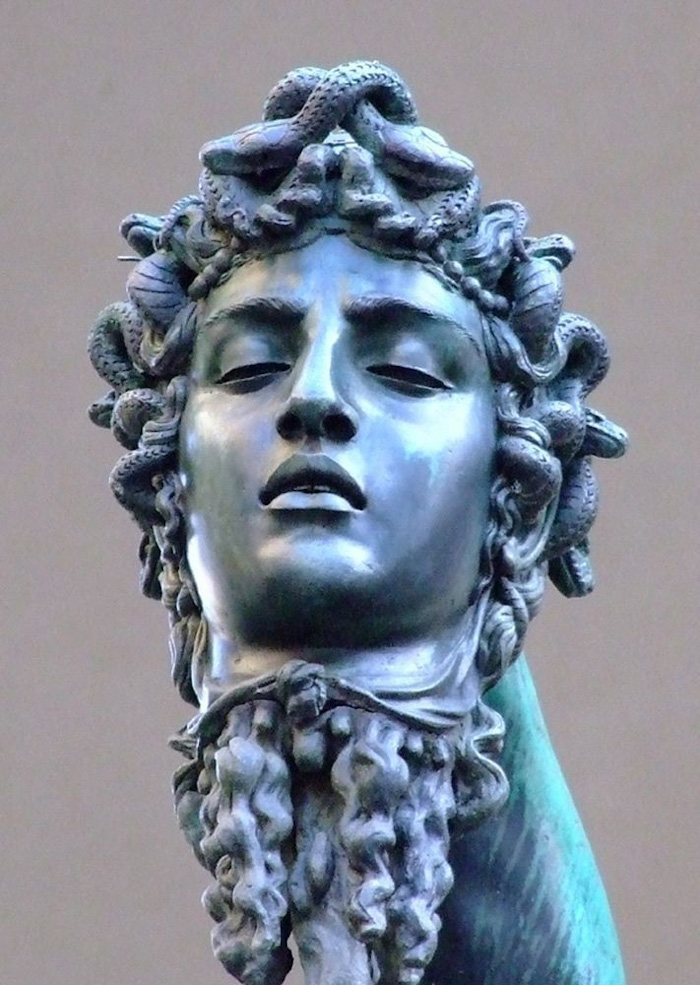
There is a sculpture in the heart of Florence that seems to breathe. A young man cast in bronze holds aloft a severed head, crowned with serpents, its eyes still half-open as if the instant of decapitation had not yet ended. Legend has it that whoever dares look into those stone eyes meets the same fate as its victims.
This is the story of Medusa, the cursed gorgon, and of Perseus, the hero who dared to face her, immortalized centuries later by the sculptor Benvenuto Cellini.
The Origin: A Prophecy Impossible to Escape
It all began with a prophecy. An oracle warned Acrisius, king of Argos, that his own grandson would bring about his death. Terrified of that fate, Acrisius locked his daughter Danaë away in a tower, isolated from any man, convinced this would prevent her from ever bearing a child.
But not even the tallest towers can stop the gods. Zeus, who desired Danaë, transformed himself into a shower of gold and slipped through the tower's walls. From that union, Perseus was born, one of the most celebrated demigods of Greek mythology.

A Fate Sealed by the Sea
When Acrisius discovered the child, he did not dare kill him directly, fearing the wrath of the gods. Instead, he had mother and son sealed inside a large wooden chest and cast into the sea, leaving their fate to destiny.
Zeus, however, did not abandon his own: he guided the chest to the island of Seriphos, where King Dictys received and protected them. There, alongside his mother and under the king's care, Perseus grew up strong and noble.
Polydectes' Trap
On that same island ruled Polydectes, a cruel king who had grown obsessed with Danaë and saw the now-grown Perseus as an obstacle to his plans. To get rid of him without raising suspicion, he set a trap: he demanded, as tribute, the head of Medusa — a mission that amounted, in practice, to a death sentence.
Medusa was no ordinary monster. According to Ovid, she was a gorgon whose gaze alone turned to stone anyone who met her eyes. Her name, of Greek origin, means "guardian and protector," a cruel irony for a creature whose presence brought only destruction. Facing her seemed an impossible task for any mortal.
Gifts from the Gods
When the gods learned of the task, they decided to intervene. Each contributed an essential tool for the feat: Athena gave him her shield, polished like a mirror, so he could avoid Medusa's direct gaze; Hades lent him his helmet of invisibility; Hermes gave him winged sandals to fly and move with speed; the nymphs wove a special pouch capable of containing the severed head's power; and Hephaestus forged a sword worthy of slaying a monster. Athena also warned him never to look at Medusa directly — to meet her eyes meant instant death.
The Confrontation with the Gorgon
Armed with these divine gifts, Perseus reached the gorgons' hideout. He found the three sisters asleep and advanced without a sound, never losing sight of Medusa but never looking at her directly, using Athena's shield as a mirror to guide every step. When he was close enough, with a single stroke of his sword he beheaded her, placed the snake-covered head in the magic pouch, and fled before her sisters awoke.
Cellini and the Challenge of Bronze
Centuries later, in the heart of the Renaissance, the sculptor Benvenuto Cellini set out to immortalize this mythical moment in one of the most ambitious sculptures of his career. It was no casual choice: at the time, bronze had not been used for a monumental work in nearly half a century. As he poured molten metal into his mold, Cellini felt he was giving the sculpture a kind of lifeblood of its own, setting it apart from the character of carved marble.
The undertaking was no small feat. Cellini was competing directly against the giants of sculpture already standing in the Piazza della Signoria: Donatello's Judith and Holofernes — cast in bronze, though in several joined sections — and, above all, Michelangelo's David, carved in marble. Casting a figure of that size in a single piece was almost an act of faith, and the greatest technical challenge would be completing the entire pour at once, without a single flaw.
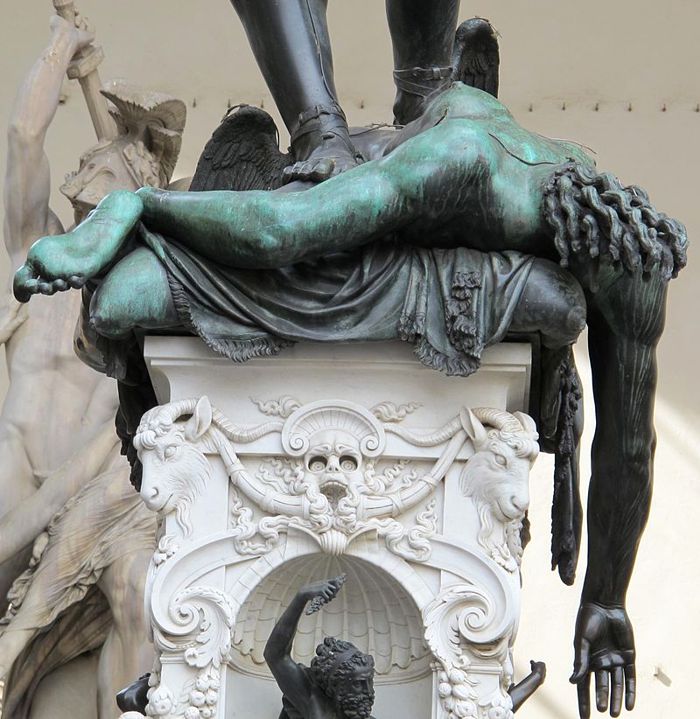
The Hidden Self-Portrait
At first glance, the viewer sees the triumphant Perseus holding aloft the horrifying head of Medusa. But hidden on the back of the hero's helmet lies an unexpected detail: a small self-portrait of Cellini himself. The eyes and nose visible there belong to the sculptor, who was unwilling to go unnoticed in his greatest work and left his signature hidden in plain sight, for anyone who knew where to look.
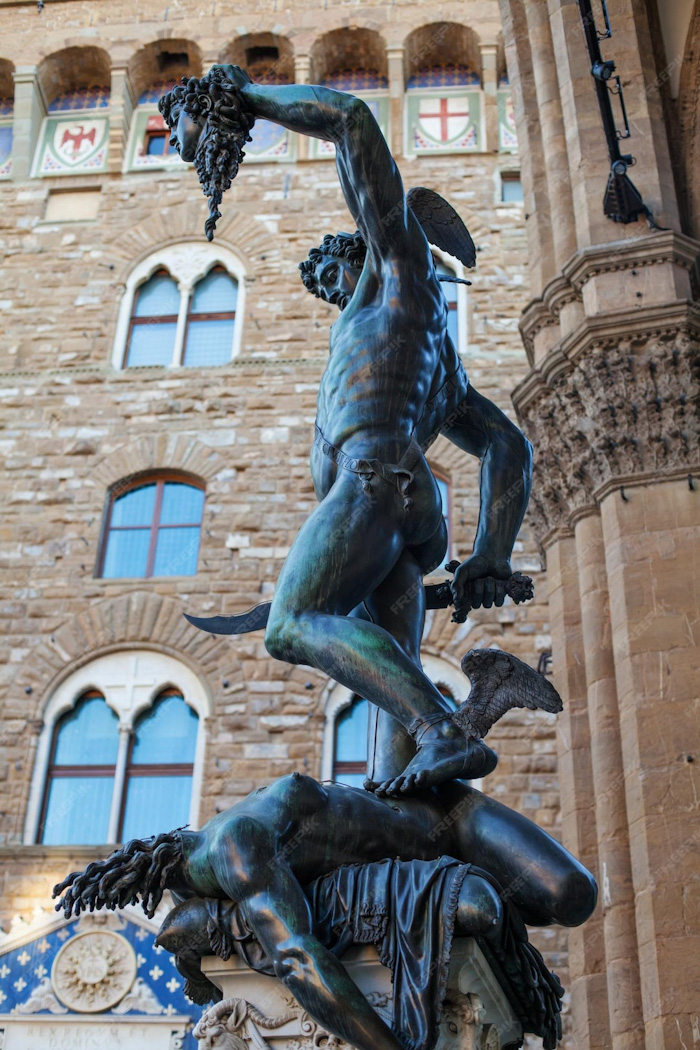
Perseus, the Medici, and Power
Cellini's work responded to two ideas at once. On one hand, it engaged in dialogue with the sculptures already standing in the piazza through the theme of Medusa, echoing the idea of a power capable of turning men to stone. On the other, Perseus served as a veiled representation of the Medici, both in the main figure and in the relief below on the pedestal. By breathing life into his sculpture through bronze, Cellini simultaneously reaffirmed the Medici's control over the people of Florence through the motif of the victorious hero.
There is also a smaller-scale bronze copy of notable quality on display outside the Ringling Museum in Sarasota, Florida, USA — a testament to how far this work's influence reached beyond Florence.
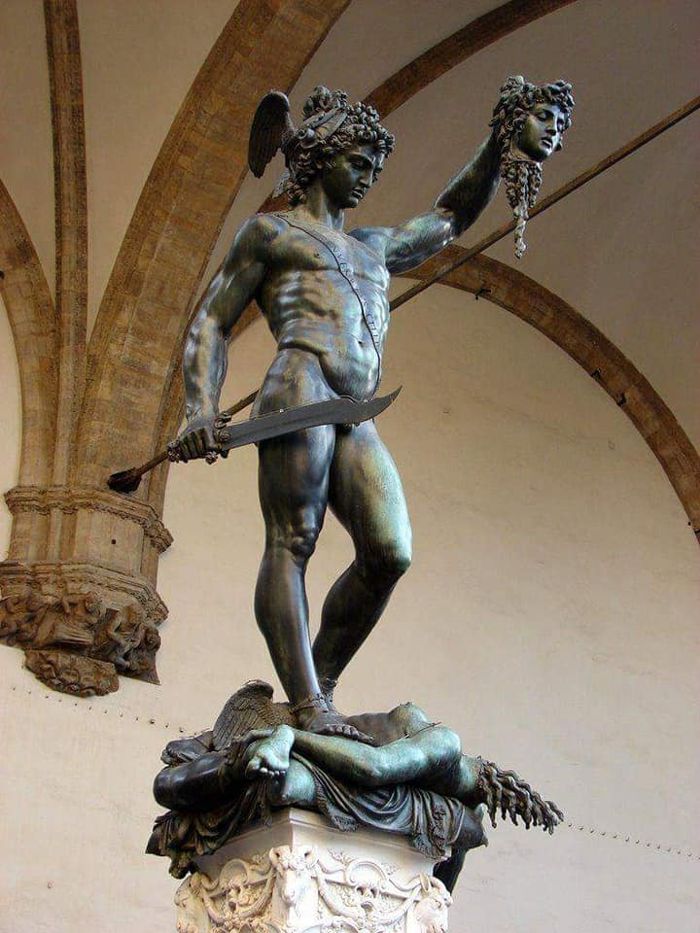
Today, the sculpture still stands in the Piazza della Signoria, over three meters tall: a story of gods, betrayal, and courage, forever cast in bronze.
THE ARTWORK
Perseus with the Head of Medusa
Artist: Benvenuto Cellini
Original title: Perseo con la testa di Medusa
Created: 1545–1554
Dimensions: 3.20 m (5.20 m including pedestal)
Location: Piazza della Signoria, Florence, Italy