

There are images from the Bible that seem to have existed forever: God creating the world among clouds and darkness, Adam and Eve in Paradise, the Flood, Moses descending from the mountain, David facing Goliath, angels announcing extraordinary events, Christ carrying the cross, and the overwhelming visions of the Apocalypse.
Many of them have something in common: for generations, millions of people have imagined these episodes through the images of a 19th-century French artist. His name was Gustave Doré. Although he is mainly remembered today as the illustrator of the Bible, his career was much broader. He was a draftsman, caricaturist, illustrator, painter, watercolorist and sculptor, and worked on some of the great works of European literature, including texts by Dante, Cervantes, Milton, Rabelais, Perrault and Shakespeare. But it was his 1866 Bible that forever transformed his relationship with the public and turned many of his biblical interpretations into part of the visual memory of the Western world.
The Child Who Wanted to Draw Everything
Paul Gustave Louis Auguste Doré was born in Strasbourg in 1832 and died in Paris in 1883. According to the Musée d'Orsay, he began drawing at the age of four and, when he arrived in Paris in 1847 as a teenager, he began collaborating with satirical publications. The following year he was already exhibiting at the Paris Salon. His talent was extraordinary, but so was his ambition. Doré did not want to limit himself to illustrating small books or accompanying texts with a few images: he wanted to take on the great works of literature and create complete visual worlds for them. During the 1850s he began to establish himself with illustrations for authors such as Rabelais and Balzac, and increasingly ambitious projects followed. Dante, Cervantes, Milton and finally the Bible. For Doré, illustrating a book did not simply mean placing an image alongside a text. He wanted to turn reading into a visual experience. That ambition largely explains the monumental scale of his production and his enormous influence afterward.
He Was Already a Famous Artist Before the Bible
When Doré began working on his great biblical project, he was not an unknown artist. He had already gained recognition through his illustrations of literary works, especially his interpretation of Don Quixote. To undertake that work, he traveled through Spain and sought to become familiar with the landscapes associated with Cervantes's novel. He had also illustrated The Inferno by Dante, where one of the fundamental characteristics of his art was already evident: his ability to transform literary scenes into monumental images. His characters could appear small against immense landscapes; the mountains seemed endless, the skies occupied much of the composition, and light became a dramatic element. His protagonists constantly appeared to confront forces greater than themselves. This visual language would prove especially powerful when Doré turned to the Bible.
The Bible of 1866
The work now popularly known as the Doré Bible appeared in France in 1866. The edition was published in Tours by Alfred Mame et fils under the title La Sainte Bible selon la Vulgate, with a new translation based on the Vulgate and drawings by Gustave Doré. The Bibliothèque nationale de France preserves the record of that edition and documents that the drawings were transformed into engravings by different professionals, including Laplante, Ligny, Pannemaker and Pisan. This detail is important: Doré created the designs, but he did not personally execute all the engravings we know today. His drawings were transferred into the engraving technique by specialists capable of translating the artist's lines and effects of light into images that could be reproduced using the printing techniques of the time. The result was a monumental work that allowed Doré's visual universe to reach a much broader audience than a painting exhibition could have.
A Bible Designed to Impress
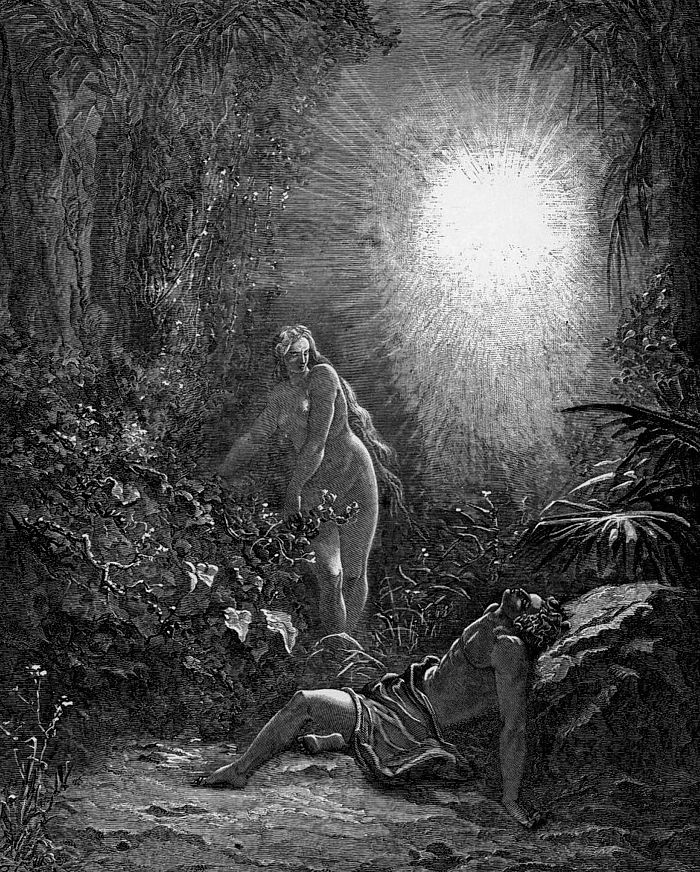
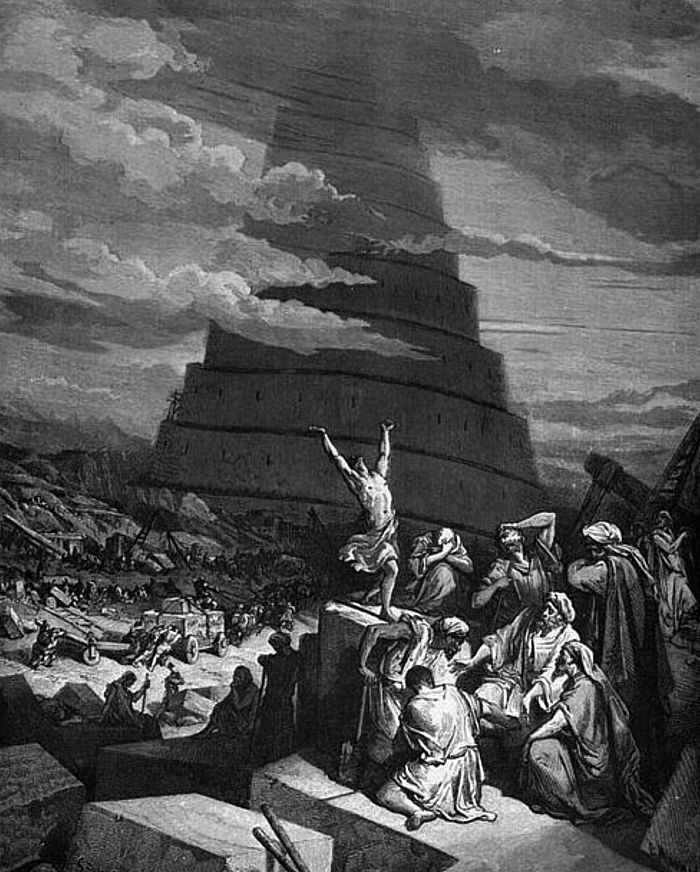
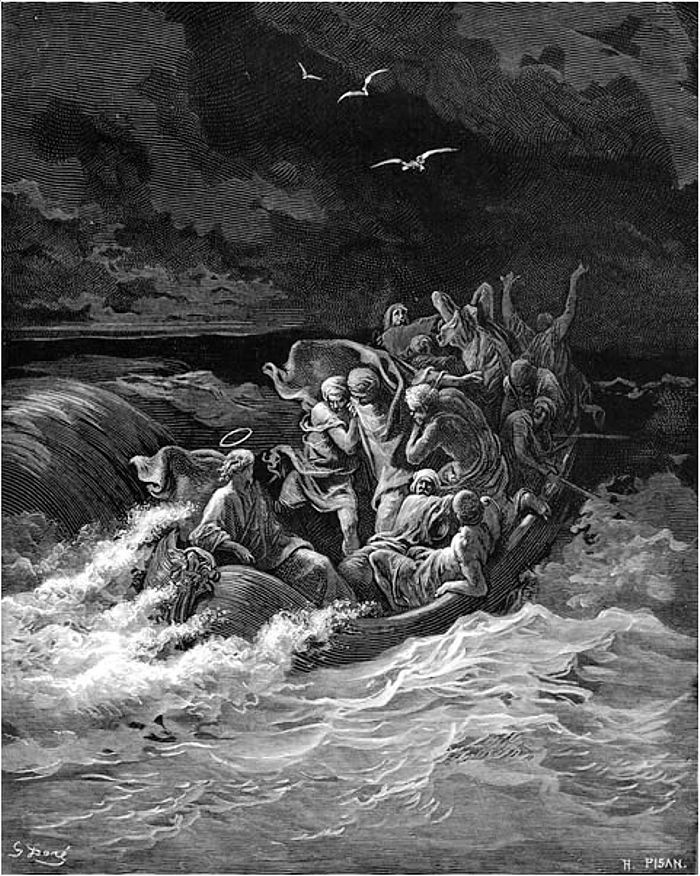
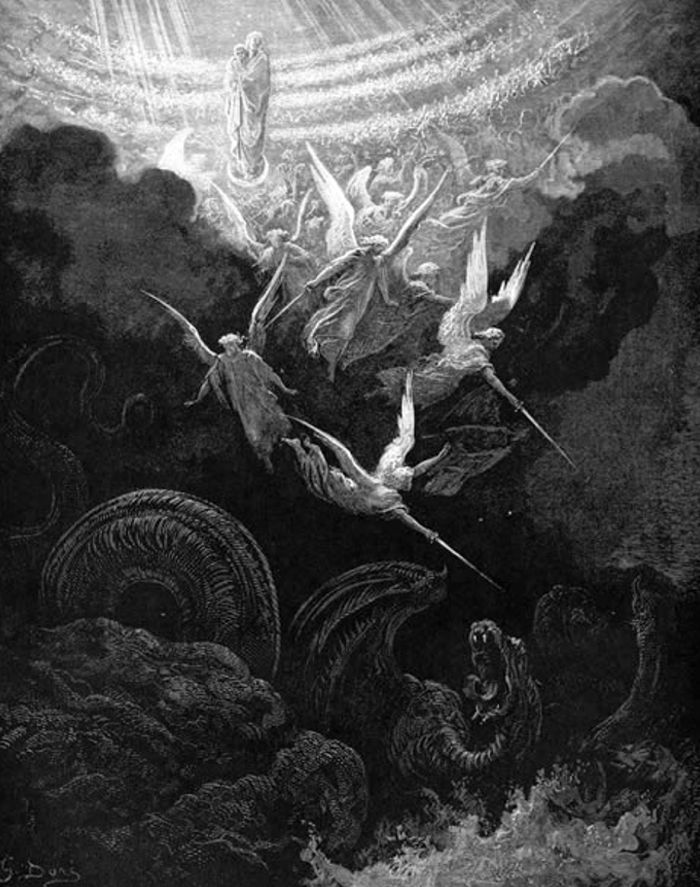
Doré's images do not function as simple decorative illustrations. They are visual events in their own right. In many of them, the viewer encounters a gigantic natural world: deserts, mountains, storms, skies filled with clouds and spaces that seem to extend indefinitely. The characters may appear tiny against such a setting, and precisely there lies much of Doré's power. Nature seems to become a manifestation of the supernatural. Darkness is not simply the absence of light, and light does not merely serve to illuminate: both create atmosphere. Doré uses the contrast between black and white to create depth, mystery and drama. Although the final result is monochromatic, his engravings possess an extraordinary tonal richness. A scene can move from almost complete darkness to an area of intense light within just a few inches, guiding the viewer's eye toward the point the artist considers essential.
A Monumental God
One of the most striking images in the first edition depicted God creating the world. The scene was so audacious that it caused controversy. The Musée d'Orsay notes that the image of God standing on a cloud while creating the world, placed at the beginning of the first volume and displayed in a Cassell bookstore in London, was eventually removed after protests from members of the public. The episode is revealing because it shows how far Doré moved away from a discreet or conventional representation. His intention was to inspire awe. His supernatural figures are not necessarily reduced to small symbols within a composition: they can occupy a gigantic space and dominate the landscape. In his interpretation, the Bible becomes a universe of enormous proportions.
The Old Testament as Spectacle
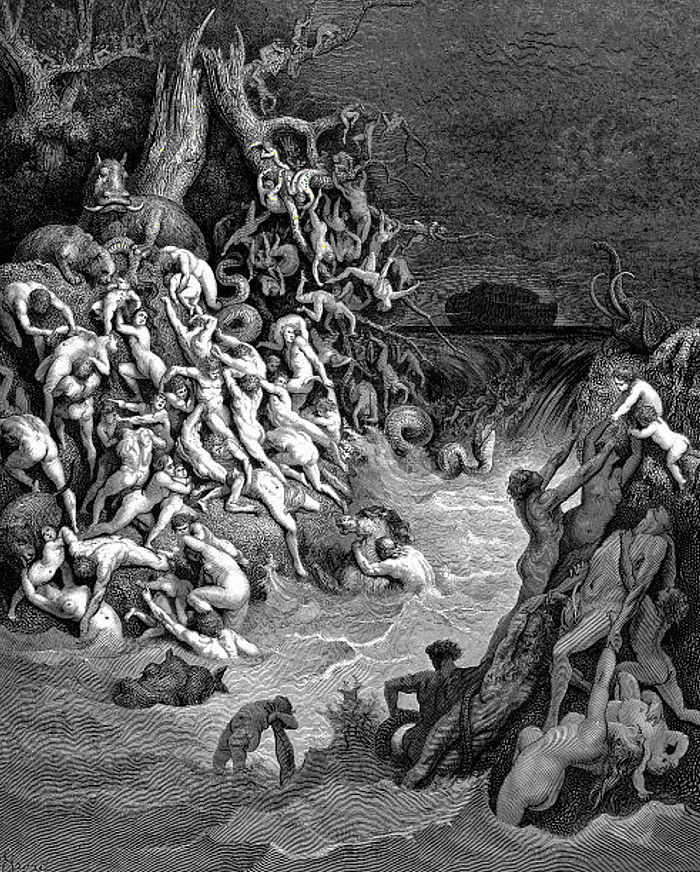
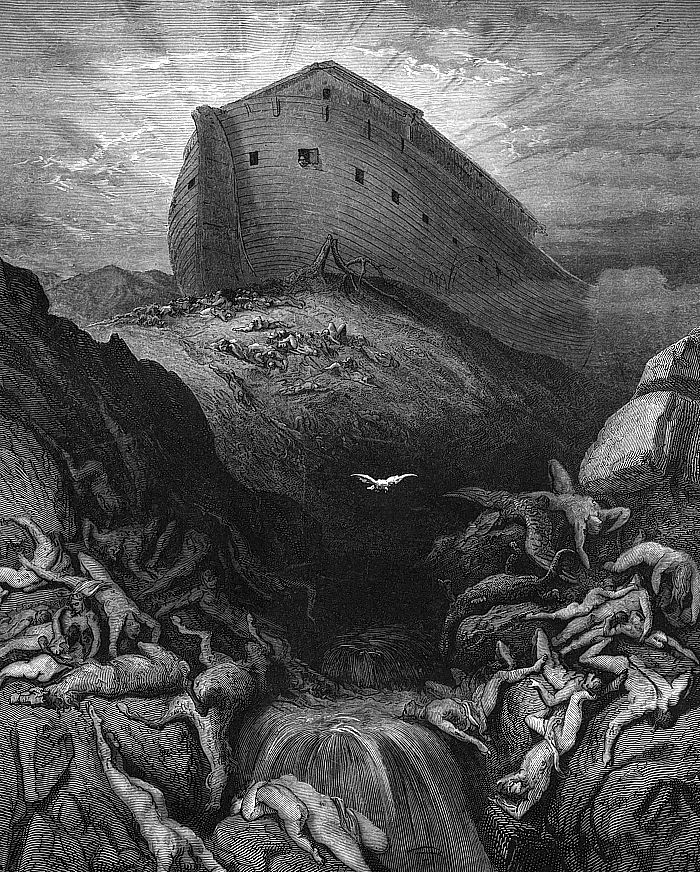
The first major part of Doré's Bible follows the stories of the Old Testament: Creation, Adam and Eve, Cain and Abel, Noah and the Flood, Abraham, Moses, the Exodus, David, the prophets, the kings and numerous episodes of wars, tragedies and visions. Each story gives him an opportunity to construct a dramatic image. Doré does not attempt to represent only what happens, but the magnitude of what happens. The Flood can become a catastrophe that seems to have no limits; a small human figure can confront a gigantic natural world; in battle scenes, the masses create a sense of chaos; and in episodes involving prophets and visionaries, the landscape becomes an almost supernatural space. When angels appear, Doré turns them into monumental presences. When he depicts a crowd, he can make it seem to extend until it disappears into the horizon.
Light as a Protagonist
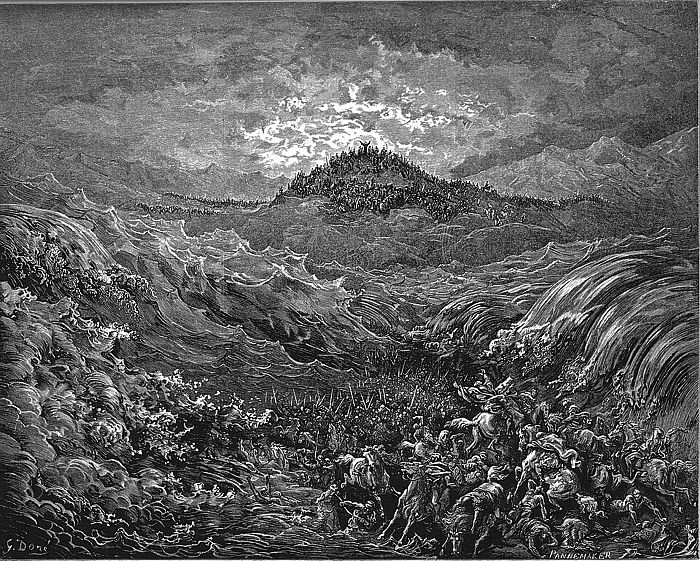
One of the most recognizable elements of Doré's work is his use of light. His images are constructed with an extraordinary variety of grays, even though the final result is essentially black and white. Light can appear behind a figure, pass through the clouds, fall upon an isolated character, separate the sky from the earth or almost disappear entirely, leaving the viewer facing a scene dominated by darkness. This is why his images continue to work with such force even in modern reproductions. The visual contrast is immense, the compositions are easy to read, and the scenes possess an almost cinematic theatricality. Doré understood that lighting could tell part of the story without words.
The New Testament
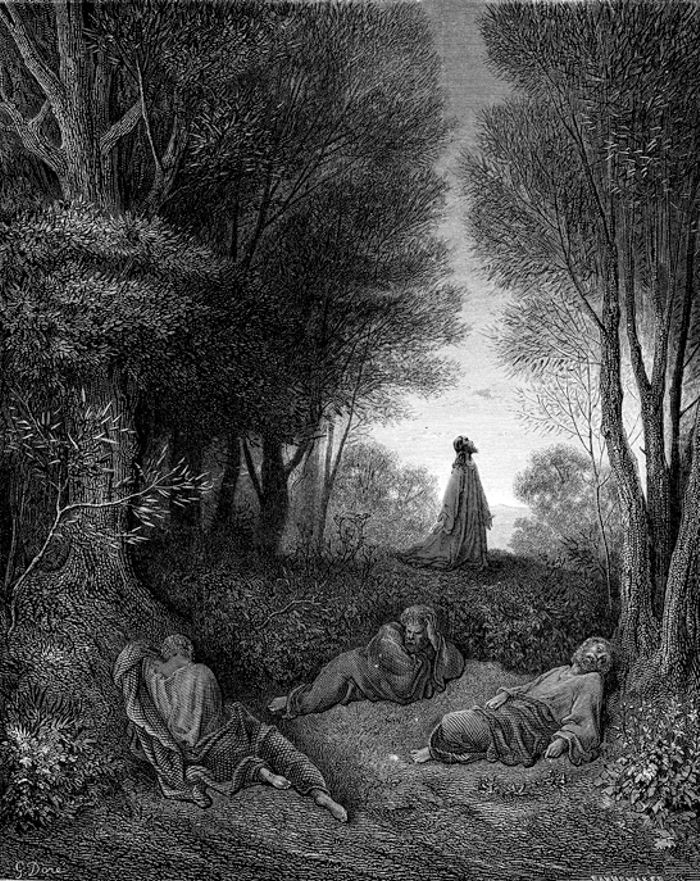
When Doré reaches the New Testament, the tone changes. The Annunciation, the birth of Jesus, different episodes from his public life, the miracles, the entry into Jerusalem, the Last Supper, the Passion, the Crucifixion and the Resurrection all appear. Here one of his great visual concerns returns: the relationship between an individual figure and a crowd. Christ may appear surrounded by people, but he may also stand completely alone. Doré uses space to direct attention toward the main character: a figure illuminated in the midst of a dark crowd, a group of people watching from below, a path leading toward a distant figure or a solitary silhouette against an immense landscape. These are devices the artist repeatedly uses to establish visual hierarchies.
The Tragedy of the Passion
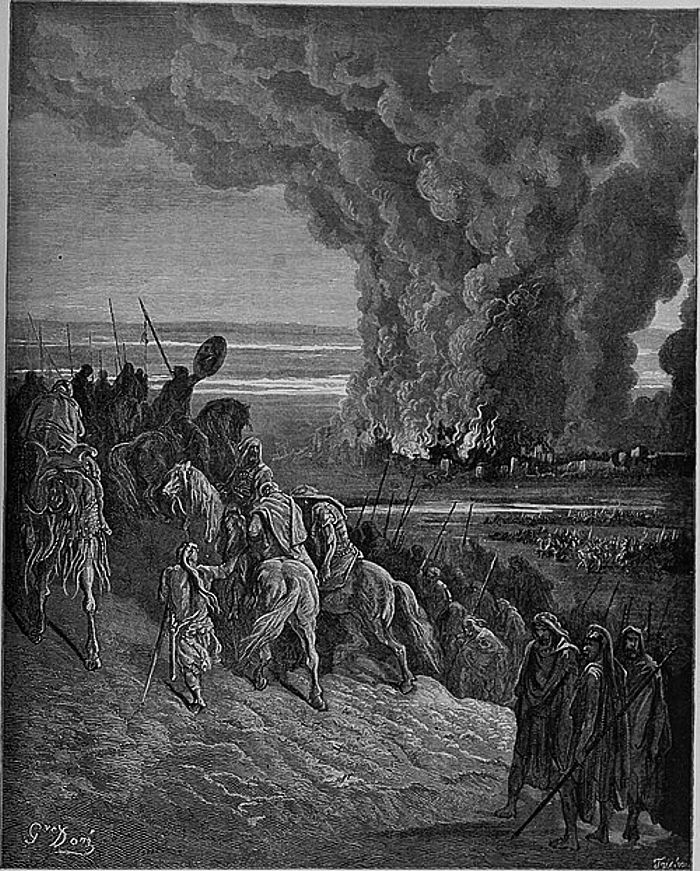
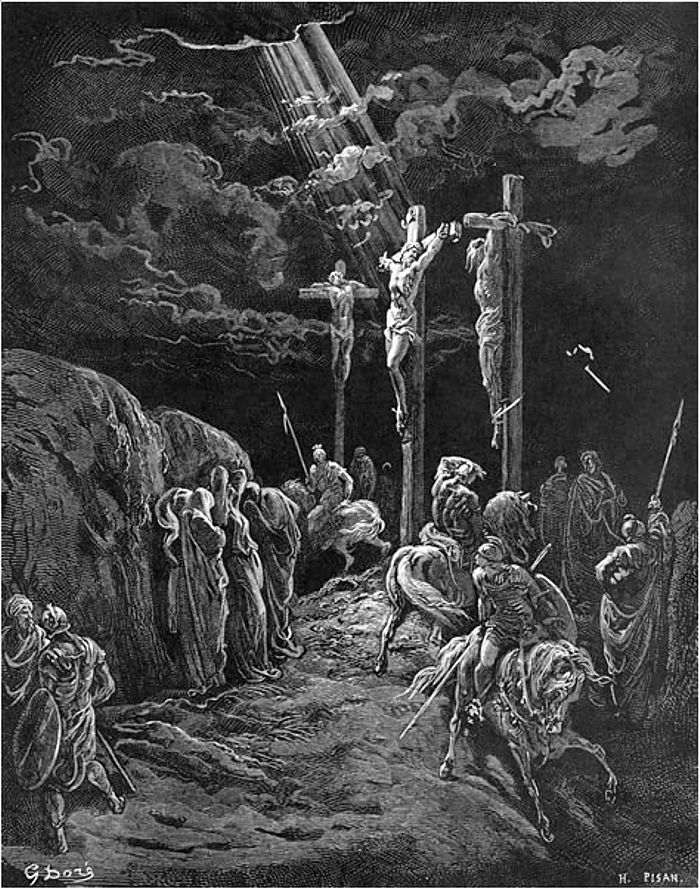
The scenes of the Passion were particularly suited to Doré's artistic language. The drama depends not only on depicting suffering, but also on space, the crowd, the sky, the mountains and solitude. In his representations of Christ, the religious event takes on an almost theatrical dimension. The Musée d'Orsay notes that, after the 1866 Bible, Doré's reputation as a religious artist became firmly established and that his later works developed this spectacular and dramatic character even further. His interpretation of the Passion is not intimate in the traditional sense: it is usually grand, open and deeply theatrical. Even when the central figure appears alone, the surrounding landscape seems to remind the viewer that they are witnessing an event of universal dimensions.
And Then Comes the Apocalypse
If Genesis allows Doré to represent the beginning of the world, the Apocalypse gives him the possibility of representing its end. And probably no other biblical episode was better suited to his imagination. Angels, beasts, horses, crowds, open skies, battles, abysses, fire, light and darkness form a visual universe of cosmic dimensions. Human figures cease to be individual protagonists and become part of a gigantic vision. Doré's Apocalypse seems designed to produce one very specific sensation: that we are witnessing something too great for us. This idea runs through much of his biblical work. Human beings are important, but they almost always appear within a world infinitely greater than themselves.
Doré Did Not Invent the Bible: He Invented Many of Our Images of It
Doré was not the first artist to represent biblical stories. For centuries, artists such as Michelangelo, Raphael, Caravaggio and Rembrandt had created images based on these same narratives. But Doré lived in a different era. Industrial printing made it possible to reproduce images in enormous quantities and distribute them to an increasingly broad audience. His illustrations could appear in books that traveled throughout Europe and America and reach people who might never have had the opportunity to see a great religious painting. The BnF notes that the 1866 edition contributed decisively to Doré's international fame and that it was subsequently published in numerous European and American cities. In this way, an artistic interpretation could become an image shared by millions of people. And that changed the history of biblical representation.
A Bible That Left the Book
The influence of these images did not end on the printed page. The BnF notes that some were used as aids to preaching by English pastors, while others were projected through dioramas and eventually influenced even the imagery of major biblical spectacles in American cinema in the mid-20th century. The Musée d'Orsay also points out that his religious works were used in magic lantern shows, tableaux vivants and Passion plays. In other words, Doré was doing more than illustrating books. His images could move from one medium to another: first the drawing, then the engraving, then the book, then the projection and finally the spectacle. This adaptability helped his imagery survive far beyond the era in which it was created.
An Artist Who Seemed to Think in Cinematic Images
This is one of the reasons his works can seem surprisingly modern. Doré constructs scenes using devices that we now immediately associate with audiovisual language: panoramas, crowds, backlighting, figures viewed from below, gigantic landscapes, diagonal compositions and scenes in which a small figure leads our gaze toward the background. This does not mean that he was making cinema before cinema existed, but his way of organizing space possesses an extraordinary narrative power. The Musée d'Orsay considers that his influence later reached comics and cinema and that his imagery maintained an important presence long after his death.
Much More Than the Illustrator of the Bible
It would be unfair to remember Doré only as “the biblical illustrator.” His output was enormous. He illustrated Dante, Cervantes, Milton, Rabelais, La Fontaine, Perrault, Balzac, Edgar Allan Poe, Coleridge and Tennyson, among many other authors. He was also a painter and created large religious and historical compositions, landscapes, watercolors and sculptures. He was particularly interested in landscape and traveled through places such as Spain, Scotland, Switzerland and the French mountains. In London he even participated in the creation of the Doré Gallery, opened in 1867-1868, where his works could be viewed in a setting much closer to spectacle than to the traditional art exhibition. His career reveals an artist who did not want to remain confined to a single discipline and who constantly sought new ways of bringing his images to the public.
An Artist Between Two Worlds
Doré was born in an era still dominated by great religious, historical and literary narratives, but he died in a world already entering visual modernity. Photography was advancing, the illustrated press was growing and mass printing was transforming access to images. Doré stood precisely at the center of this transformation. His imagination was deeply connected to Romanticism and the tradition of great narratives, but he used reproduction methods and visual strategies that anticipated a much more modern visual culture. Perhaps that is why his images still work so well: we do not need to know every technical detail of engraving, or even share the beliefs of the characters they depict. They function as visual narratives.
Why Do We Still Remember Doré?
Because Doré understood something fundamental about images: an image does not have to explain everything in order to remain in our memory. It has to make an impression. And his scenes make extraordinarily powerful impressions. Darkness, light, emptiness, crowds, skies, abysses, angels, monsters and tiny human figures facing a gigantic natural world seem to belong to the same universe. That is why, more than a century after his death, simply looking at one of his engravings is enough to immediately recognize his visual language.
The Doré Bible
The original 1866 edition remains a fundamental work for understanding the relationship between literature, religion, illustration and visual culture in the 19th century. The Metropolitan Museum of Art holds a copy of La Sainte Bible from 1866 and identifies Gustave Doré as the illustrator and Alfred Mame et Fils as the publisher and printer. The Bibliothèque nationale de France also preserves copies and numerous original prints from the series, including Doré's designs and the corresponding engraved versions. These materials make it possible to understand that behind each image lay an enormous amount of work: first came Doré's imagination, then the drawing, followed by the engraver's interpretation, the printing process and finally the circulation of the copies. The image traveled much farther than the artist.
The Legacy of Gustave Doré
Gustave Doré died in Paris in 1883, at just fifty-one years of age. He had worked for decades at an extraordinary pace and had left a body of work that encompassed virtually every field of the visual culture of his time. But some of his images eventually acquired a life of their own. The Doré Bible is probably the clearest example. His illustrations did not replace the biblical text: they created a particular way of imagining it. And that way of imagining Creation, the Flood, Moses, the prophets, Christ, the Crucifixion and the Apocalypse became part of the visual memory of generations.
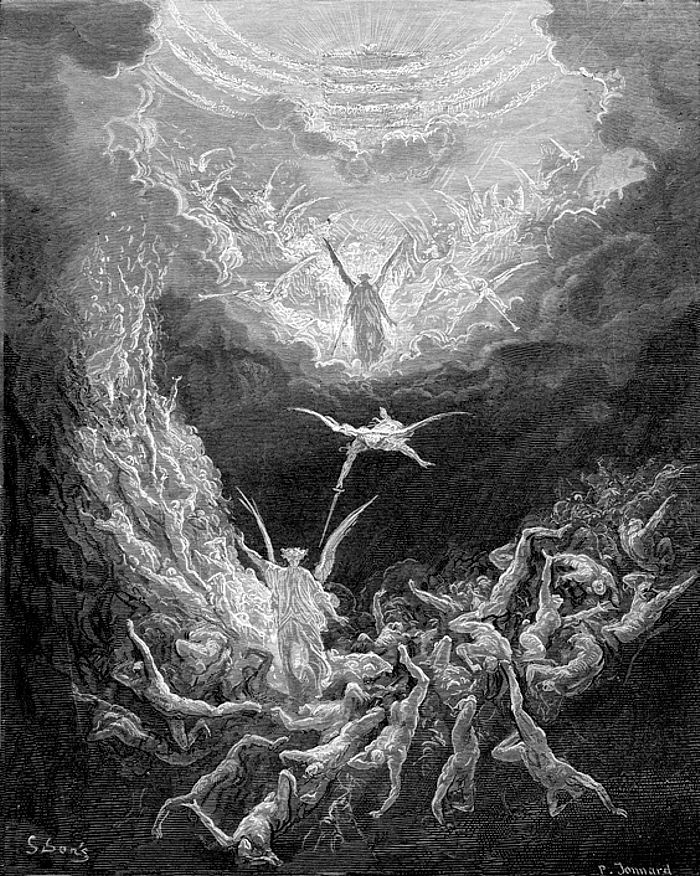
Perhaps that is the true significance of Gustave Doré. He was not simply the man who drew the Bible. He was one of the artists who taught the modern world how to imagine it. And when we look through his black-and-white images today, more than 150 years after their publication, we can still sense the enormous ambition behind them: to take some of the oldest narratives of our culture and turn them into images capable of transcending time.