

Before Goya painted horror, horror already existed. It lived in myths, in the stories ancient civilizations used to explain the unexplainable: time, violence, power, and the fear of losing it all. Saturn —Cronos to the Greeks— was not a monster. He was a god. The god of time. And like every god who rules over something that cannot be stopped, he was condemned to paranoia.
According to mythology, Saturn received a prophecy: one of his children would overthrow him, just as he had overthrown his own father. The cycle was clear, inevitable, almost mechanical. Time devours its creators. Power is inherited… or seized.
Saturn chose another way out.
A way that does not stop time, but postpones it.
Each time his wife Rhea gave birth, he took the newborn and devoured it. Not out of hunger. Not out of pleasure. Out of fear. Out of control. Out of the desperate illusion that if he consumed the future, the present could remain intact.
In classical mythology, this act still retains a narrative structure: there is deception, there is salvation, there is final punishment. Rhea manages to hide Zeus, the child destined to survive. Saturn falls. Order is restored.
But Goya does not paint that version.
Goya erases the consolation of myth.
The moment no one wanted to look at
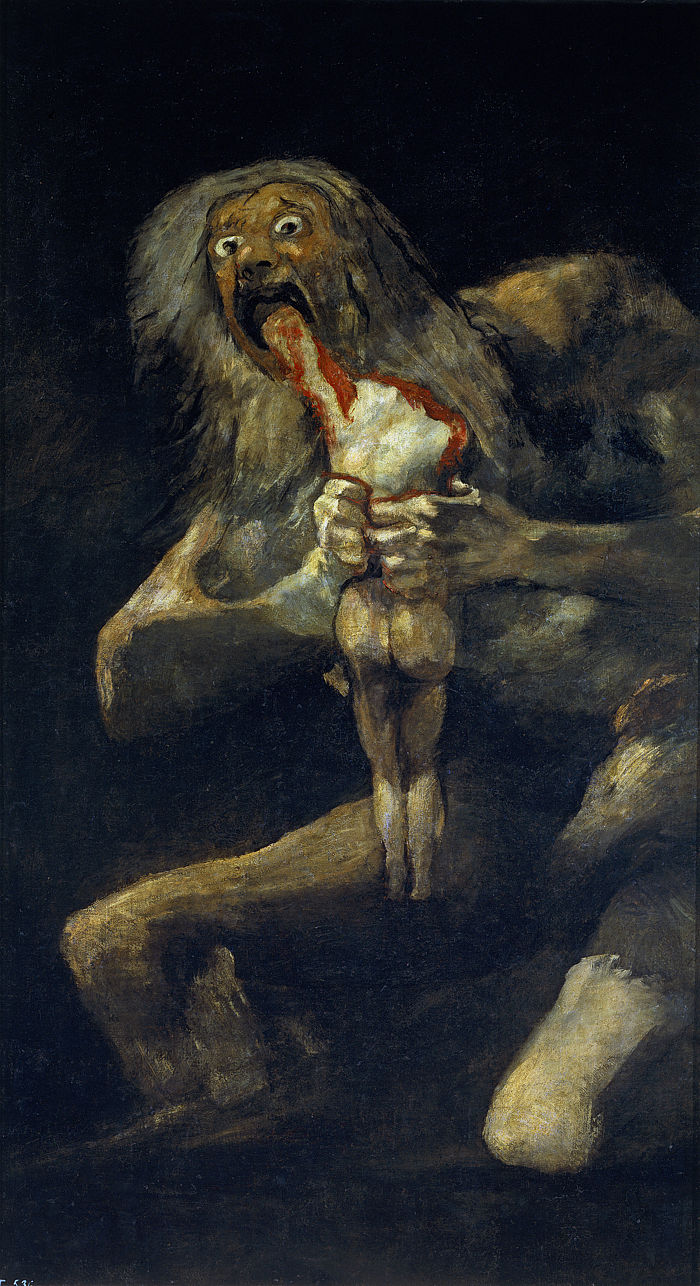
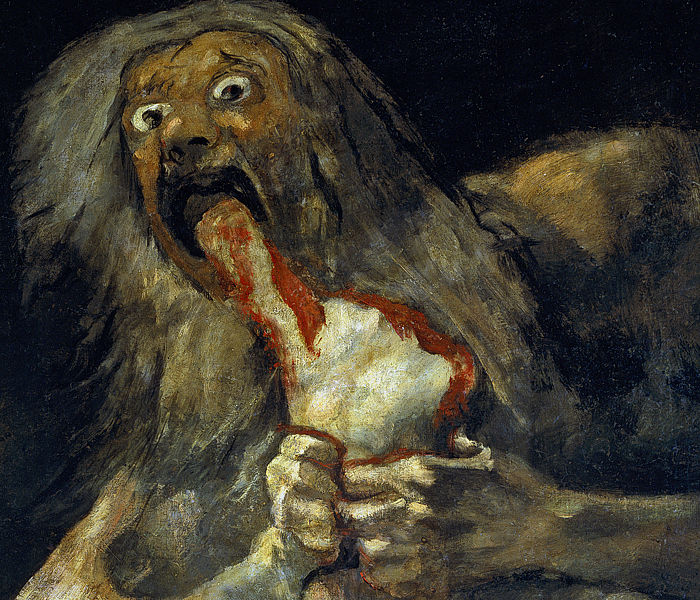
Saturn Devouring His Son does not represent an epic scene or a closed narrative. There is no context, no setting, no gods watching from above. There is no Olympus. There is no future justice.
There is a mutilated body.
There is an open mouth.
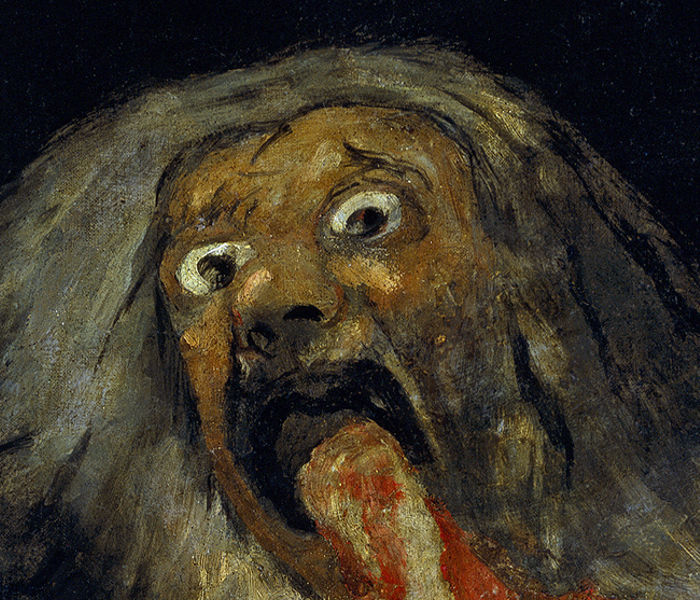
There are bulging eyes that are not looking at the son, but at something deeper.
Goya paints the instant in which myth breaks and becomes human.
This Saturn is not a classical, idealized, muscular and solemn god. He is a hunched, aged, almost animal creature. His strength is not heroic; it is desperate. His hands do not hold: they grip. His gesture is not solemn: it is urgent.
The son is no longer a whole child. He is a fragment. A remainder. Something that can no longer defend itself or flee.
Here the act is not symbolic. It is literal.
And that changes everything.
Time turned into fear
Cronos was time.
Goya turns time into panic.
This Saturn does not devour because he must, but because he cannot stop himself. There is no strategy, only reaction. No calculation, only impulse. Power is not exercising control: it is defending itself.
And here an uncomfortable reading appears.
Time does not destroy because it is cruel.
It destroys because it moves forward.
Power, on the other hand, destroys when it feels threatened.
Goya seems to tell us that the true horror is not the passage of time, but the human attempt to stop it at any cost. Saturn cannot bear the idea of being replaced. He cannot bear ceasing to be the center. He cannot bear disappearing.
Thus, the act of devouring ceases to be mythical and becomes psychological.
A painting without spectators… except us
In most classical representations, horror is observed. There are gods, witnesses, choirs, angels or demons. Violence is framed. It is explained.
Here, there is none of that.
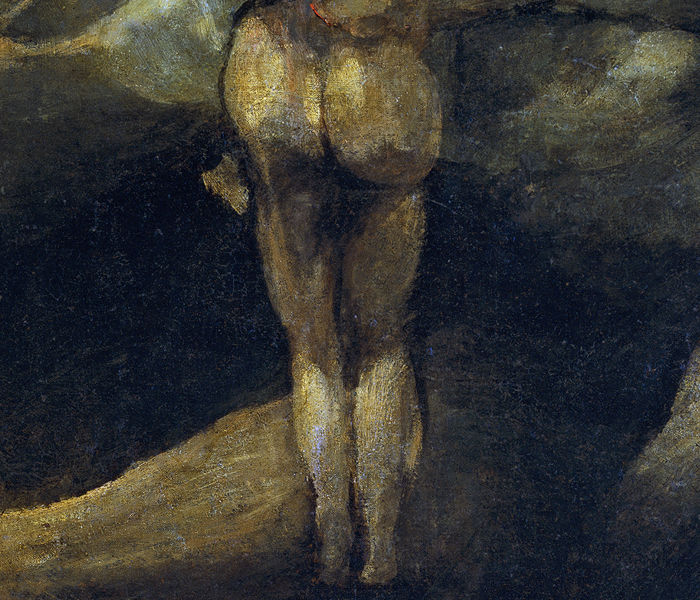
The background is black. There is no space. No place. Saturn is not inside a scene: he is trapped within it. And we are trapped with him.
Goya gives us no distance. He does not allow contemplation. He forces us to witness.
The painting does not offer itself to the viewer; it confronts them.
That is why it is so disturbing.
That is why it does not age.
That is why it remains current.
The Black Paintings and the collapse of all illusion
Saturn Devouring His Son is part of the so-called Black Paintings, executed directly on the walls of Goya’s house. They were not meant to be exhibited. They did not seek fame or recognition. They did not dialogue with an audience.
They were private. Almost confessional.
And that matters.
Because here Goya is not composing an elegant allegory. He is letting something emerge that does not fit within academic language. Something that cannot be softened.
In this context, Saturn ceases to be a mythological character and becomes a universal figure: power that fears, authority that knows it is fragile, a system that devours itself to survive one more day.
The son as sacrificed future
The son has no face.
No identity.
It does not matter who he is.
That, too, is a statement.
This is not about an individual, but about what he represents: the future, continuity, the possibility of change. Saturn does not destroy a specific child; he destroys what could replace him.
The fear of succession.
The terror of losing control.
The inability to accept an end.
In this sense, the painting stops speaking about gods and begins to speak about societies, regimes, parents, institutions—any structure that prefers to destroy what is coming rather than transform itself.
Silence as an accomplice
There is something even more disturbing than the explicit violence of the painting: its silence.
No one screams.
No one intervenes.
No one stops the act.
Goya does not paint resistance. He paints absence.
And that silence does not belong only to the past. It repeats itself every time power acts out of fear and the surrounding world chooses to look away. Every time destruction is normalized. Every time violence is justified as necessity.
The true monster is not Saturn.
It is the void that surrounds him.
A mirror we do not want to accept
Saturn Devouring His Son is not a painting meant to be understood. It is a painting meant to be endured. It offers no clear morals or redemption. It does not comfort.
It forces us to recognize something uncomfortable: that horror does not always come from external, supernatural, or alien forces. Sometimes it is born from the human desire to remain, to dominate, to not disappear.
Goya does not show us an ancient myth.
He shows us a structure that repeats itself.
Time passes.
Power fears.
The future is sacrificed.
And silence watches.
That is why this painting remains alive.
Because it does not speak of the past.
It speaks of what happens every time no one dares to look directly.
THE ARTWORK
Saturn Devouring His Son
Year 1820–1823
Artist Francisco de Goya
Technique Oil mural transferred to canvas
Style Romanticism
Dimensions 146 cm × 83 cm
Location Museo del Prado, Madrid, Spain