

The story of Cupid and Psyche is, perhaps, the most beautiful allegory ever told about the human soul's journey toward immortality. The plot begins with Psyche, a king's daughter, whose beauty was so overwhelming that the people of her kingdom spoke only of her and, in doing so, forgot to follow the cult and adoration of Venus (Aphrodite), the goddess of love and beauty. The goddess, feeling outraged by this rivalry born of mortality, sends her son, Cupid (Eros), the god of desire, to punish the insolent girl.
But, as often happens in myths, fate is inflexible. Cupid falls madly in love with Psyche upon seeing her, betraying his mother's command. The young woman, for her part, is warned by an oracle that she will be married to a "flying monster" who will take her to the underworld. Her heartbroken parents abandon her on a lonely mountain to fulfill the prophecy.
A short time later, Zephyrus, the gentle god of the west wind, transports her to a lavish palace, full of precious stones, gold, and luxury, worthy of the tales of The Thousand and One Nights. There, the young woman is visited at night by an invisible form that makes love to her as only the gods are capable of doing. This being, who always withdraws in the morning to conceal his identity, is Eros. The condition imposed is strict: she must never try to look at him.
We have told this story before in La vida es Arte, a saga of trials, Venus's traps, and misadventures in the underworld, the climax of which is a cinematic kiss from Eros to Psyche, elevating her to divinity.
Psyche: Not Just a Character, But the Soul Itself
The story, brilliantly told by Apuleius in his Metamorphoses or The Golden Ass (2nd century AD), poses a fundamental question: What is the power of love and, above all, how does Psyche (whose Greek name means "The Soul"), symbolized by a butterfly, attain the status of myth?
It is vital to understand that Psyche was not born with Apuleius's story. There is an entire ancient tradition, iconographic, philosophical, and literary, surrounding the name Psyche and its interpretation. Apuleius's story is not a foundational text, but a recreation of a much deeper and older allegory, whose symbolism connects ancient paganism with the nascent notions of spirituality and Neoplatonism.
From Plato and Homer onward, Psyche is above all, the soul, in the sense of a vital breath, the principle that gives life and leaves the body after death. This idea is represented by a butterfly or a winged maiden. The soul or psyche was linked to the constitutive elements of life: air, fire, water. Psyche's relationship with natural elements later brings her closer to the myth of Pandora, and she is finally linked to the myth of Prometheus in texts by philosophers like Plotinus, who unified these figures as archetypes of the human condition and the pursuit of knowledge.
Apuleius's story is the allegory of how the Soul (Psyche) suffers, stumbles, and is purified through trials, until finally, thanks to Love (Eros/Cupid), it achieves immortality. It is the mystical union of passion (Eros) and the mind (Psyche) in the search for truth. This philosophical depth is what elevated the myth above simple fairy tales and guaranteed its appeal during the Mannerist and Renaissance periods, which were highly interested in Platonic ideals.
The Detailed Mannerism of Jacopo Zucchi
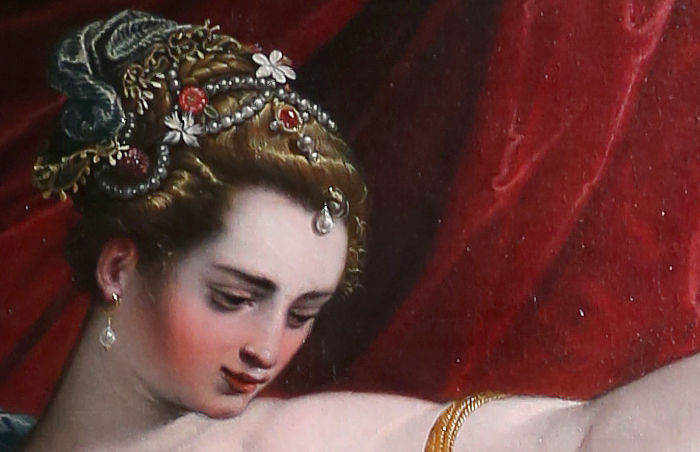
The work we are examining, painted by Jacopo Zucchi (c. 1541–1596), portrays the most salient and fateful moment of the myth: the betrayal of curiosity. The young woman, driven by doubt and encouraged by her envious sisters, decides to discover the identity of the mysterious lover who visits her every evening to "animate" her without showing his face.
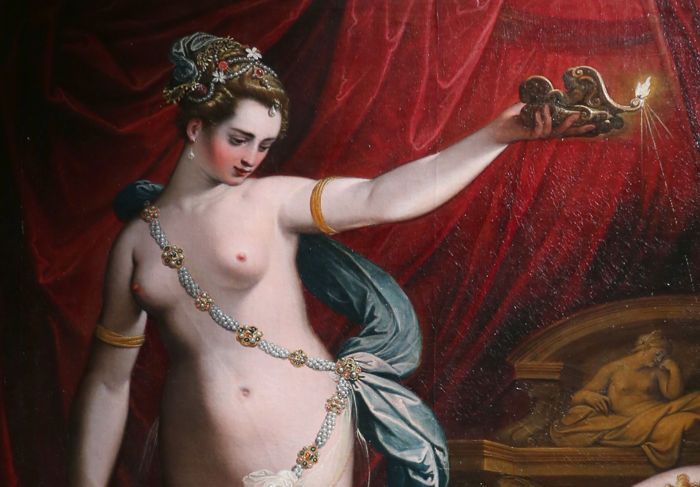
In the painting, Psyche leans over the bed, the oil lamp in hand, her face illuminated by the revelation: the "monster" is the beautiful god Cupid. A drop of hot oil from the lamp falls onto Cupid's shoulder, waking him and forcing his immediate flight.
Zucchi, a Mannerist painter who worked under the influence of Giorgio Vasari in Florence and later in Rome, reveals himself in this work as a refined artist, attentive to the trends of his time. His style is clearly influenced by Michelangelo Buonarroti in the monumentality of the figures and the torsion of the bodies, and by other Tuscan sculptors of the era. However, his distinctive touch is late Mannerism, characterized by:
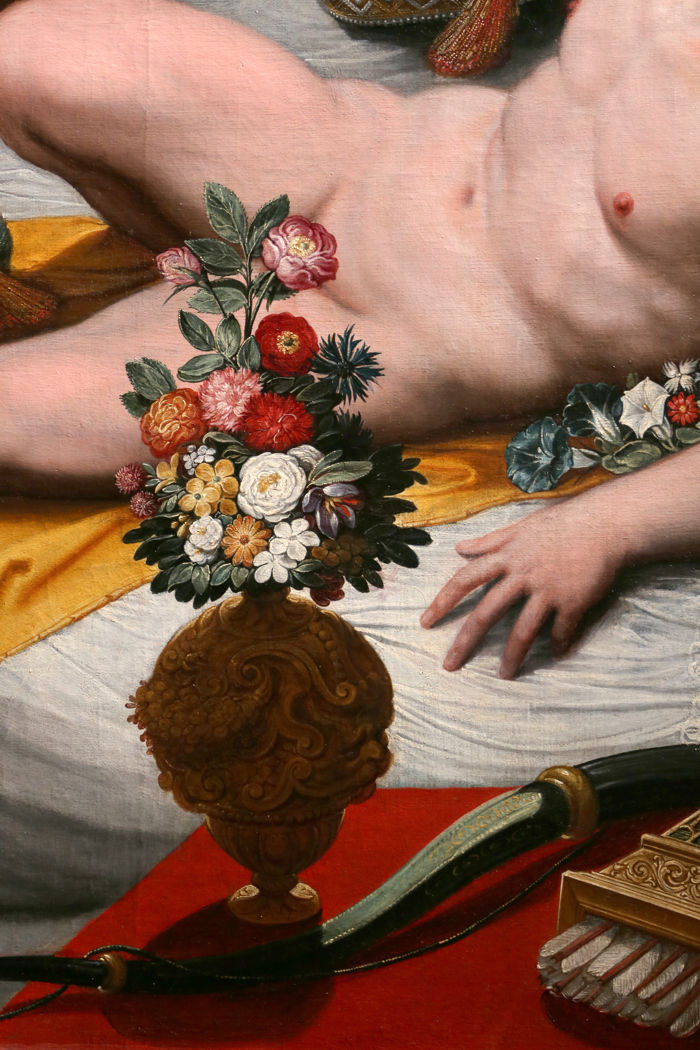
- Precise Detail: Zucchi looks to the Nordic tradition and the Venetian school for his precision of detail. The fabrics, the jewels, the flowers, and, crucially, the bedroom setting, are painted with microscopic exquisiteness. The palace's luxury, as described by Apuleius, is materialized in the bed's brocades and the shine of the lamp's metal.
- Emotional Tension: The scene is frozen at a moment of extremely high emotional tension. Cupid's face, barely visible as he is wounded, and the expression of surprise and terror on Psyche's face, contrast with the stillness of the luxurious room.
- Artificial Light: The lamp's light, central to the narrative (symbolizing the illumination of truth), is the sole light source and creates a strong chiaroscuro, accentuating the drama and the sinuous contours of the bodies, typical of Mannerism.
The Mannerist Symbolism of Betrayal and the Soul's Trials
Zucchi's work, unlike more direct representations, uses the composition to heavily load the moment with symbolism. The presence of the lamp is key: it is knowledge that, when sought prematurely, causes harm. Psyche, in her curiosity, breaks trust and condemns Love to flee, which triggers her long and painful path of atonement.
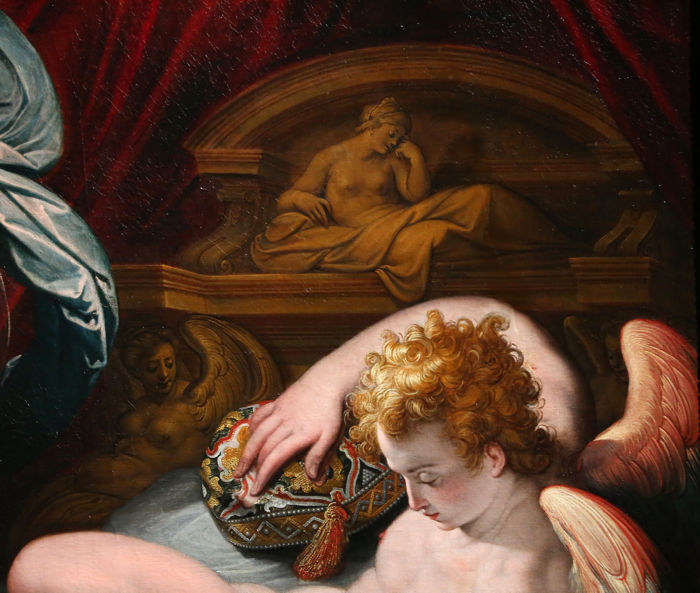
The bed itself becomes a stage for theatricality and excessive luxury, a reflection of the opulence that Mannerism adored, but also a reminder that superficial happiness can vanish upon contact with the harsh truth. The figures are beautifully drawn, with an elongated elegance that was the hallmark of the style, lending Psyche an ethereal fragility that underscores her role as the Soul, in contrast to Eros's smooth, divine musculature.
The flight of Eros from the scene is visually powerful. Zucchi depicts the god not just waking, but violently recoiling. The presence of a winged figure fleeing upward emphasizes the rupture between the divine and the mortal, between spirit and flesh. The composition forces the viewer's eye to follow the diagonal path of Cupid's retreat, drawing attention away from the material luxury and towards the spiritual consequence of Psyche’s act.
The myth of Cupid and Psyche continued to be an inexhaustible source of inspiration, from the famous sculptor Antonio Canova to the Pre-Raphaelite painters. However, Zucchi's version stands out for its narrative detail, where the richness of the material surface coexists with the depth of spiritual symbolism. It serves as a visual sermon on the Neoplatonic idea that the soul must overcome its earthly, sensory attachments to achieve divine union. The beautiful rendering of jewels, drapery, and flesh ultimately highlights the fleeting nature of these earthly pleasures when contrasted with the eternal nature of the Love that flees.
Psyche's story is a mirror of our own lives: curiosity, error, suffering, and the final quest for union with a superior ideal (Love)—a journey only possible after the Soul has proven worthy of immortality. Zucchi, with his goldsmith's brush, captured the moment the Soul made its greatest mistake and, at the same time, sealed its most glorious destiny.
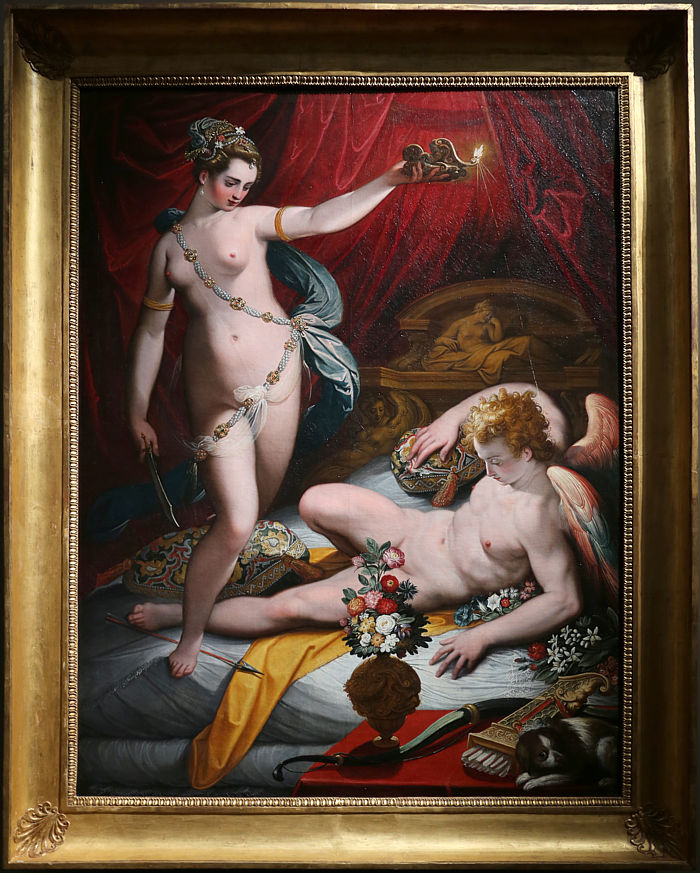
THE WORK
Cupid and Psyche
Artist: Jacopo Zucchi
Date: 1589
Dimensions: height: 173 cm; width: 130 cm
Location: Galleria Borghese, Rome