

Among all the disturbing images that Francisco de Goya painted at the end of his life, few are as unsettling as The Witches’ Sabbath. There is no heroism, no classical beauty, and no decorative intention. There is fear, superstition, and an uncomfortable feeling: the sense of looking at something that was never meant to be seen.
This work is part of what are known as the Black Paintings, a group of works that Goya did not paint for the public, for a king, or for posterity. He painted them for himself, directly onto the walls of his house. That changes everything. We are not looking at an artwork meant to please, but at an image born from an inner necessity.
The Witches’ Sabbath does not seek to explain, comfort, or embellish. It seeks to show. And what it shows is not pleasant.
What are we really looking at
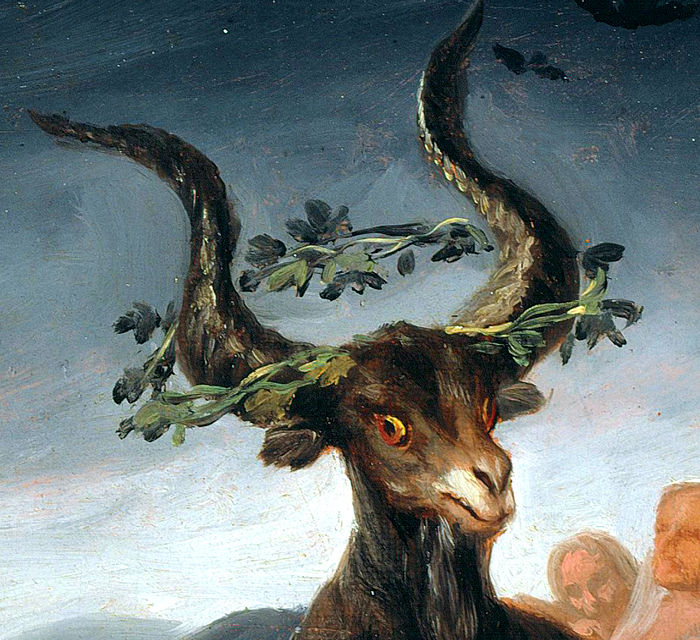
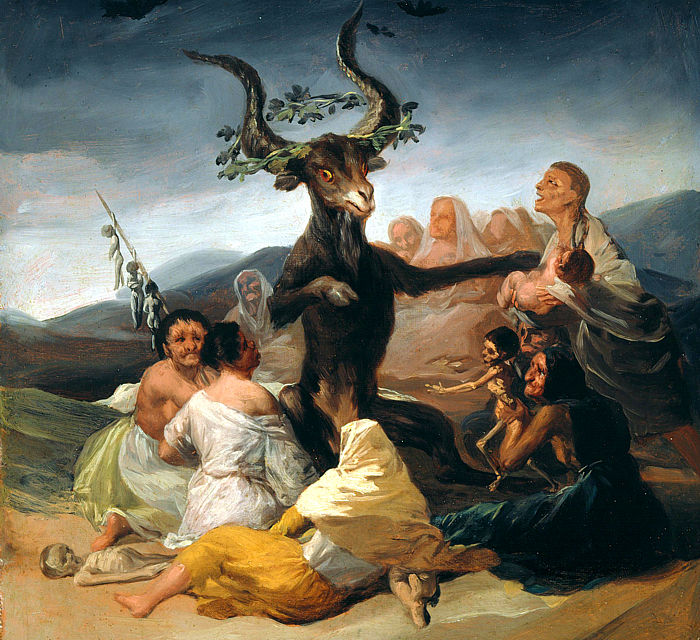
In The Witches’ Sabbath, we see a nocturnal gathering of deformed figures—peasants, elderly people, and women—assembled around a central figure: a dark goat, the traditional symbol of the devil in European popular culture.
The scene seems suspended in an undefined time. There is no recognizable architecture or clear landscape. The background is dark, earthy, almost empty. Everything takes place in a mental space rather than a physical one. The figures do not interact naturally with each other; they appear frozen in a state of expectation and terror.
But it is important to clarify a key point to understand the work: Goya is not depicting a real scene, nor is he defending belief in witchcraft. He is doing exactly the opposite.
The goat is not a powerful or majestic presence. It does not dominate the scene through strength, but through suggestion. Its size and position do not turn it into a god, but into a symbol. The true protagonist is not the devil, but collective fear.
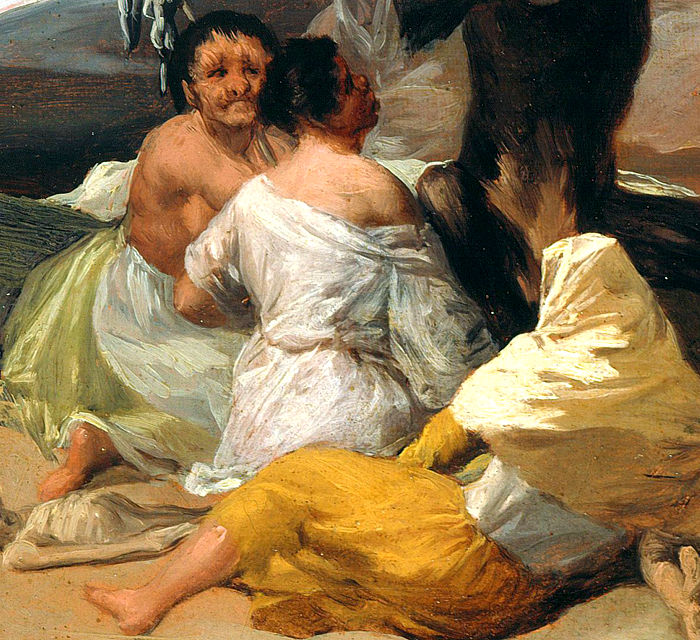
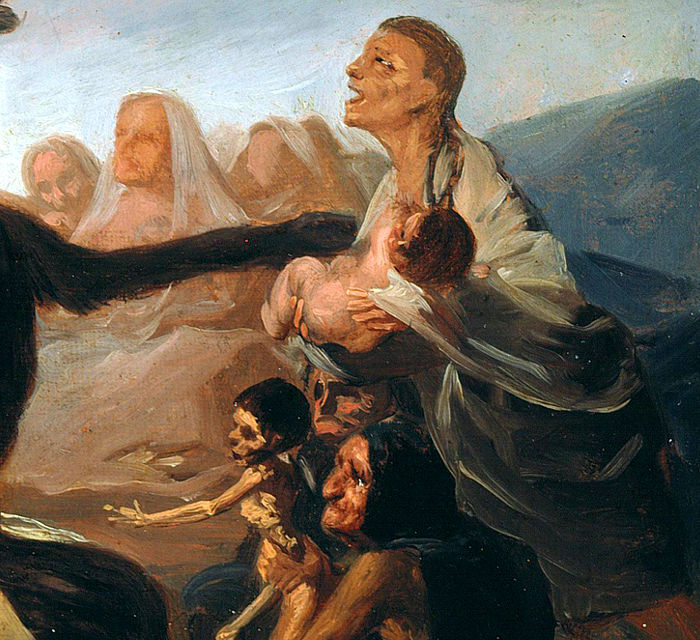
The people surrounding it do not seem evil. There is no ecstasy, no pleasure, no conviction. There are tense faces, empty stares, gestures of submission. Goya portrays superstition as a social phenomenon, not as something supernatural.
The historical context that explains everything
Spain had endured decades marked by the Inquisition, censorship, religious fanaticism, and exemplary punishment. Although the witch hunts were no longer officially at their peak, fear continued to function as a tool of control.
For centuries, superstition was used to maintain social order. The devil did not need to truly exist. It was enough for people to believe in him. Fear was more effective than any army.
Goya experienced this firsthand. Not as a distant observer, but as a direct witness to the mechanisms of power. He saw trials, anonymous accusations, public sentences, and humiliations. He saw how fear became institutionalized.
In The Witches’ Sabbath, that fear takes visual form. It is not an individual fear, but a collective one. A fear that is learned, inherited, and passed on.
A work against superstition, not in its favor
For a long time, some superficial readings interpreted this painting as a literal depiction of satanic rituals. That interpretation completely ignores Goya’s critical thinking.
Goya was an Enlightenment thinker. He believed in reason, knowledge, and the need to free society from irrational fear. In his series of prints Los Caprichos, he had already denounced superstition, fanaticism, and ignorance.
The Witches’ Sabbath does not glorify witchcraft. It exposes it as an absurd construction sustained by fear. The goat is not frightening by itself. It is frightening because people believe it is.
That is what is truly unsettling.
Why this painting is so disturbing
There is no clear scene or comforting narrative. We do not know exactly what is about to happen or what has just occurred. The figures seem trapped in a nightmare from which they cannot wake.
Their faces do not show evil. They show ignorance, submission, and terror. They are not villains. They are victims.
This is what makes the work more disturbing than any explicit image. We are not looking at monsters. We are looking at ordinary people trapped by an idea.
Goya does not mock them, but he does not idealize them either. He presents them as the result of a system that feeds on fear. That is why this work remains unsettling today. Because it speaks of mechanisms that have not disappeared.
The Black Paintings and Goya’s mind
The Black Paintings were created between 1819 and 1823 at the Quinta del Sordo, the house where Goya spent his final years in Spain. By then, he was deaf, ill, aged, and deeply disappointed with the political and social direction of the country.
He had seen the promises of reason and progress fail. He had seen violence and fanaticism return with force. And he no longer had any interest in pleasing anyone.
He did not sign these works. He did not explain them. He did not officially title them. He did not try to sell them.
This suggests something fundamental: they were not seeking approval. They were a form of emotional release, almost an internal dialogue. The Witches’ Sabbath does not aim to teach like a moral treatise. It aims to expose a bitter truth.
The use of color and distortion
In this work, the color palette is limited and dark. Blacks, ochres, browns, and grays dominate. There is no clear light. Everything seems covered by a permanent shadow.
The figures are distorted, but not in a caricatured way. Their bodies seem to lose proportion, as if fear itself affected physical form.
Goya is not seeking anatomical realism. He is seeking emotional truth. The distortion is not a technical mistake; it is an expressive decision.
Curiosities that are often overlooked
The theme of the witches’ sabbath had already been addressed by Goya decades earlier in works made for tapestries and official commissions. Those versions were more narrative, more explanatory, and in some ways more distant.
The difference with this final version is radical. Here, any satirical or didactic tone disappears. There is no irony. Only desolation remains.
Originally, the painting was executed directly on the wall. What we see today is the result of a complex transfer to canvas carried out decades later, with loss of detail and alterations in the original colors.
Many figures seem to merge with the background. There is no clear line separating them from their surroundings. This reinforces the idea that fear erases individual identity.
The message that remains relevant
The Witches’ Sabbath does not speak only about witches or the nineteenth century. It speaks about any society that gives up thinking and hands its power over to fear.
When fear rules, there is no need for a real demon. Belief is enough.
Goya did not paint monsters. He painted terrified people staring at an empty symbol. And in that, the work remains brutally current.
THE WORK
The Witches’ Sabbath
Francisco de Goya
Date: 1820–1823
Technique: oil on mural transferred to canvas
Dimensions: 140 x 438 cm
Style: Romanticism
Series: Black Paintings
Current location: Museo del Prado, Madrid