

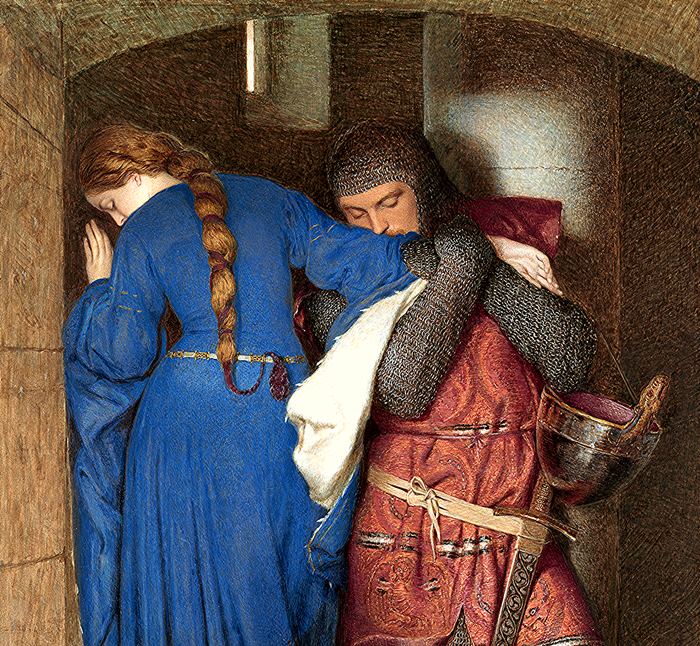
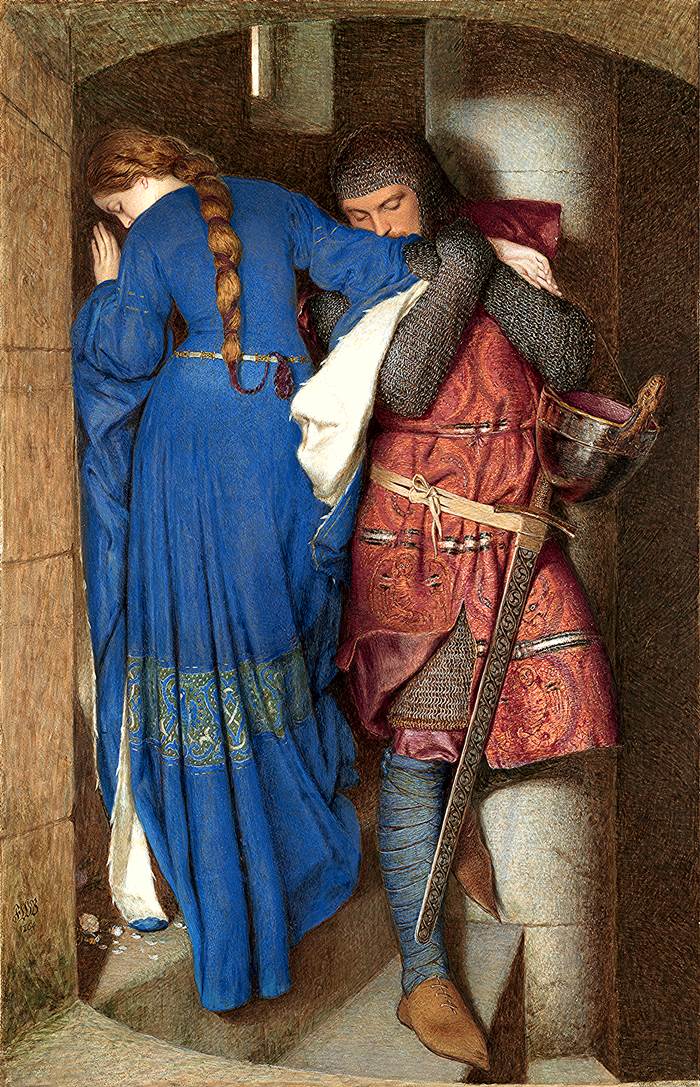
Some paintings explain themselves. Others, the more you look at them, leave more questions open. "The Meeting on the Turret Stairs" belongs to the second kind. At first glance it is a quiet scene: a man and a woman embrace on a stone staircase, her eyes closed, his lips resting on her arm.
There is no shouting, no blood, nothing seems seriously wrong. And yet this watercolour hides one of the most violent love stories in nineteenth-century art, along with a personal secret that took more than thirty years to come to light.
The man behind the brush
Frederic William Burton was born in Ireland in 1816 and trained as a miniaturist, a discipline that demands almost obsessive precision: every brushstroke counts, there is no room for carelessness. That training explains why he never worked in oil. His entire body of work, including this piece, was made in watercolour and gouache on paper, a far more fragile and demanding technique, yet capable of an intensity of colour that surprises anyone expecting something softer.
Burton was not only a painter. In 1874 he was appointed Director of the National Gallery in London, a position he held for twenty years, during which he drove the acquisition of hundreds of works for the museum's collection. He was also active in Irish cultural life: he was a member of the Royal Irish Academy and took part in archaeological research into Celtic heritage. He was, in short, a man devoted entirely to art, both with the brush and behind a director's desk. But of everything he did across more than eighty years of life, what still moves audiences today is a single scene: the one he painted in 1864, inspired by a ballad that reached him almost by chance.
The ballad almost no one remembers, but that explains everything
The story reached him through his friend Whitley Stokes, a scholar of Celtic culture who in 1855 translated an old medieval Danish ballad into English. Burton was so struck by the tale that he decided to bring it to canvas, though he chose not to show its most dramatic part. To understand why that choice was so clever, you need to know the whole story.
Hellelil was a young noblewoman, destined by her father for a convenient marriage. But she fell in love with the one person she shouldn't have: Hildebrand, the very guard her father had placed to protect her. When her father discovered the relationship, he did not hesitate: he ordered his seven sons to kill the young knight.
Hildebrand did not run. He went out to face all seven brothers, one by one, and managed to defeat six without killing them. Only the youngest remained. It was then that Hellelil, desperate, made the one mistake she could not afford: she begged Hildebrand to spare her brother's life. He lowered his guard. And the youngest brother used that instant to kill him from behind.
The ballad does not end there. The brothers dragged Hellelil back to the family home, locked her in a tower and, according to some versions, eventually traded her away for a church bell. She managed to tell her story to a Danish queen she served, before dying shortly after, consumed by grief.
The instant Burton chose to paint
Out of that whole story — the betrayal, the battle, the imprisonment, the death — Burton chose the least expected moment: the final embrace between the two lovers, just before Hildebrand went out to face the brothers. There are no swords in the scene. No violence. Just two people holding on to each other, knowing, even without saying it, that this is likely the last time they will see one another.
That choice is what turns the painting into something more than a simple illustration of the ballad. Burton wasn't interested in narrating events, but in capturing what happens one second before everything breaks. The kiss he gives her arm, rather than her lips, reinforces that sense of restrained farewell: it is a gesture of both respect and grief at once, not a conventional romantic scene. The influence of the Pre-Raphaelite movement, which Burton encountered directly in London through artists such as Dante Gabriel Rossetti, shows in that almost theatrical care to capture the exact emotion of a single instant, without ever tipping into excess.
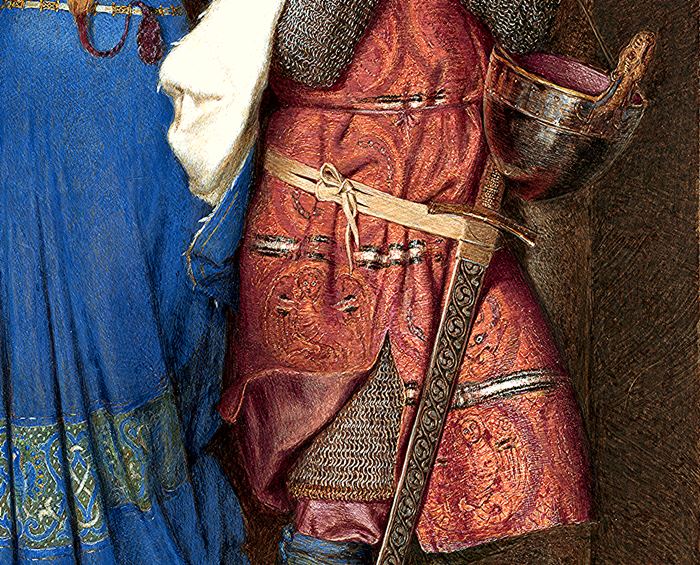
The result is a small work in size — it doesn't even reach a metre in height — but immense in intensity. Every detail, from the folds of the fabric to the knight's chainmail, is rendered with a precision only someone trained as a miniaturist could achieve.
The secret that isn't in the painting
This is where the story takes a turn that very few people know about. Burton never married. He left no clear record of his romantic life, and for a long time he was simply considered a reserved man, fully devoted to his work. But the Stokes family correspondence — the same family that brought him the ballad — tells another story.
Margaret Stokes, Whitley Stokes's sister, maintained a close relationship with Burton for decades. The surviving letters between her, her brother and their mother are full of constant mentions of Burton's wellbeing, along with carefully measured comments on Margaret's conduct whenever she was near him. In one of those letters, Whitley writes his sister a line that sums up the whole mystery: he confirms that, as she had asked him to, he burned the last letter he had received.
Margaret never married either. And in 1898, nearly two years before Burton's death, she bought this very painting — the one depicting the impossible love between Hellelil and Hildebrand — and shortly after gave it to the National Gallery of Ireland, where it remains today. No one can say for certain what Margaret felt for Burton, or whether he ever knew. But it's hard not to wonder whether, in buying that particular painting, she was holding on to the only version she could have of a story she herself never got to live.
Why it's still Ireland's favourite painting
In 2012, the Irish public voted this work their favourite painting, ahead of others signed by far more internationally recognised artists. The museum's curators weren't surprised: few works manage to combine this much technical detail with a story carrying this much emotional weight.
Today, seeing it in person isn't easy. Being a watercolour, it is extremely sensitive to light, and prolonged exposure could damage it irreversibly. Because of this, the National Gallery of Ireland keeps it locked away in a cabinet most of the time, displaying it only a few hours a week. Anyone who wants to see it has to plan the visit in advance, almost as if requesting an audience.
Perhaps that fragility is part of what makes it even more compelling. A love story that can never be fulfilled, held in a technique that cannot be exposed without extreme care, kept for over a century by someone who may also have lived, quietly, her own version of the same story.
Three hundred years after the original ballad was written, and more than a hundred and sixty since Burton painted it, "The Meeting on the Turret Stairs" is still asking the same question it asked on day one: how much of what we see in a painting is the story we're told, and how much is the story the artist himself could never tell any other way?
THE WORK
The Meeting on the Turret Stairs (Hellelil and Hildebrand)
Frederic William Burton
Year: 1864
Technique: watercolour and gouache on paper
Dimensions: 95.5 cm x 60.8 cm
Location: National Gallery of Ireland, Dublin