

A man flees his fate. And it is precisely by trying to escape it that he ends up fulfilling it from beginning to end. But the most terrible thing about this story is that the tragedy begins before the man himself even exists. And when he finally discovers the truth, it is already too late to save himself.
It all begins in Thebes, where Laius and Jocasta reign. One day, the rulers consult the oracle of Apollo and receive a horrifying prophecy: if they have a son, that child will kill his father and marry his mother. Imagine the delightful family moment. From then on, the birth of an heir ceases to be a blessing and becomes a threat. When the child is born, Laius decides that he will not allow the prophecy to come true. The baby's ankles are pierced, his feet are bound, and a servant is ordered to abandon him on Mount Cithaeron to die. However, the man cannot bring himself to carry out the order. The baby ends up in the hands of shepherds and, after passing through other hands, arrives in Corinth, where King Polybus and Queen Merope raise him as their own son. They name him Oedipus, meaning “swollen-footed.” An injury sustained at the beginning of his life becomes his name, as though the past had left a mark he could not even understand.

Oedipus grows up believing that he is the son of the rulers of Corinth. He has a family, a position, and a future. But one day he hears rumors about his origins and decides to consult the oracle of Apollo. The answer is devastating: he will kill his father and marry his mother. Oedipus does not know that the rulers of Corinth are not his biological parents. Convinced that the prophecy refers to them, he makes what seems like a sensible decision: he leaves, never to return. He does not want to hurt the people he loves. He does not want to become a monster. He wants to escape his fate. And that is where the cruelest irony of the entire story begins: by leaving the people he believes to be his parents, Oedipus heads straight toward his real ones.
At a crossroads, he encounters an old man accompanied by several servants. A dispute breaks out over who has the right of way, and the argument turns violent. Oedipus kills the man and almost everyone in his retinue. He does not know that he has just murdered Laius, king of Thebes, his biological father. The first part of the prophecy has come true, but Oedipus continues on his way without knowing the truth. There is no divine revelation, no thunder announcing the tragedy, no voice explaining what he has just done. There is only a man moving forward, convinced that he can still decide who he will become.
When he reaches Thebes, he finds a terrified city. At its gates has settled the Sphinx, an extraordinary creature, half woman and half lion, with wings. Its presence turns the roads into deadly traps. It poses a riddle to every traveler, and anyone who cannot solve it is devoured. The city needs a savior, and Oedipus agrees to confront the monster. The Sphinx asks its famous question: “What creature walks on four legs in the morning, two at noon, and three in the evening?” Oedipus understands the answer: the human being. In childhood, a person crawls on hands and feet; in adulthood, walks upright on two legs; and in old age, needs a cane for support. The man has solved the mystery of human life and defeated the Sphinx. According to the best-known version, the creature throws itself into the abyss after being defeated.
Thebes celebrates its savior. As a reward, its people make him king and give him the widowed queen, Jocasta, as his wife. Oedipus accepts. She is his mother, although neither of them knows it. The second part of the prophecy comes true without its protagonists understanding what has happened. Oedipus and Jocasta build a family and have four children: Eteocles, Polynices, Antigone, and Ismene. For years, they live without knowing the secret that binds them. The prophecy seems buried beneath an apparently happy life. But in Greek tragedies, the past never disappears: it waits.

One day, a devastating plague strikes Thebes. The city falls ill, the fields stop producing, and the people search for an explanation. Oedipus, who has already proved himself a ruler capable of solving problems, promises to find the cause of the disaster. The oracle announces that the plague will not end while the murder of Laius remains unpunished. Oedipus swears to discover the culprit and pronounces a curse upon the murderer, never imagining that his words will fall upon himself. Tiresias, the blind prophet who knows the truth, becomes involved in the search. At first he refuses to speak, but when he finally reveals that Oedipus is responsible for the former king's death, Oedipus refuses to believe him. How could he accept such an accusation? How could he imagine that his own life is the crime he is trying to solve?
Yet the pieces begin to fall into place. Memories of the crossroads return, news emerges about the abandoned child, and a messenger arrives from Corinth with his testimony. Oedipus's identity begins to crumble. Jocasta understands the truth before he does. She begs him to stop investigating, to ask no more questions, to stop before reaching the end. But Oedipus presses on. He needs to know. He needs to get to the bottom of the mystery, even if that mystery is himself.
When he finally discovers who he is, the horror is unbearable. Jocasta takes her own life by hanging herself. Oedipus finds her body and, in despair, takes the brooches from her dress and pierces his own eyes. The man who defeated the Sphinx, the king who promised to uncover the truth, can no longer bear to look at the world. He gives up the throne and is eventually banished from Thebes. Blind and condemned to wander, he finds a guide and companion in his daughter Antigone. His story continues in other tragedies: his sons, Eteocles and Polynices, will eventually kill each other in a struggle for power. The curse seems to pass from one generation to the next, as though no one can escape the consequences of that first attempt to prevent the prophecy.
But here an uncomfortable question arises: is Oedipus really guilty? He did not know that Laius was his father. He did not know that Jocasta was his mother. He did not consciously intend to commit those crimes. The tragedy does not simply portray an evil man receiving his punishment, but someone who tries to do the right thing and discovers that his choices have led him straight toward what he feared most. His story pits two forces against each other that are difficult to reconcile: fate, which seems to have been written in advance, and human will, which insists on believing it can change it.

And there is another disturbing detail: Oedipus is not the first to commit an act of violence in this story. His father, Laius, is, when he decides to get rid of a newborn in order to protect himself from a prophecy. Before Oedipus can make a single decision, the adults have already decided his fate. The child is injured, abandoned, and separated from his identity. Later, when he hears the oracle, he flees to protect the people he believes to be his parents. Every step he takes springs from an understandable intention, yet the sum of those decisions produces a catastrophe. To what extent are we responsible for what we do when we are unaware of the truths that shape our lives? And how much of our suffering comes from trying to control what we do not understand?
Centuries later, this tragedy would find a new life in psychology. In the early twentieth century, Sigmund Freud made the Oedipus myth one of the central references of psychoanalysis and proposed the concept known as the Oedipus complex. In broad terms, his theory described a stage of childhood development in which unconscious desires for exclusive emotional attachment to one parent and rivalry with the other were thought to arise. Freud found in the tragedy a powerful image through which to explore family conflicts and desires that, in his interpretation, could remain outside conscious awareness.
An important distinction should be made: the Oedipus complex is a historical psychoanalytic formulation, and its claims have been widely debated. It is not a universally proven truth about all children, nor does it mean that people literally wish to repeat the character's actions. Above all, Oedipus does not know that Jocasta is his mother and does not consciously seek to marry her. The tragedy's power lies precisely in this ignorance: the characters live in a reality whose true structure they do not understand.
The story also allows for another psychological interpretation without turning it into a diagnosis. Oedipus tries to avoid a terrible threat, but he organizes his entire life around it. He flees Corinth to avoid harming the parents he believes are his own, and that flight leads him to Laius and Jocasta. When disaster strikes, he searches for answers with extraordinary determination, yet struggles to accept those that contradict the image he has of himself. This is not a claim that fate works this way in real life, nor that we all end up causing the very things we fear. The reflection is subtler: sometimes fear can narrow our perspective; we may make decisions without knowing the whole story and cling to an explanation of ourselves that no longer fits the facts. Oedipus is not to blame for discovering his origins too late, but his tragedy forces us to ask how much we are willing to uncover when the truth threatens to destroy the identity we have built.
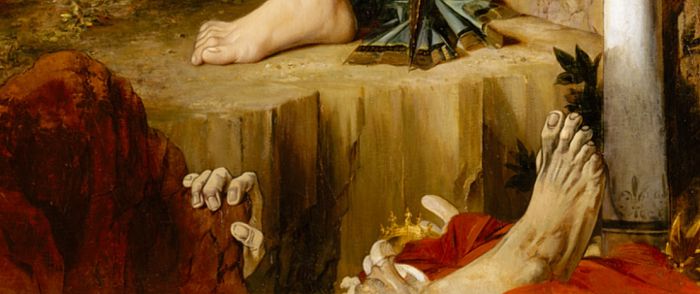
And this is where the Sphinx takes on a fascinating new dimension. Oedipus solves its riddle because he knows how to look at human beings from the outside: he understands the stages of life and recognizes the child, the adult, and the elderly person. Yet he cannot apply that knowledge to his own existence. He can explain what a human being is in general terms, but he does not know who he is. He can decipher the mystery threatening an entire city and, at the same time, remain blind to the mystery of his own history. The great irony is that he defeats the Sphinx but cannot overcome his ignorance of himself.
This tension between knowledge and ignorance appears with extraordinary force in the painting Oedipus and the Sphinx, created by Gustave Moreau in 1864. The work belongs to the Symbolist movement and presents the encounter as something far more unsettling than a simple struggle between a hero and a monster. Moreau does not depict Oedipus in the middle of a battle or show the Sphinx throwing itself into the abyss. He freezes time at the very instant the two confront each other, when we still do not know what will happen. The danger has not disappeared: it hangs suspended between the two figures.
The Sphinx clings to Oedipus's body. Its claws dig into him, its wings spread out, and its face remains close to his. This is not a distant creature the hero can defeat without coming near it. It is pressed against his body, invading his space and turning the riddle into an intimate confrontation. Oedipus, meanwhile, stands upright and meets the creature's gaze. His body conveys tension and caution; he does not look like a victor already celebrating his triumph, but like a man who must confront something whose true nature he does not yet understand.

Around them, the rocky landscape, bones, and human remains recall the fate of those who failed before him. Death is present even though the confrontation has not yet ended. Moreau transforms the encounter into a scene rich with symbolism: human intelligence facing the unknown, will confronting danger, reason facing a creature that seems to belong both to the outside world and to the darker regions of the imagination.
The painting received recognition at the Paris Salon of 1864 and helped establish Moreau's reputation. Today it is held at the Metropolitan Museum of Art in New York. It is an oil painting on canvas measuring approximately 206.4 by 104.8 centimeters. Its vertical format, wealth of detail, and intensity of the encounter make the scene feel almost like a threshold: Oedipus is about to cross it, but we know something he does not yet know. We know that he can solve the Sphinx's riddle and still fail to solve the mystery of his own identity in time.
Perhaps that is why this story continues to unsettle us thousands of years later. It is not only about a prophecy, an unwitting murder, or a family trapped by a curse. It is about the limits of knowledge, the truths we do not know, and the difficulty of recognizing ourselves when reality contradicts everything we thought we understood. Oedipus defeats the monster that devours travelers, but the truth waiting for him at the end of the road proves more devastating than any mythological creature.
And perhaps the most unsettling question is not whether we can escape our fate, but whether we are capable of recognizing the path we are taking. Because sometimes we spend our lives trying to decipher the world, convinced that the greatest mystery lies outside ourselves. Until one day we discover that the hardest question was not the one the Sphinx asked us.
It was the one we had never dared to ask ourselves.
Are we building our own path, or, without realizing it, are we running away from something about ourselves that we still do not understand?
THE ARTWORK
Oedipus and the Sphinx
Gustave Moreau
1864
Oil on canvas
Dimensions: 206.4 cm × 104.8 cm
The Metropolitan Museum of Art, New York