

When we think of Leonardo da Vinci's female portraits, one image immediately monopolizes our collective memory: the serene, ambiguous, and hypnotic face of the Mona Lisa. Yet before that small poplar panel became the most famous painting on Earth, Leonardo had already explored the female face on at least five other occasions.
They were a poet, a mistress, a favorite, a marchioness, and an unknown woman. Five women whose stories—and whose images—were shaped by politics, arranged marriages, court rivalries, or the desires of powerful men seeking to possess them, display them, or immortalize their own prestige through them. All of them were caught in the wills of others. All of them, save one.
This is the chronicle of those six women and the mysterious reason why Leonardo, an artist famous for leaving works unfinished and abandoning commissions without looking back, could never let go of the portrait of Lisa Gherardini.
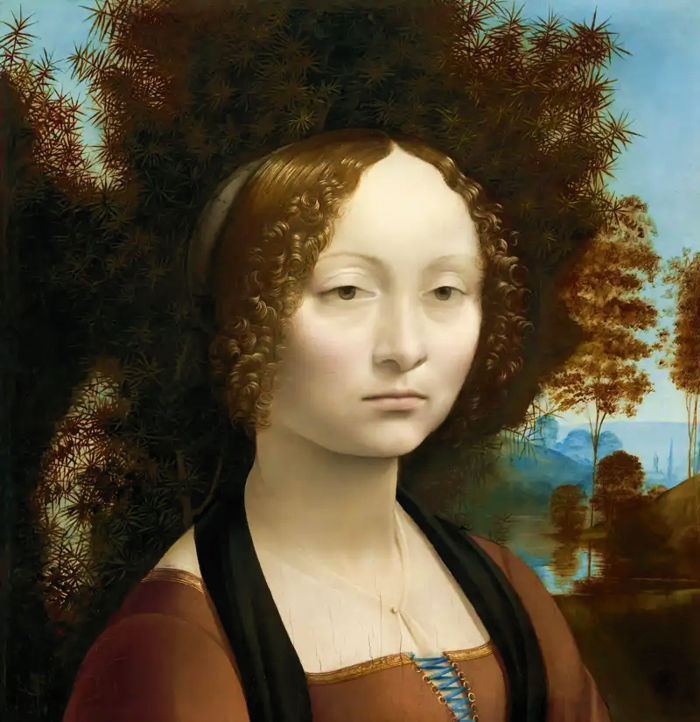
Ginevra de' Benci: The Poet Hidden Among Juniper
The story begins in Florence in the mid-1470s. Ginevra de' Benci is barely seventeen or eighteen years old, comes from a well-to-do family, writes poetry, and has just married a man considerably older than herself. Leonardo, then around twenty-two or twenty-three and beginning to stand out beyond Verrocchio's workshop, receives the commission to paint her.
The result breaks with the conventions of the time. Instead of showing her in profile—as Florentine tradition dictated to display jewels, lineage, and modesty—Leonardo turns her almost full-face. Yet he grants her no trace of sweetness: Ginevra looks out with a contained, distant, almost impenetrable seriousness. Behind her head, the painter unfolds a dense juniper bush, called ginepro in Italian: a visual play that camouflages the sitter's name within the landscape itself.
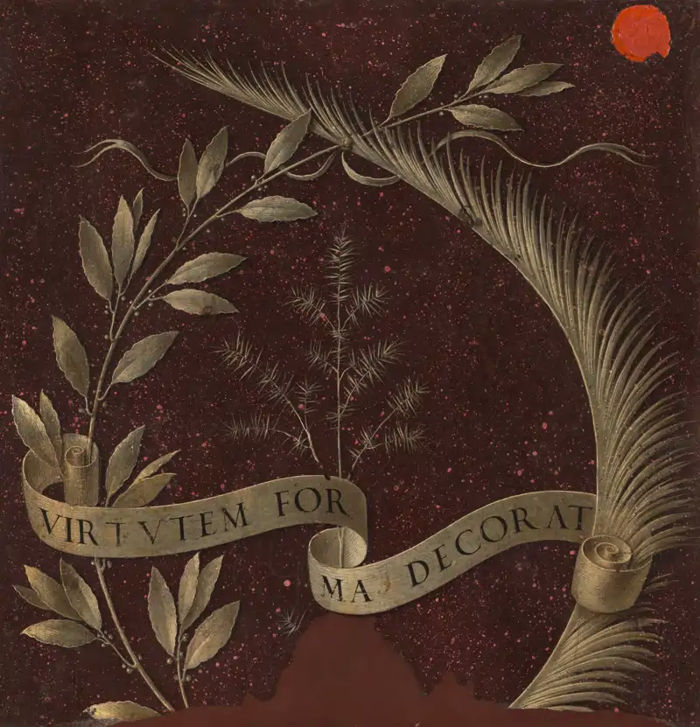
However, that painting was born amid sentimental and symbolic tension. Bernardo Bembo, the Venetian ambassador to Florence, was platonically courting Ginevra with verses and literary commissions. If we turn the panel over, we find the trace of that bond: a juniper branch surrounded by a wreath of laurel and palm—Bembo's personal emblem—alongside a scroll bearing the Latin inscription Virtutem forma decorat ("Beauty adorns virtue").
To this day, historians debate who actually funded the work: whether her husband, Luigi Niccolini, to celebrate the wedding, or the Venetian admirer, to record his devotion. Added to this is a revealing physical detail: the panel preserved today at the National Gallery of Art in Washington is mutilated. At some point in its history, a significant strip along the bottom was cut away, where her hands very likely rested, perhaps holding a symbol or flower. What is indisputable is that, from his very first major female portrait, Leonardo painted a woman contested by the gaze of others.
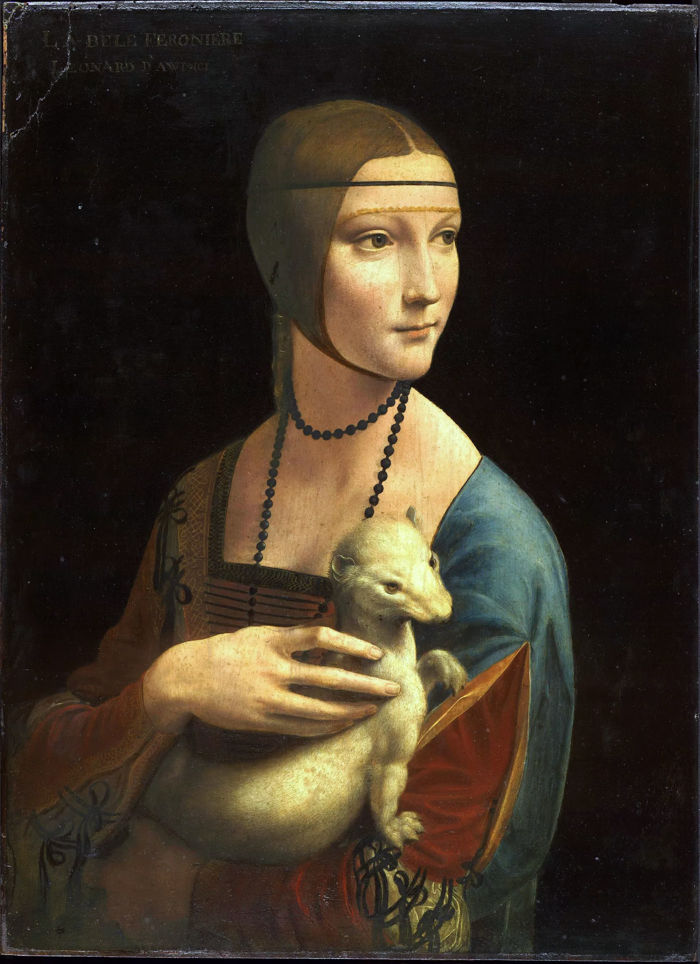
Cecilia Gallerani: The Ermine of a Banished Mistress
Years later, Leonardo trades Florence for Milan and enters the service of Ludovico Sforza, the strongman of the duchy. In that brilliant, calculated court he meets Cecilia Gallerani, the young mistress of the ruler. Cecilia is around sixteen or seventeen years old, fluent in Latin, composes verse, and surrounds herself with the sharpest intellectuals in Lombardy.
Leonardo portrays her in a moment of suspended motion. She turns her head to one side, as if someone had just entered the room and caught her attention. In her arms she holds a white ermine, muscular and alert. The choice of animal is no accident: on one hand, the ermine was one of Ludovico Sforza's personal emblems—known as l'Ermellino Bianco after receiving the Order of the Ermine; on the other, its name in ancient Greek (galê) served as a phonetic wink to the surname Gallerani.
Yet courtly happiness comes with an expiration date. Ludovico must seal his political marriage to Beatrice d'Este, and the young wife is unwilling to tolerate the favorite's presence at court. When Beatrice arrives in Milan, Cecilia is pregnant with the duke's child. The court's solution is swift and cold: they marry her off to a count and distance her from the center of power. Her son is born nonetheless, and Cecilia keeps the portrait Leonardo painted for her, as the sole intimate keepsake that Ludovico's political machinery could not strip away.
Over the centuries, technology revealed that the panel hid a secret beneath its layers of oil. Studies conducted under special light have suggested that Leonardo may have first painted Cecilia without the ermine and against a different background, adding the animal and dark backdrop at a later stage. If that reading is right—though debate continues over what belongs to the master and what to later retouchings—it means the duke's symbol was introduced into the painting when the portrait already existed, visually marking the sitter's ownership.
The fame of the painting reached beyond the walls of her residence. In 1498, Isabella d'Este—Beatrice's sister and one of the most determined collectors of the Renaissance—asked to borrow the portrait to compare it with works by Giovanni Bellini. Cecilia agreed, yet accompanied the shipment with a tactful letter distancing herself from that image: time had passed, and the young woman portrayed no longer resembled the woman she had become.
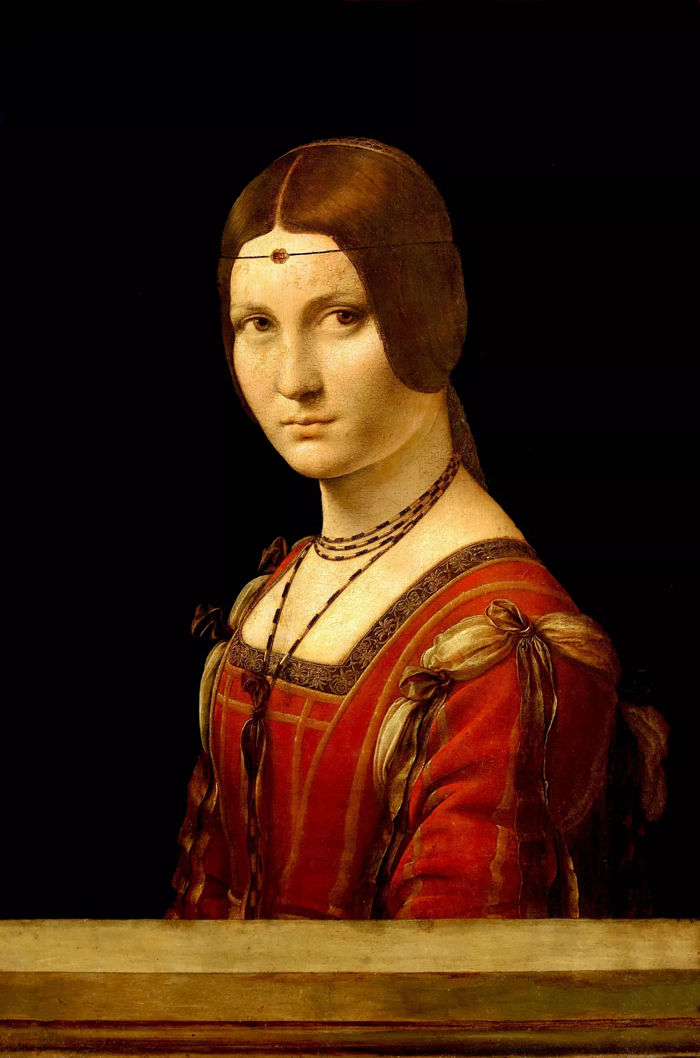
Lucrezia Crivelli: The Favorite Without a Certain Name
Fate struck the Milanese court once more in January 1497, when Beatrice d'Este died young after a difficult childbirth. By then, Ludovico Sforza already had a new favorite in his circle: Lucrezia Crivelli, lady-in-waiting to the duchess herself.
For centuries, tradition identified Lucrezia with the enigmatic woman portrayed in La Belle Ferronnière, today in the Louvre Museum. Dressed in a rich red gown and wearing a thin dark band across her forehead, the young woman directs a steady, slightly elusive gaze toward someone outside the frame.
However, the case of this work illustrates just how far the identity of these women faded behind the veil of courtly mystery. The identification with Lucrezia Crivelli is little more than a hypothesis—other specialists have suggested Beatrice d'Este or figures from the court of Mantua—and even the title by which the painting passed into posterity, La Belle Ferronnière, stems from a historical mix-up centuries later. Once again, a woman tied to the circle of the powerful was immortalized to be observed forever, yet without certainty even of her own name.
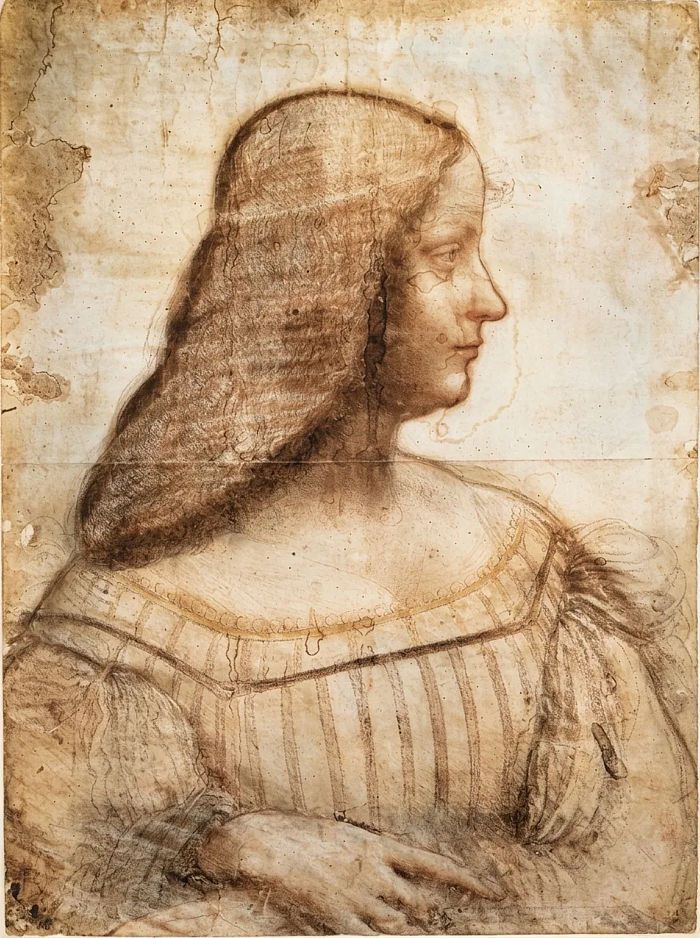
Isabella d'Este: The Marchioness Who Could Not Buy the Genius
When Milan fell to French forces in late 1499 and Ludovico Sforza lost his throne, Leonardo left the city. On his route toward Venice, in early 1500, he stopped in Mantua. There awaited Isabella d'Este, Marchioness of Mantua, the very woman who years earlier had looked upon Cecilia Gallerani's portrait with envy.
Isabella saw her opening and got Leonardo to turn his gaze toward her. In just a few days, the master sketched a famous preparatory drawing in charcoal, red chalk, and pastel: the marchioness appears in strict profile, torso turned and hands clasped, projecting authority and composure. Yet that cartoon was only the first step. Isabella wanted a painted portrait in oil.
What followed was an epistolary pursuit that lasted for years. At first, the marchioness wrote with diplomatic courtesy; over time, her letters grew urgent and almost pleading. In 1501, a Carmelite friar named Pietro da Novellara sent her a discouraging report from Florence: Leonardo was completely absorbed in his mathematical and geometric studies and could barely bear the sight of a brush. Isabella persisted. She offered to pay any sum and even said she would accept any other painting from his hands if he did not wish to paint her portrait.
She never received it. One of the most influential women in Italy, accustomed to having the great masters of her time indulge her artistic whims, ran up against Leonardo's free, scattered, untamable mind. Today only that drawing in the Louvre remains as testament to a desire that never reached canvas.
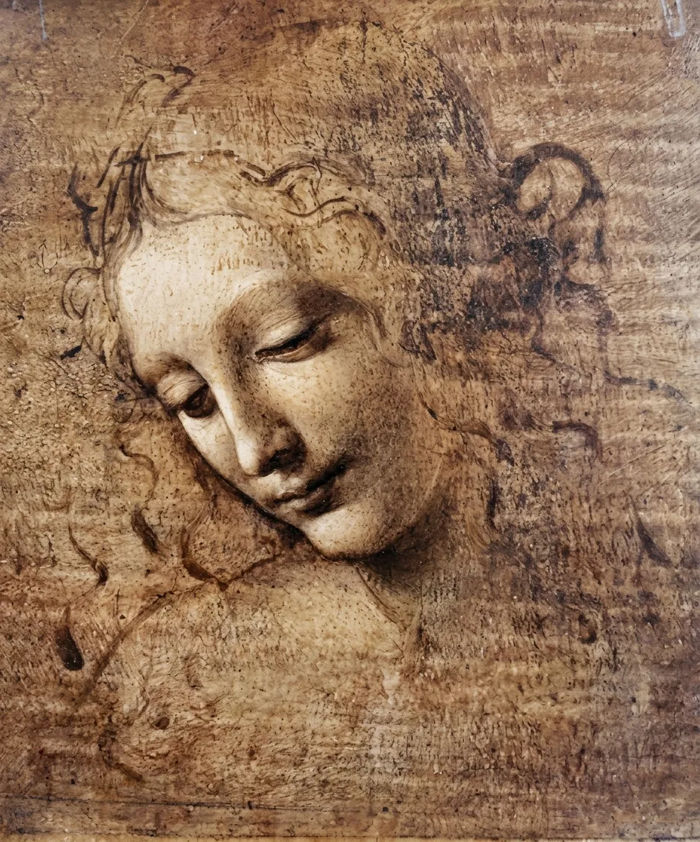
La Scapigliata: The Freedom of the Unfinished
Around 1506–1508, something seems to shift in the way Leonardo approaches the female face. From that period dates a small walnut panel known as La Scapigliata—"the disheveled woman"—preserved at the Galleria Nazionale in Parma.
Unlike the earlier works, here there are no ostentatious jewels, no courtly dresses, no heraldic emblems, no clues about a husband or a powerful lover. We see only the tilted head of a young woman, with half-closed eyelids and loose, waving hair that seems to float in the air. We do not know who the model was, nor whether any patron stood behind the piece.
The work was left deliberately—or mysteriously—unfinished, and its magnetism lies precisely there. Uncovered by final layers of varnish or completed glazes, it lets us peer straight into Leonardo's mental laboratory. There is almost no color: only earthy pigments, ochres, and touches of lead white sculpting the face out of light and shadow, without a single rigid contour line. It is the very essence of sfumato in its pure state. Although its origin remains an enigma, it is hard not to see it as a space of creative freedom, far from the demands of courts.
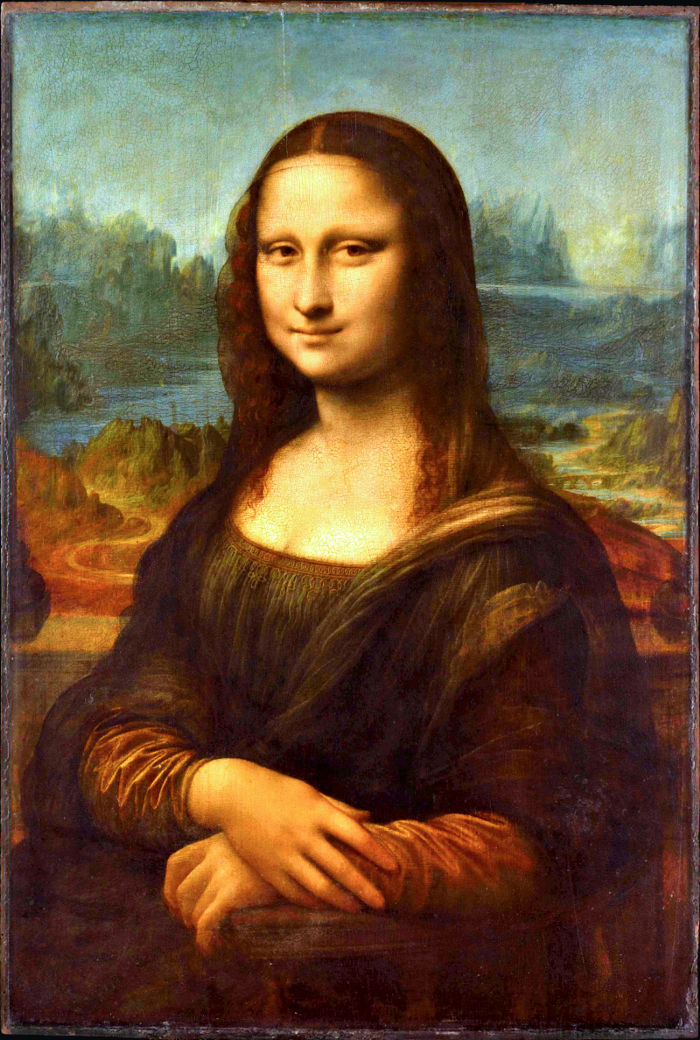
Lisa Gherardini: The Woman Leonardo Never Let Go Of
By the time he was working on La Scapigliata, Leonardo had already spent years living alongside another portrait that had begun, in appearance, as a conventional commission.
In Florence, around 1503, the prosperous silk merchant Francesco del Giocondo asked him to paint his young wife, Lisa Gherardini, then twenty-three or twenty-four years old. She was a woman without noble titles or palace scandals; a mother from the Florentine bourgeoisie. Leonardo accepted the job, began painting the panel... and never handed it over.
When he left Florence to return to Milan, the painting traveled with him. When he moved to Rome under the protection of the Medici, the painting stayed in his luggage. And when he crossed the Alps into France, invited by King Francis I to spend his final years at the manor of Clos-Lucé, Lisa Gherardini's panel was still at his side. Francesco del Giocondo never received the painting he had paid for. Lisa, for her part, went on with her everyday life in Florence: she raised her children, was widowed, and spent her final years connected to the convent of Sant'Orsola, where she died in 1542, never suspecting that her face would become the most recognized icon in art history.
Scientific analyses carried out by the Louvre Museum's laboratory have shown why that work occupied so much time in the master's life. The surface is built through extraordinarily thin glazes, barely a few micrometers thick, applied one over another for years to dissolve any boundary between light and shadow, from the corner of the lips to the translucent veil covering her hair and shoulders. Leonardo returned to that panel time and again, unable to declare it finished.
Therein lies the fundamental difference among them all. Ginevra and Cecilia he painted within a web of alliances, ambitions, and outside desires. To Isabella he denied the oil painting she craved so deeply. With La Scapigliata he explored the freedom of the stroke without constraints. Yet with Lisa, the simplest of them all, something else happened: the painting ceased to be a commission and became a personal, never-ending quest.
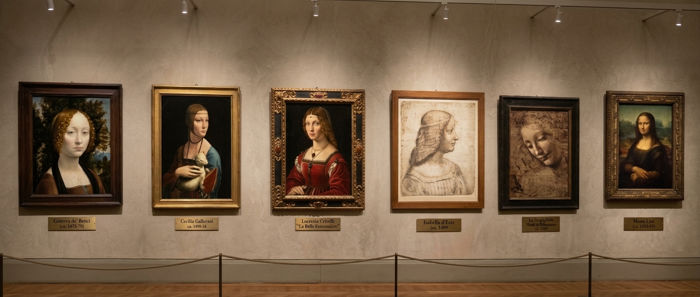
Six women passed before Leonardo da Vinci's gaze. Five were caught in the history of those who sought to possess them. Only one stayed with him until the end of his days.