

The story of the abduction of Persephone is more a story about Demeter than about her daughter Persephone. The violation of Persephone had terrible family precedents, beginning with the relationship of her mother Demeter with one of her brothers, the father of her daughter, Zeus, king of the gods, who also refused to intervene to help the girl, at least in a timely manner. Demeter, goddess of the earth and grain, as we have already told in La Vida es Arte, was the sister of Zeus, as well as of Poseidon and Hades.
Because Zeus betrayed her through his participation in the violation of Persephone, Demeter left Mount Olympus to wander among men. Therefore, although a throne on Olympus was her birthright, Demeter is sometimes not counted among the Olympians. This "secondary" status did nothing to diminish her importance to the Greeks and Romans. The cult associated with Demeter, the Eleusinian Mysteries, endured until it was suppressed in the Christian era.

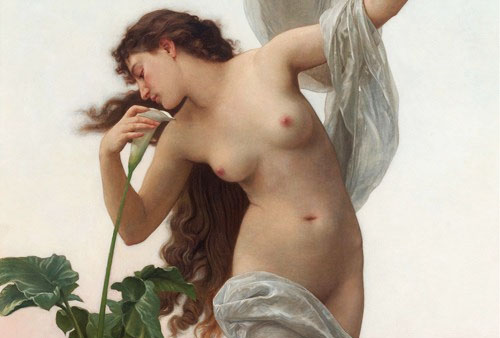
Now then, Demeter and Zeus are the parents of Persephone. Demeter’s relationship with Zeus had not always been as tense as it was now: he was Persephone’s father, however difficult the circumstances. Persephone grew into a beautiful young woman who enjoyed playing with the other goddesses on Mount Aetna, in Sicily. There they gathered and enjoyed the beautiful flowers. One day, a narcissus caught Persephone’s attention, so she picked it to take a closer look, but when she pulled it from the ground, a crack formed... Someone was watching her.

Demeter was busy with her tasks and was not paying attention to her daughter. After all, Persephone had grown up. Besides, Aphrodite, Artemis and Athena were there with her, or so Demeter assumed. However, when Demeter’s attention returned to her daughter, the young maiden (Kore in Greek) had disappeared. But where was Persephone? Aphrodite, Artemis and Athena did not know what had happened. It had been so sudden... One moment she was there and the next she was gone. Demeter was beside herself with grief. Was her daughter dead? Kidnapped? What had happened? No one seemed to know. So Demeter wandered across the land searching for answers.

After nine days and nights searching for her daughter and showing her anger by setting the earth on fire at random, the three-faced goddess Hecate told the anguished mother that although she had heard Persephone’s cries, she had not been able to see what had happened. Then Demeter asked Helios, the god of the sun; he had to know, since he sees everything that happens on the earth during the day. Helios told Demeter that Zeus had given her daughter to "The Invisible" (Hades) as his bride and that he had taken Persephone to his home in the Underworld. Was it possible that the king of the gods had dared to give Persephone to Hades, the dark lord of the Underworld, behind her back? Imagine Demeter’s indignation at this revelation. When the sun god Helios suggested that Hades might be a good match for the girl, it was the last straw.
The rage soon turned into deep sorrow, then depression, which led Demeter to be unable even to think about doing her work, and since the goddess was not providing food, soon no one would eat. Not even Demeter. Hunger would strike humanity. It did not help when Demeter’s third brother, the lord of the sea Poseidon, attacked her while she wandered through Arcadia. There he tried to violate her. A broken family... Demeter tried to escape by transforming herself into a mare grazing among the other horses. Unfortunately, Poseidon easily recognized his sister even in her mare form, and so, as a stallion, Poseidon violated Demeter. If the goddess had ever considered returning to Mount Olympus, this was the decisive factor in abandoning that idea. Now then, Demeter was not a heartless goddess. She was depressed, but despite everything she did not seek revenge. She hoped to have better luck among mortals, so she took the appearance of an old Cretan woman to hide among them and begin again. When Demeter arrived in Attica in the form of a decrepit old woman, she was thirsty. They gave her water to drink and she took the time to satisfy her thirst. When she stopped, a spectator named Ascalabus laughed at the old woman. He said she did not need a cup but a tub to drink from. Demeter, weary of everything and everyone, felt insulted, and by throwing water at Ascalabus she turned him into a gecko, a kind of small lizard. Then Demeter continued on her way.
Upon arriving at Eleusis, she sat beside an old well where she began to cry. Four daughters of Celeus, the lord of the place, invited her to meet their mother, Metaneira. Metaneira was impressed by the old woman and offered her the position of nurse for her young son. Demeter accepted. In return for the hospitality they had shown her, the goddess wanted to offer a service to the family, so she set out to make the baby immortal through the usual procedure with fire and ambrosia. This would have worked if Metaneira had not spied on the old woman that night while she held the baby, anointed with ambrosia, over the fire. The mother screamed in terror. Demeter, surprised and offended, lowered the child and did not complete the ritual. Then she revealed herself in all her divine glory and demanded that a temple be built in her honor where she would teach her worshippers her special rites. After the completion of the temple, Demeter continued living in Eleusis, suffering for her daughter and refusing to feed the earth with grain crops. No one else could do the work because Demeter had never taught anyone the secrets of agriculture. Zeus knew he had to do something to appease his furious sister Demeter and restore normality. When reassuring words failed, as a last resort Zeus sent Hermes to Hades to bring Demeter’s daughter back to the light. Hades agreed to let his wife Persephone return, but first he offered her a farewell meal. Persephone knew she could not eat in the Underworld if she ever hoped to return to the land of the living, so she had fasted with discipline, but Hades, her future husband, was so kind that she finally gave in. Thus Persephone lost her head for a second, long enough to eat one pomegranate seed or ten, it makes no difference. Or perhaps Persephone did not lose her head and had simply grown fond of her relentless husband, what some call the Stockholm syndrome. In any case, according to a pact among the gods, eating food guaranteed that Persephone would be forced to return to the Underworld with Hades. And so it was agreed that Persephone could stay with her mother Demeter for two-thirds of the year but would spend the remaining months with her husband. By accepting this compromise, Demeter agreed to let the seeds sprout from the earth throughout the year, except for three months, the time known as winter, when Demeter’s daughter was with the dark lord.
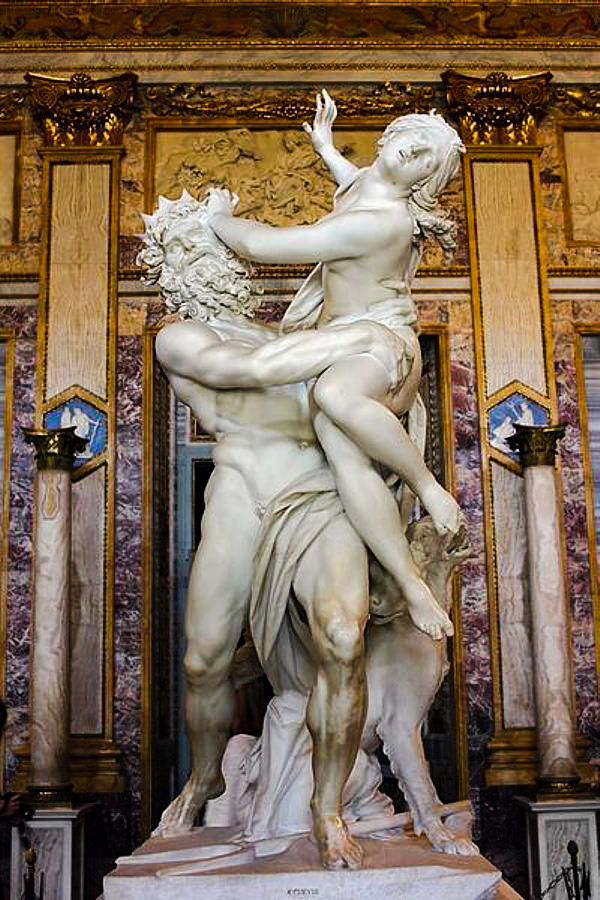
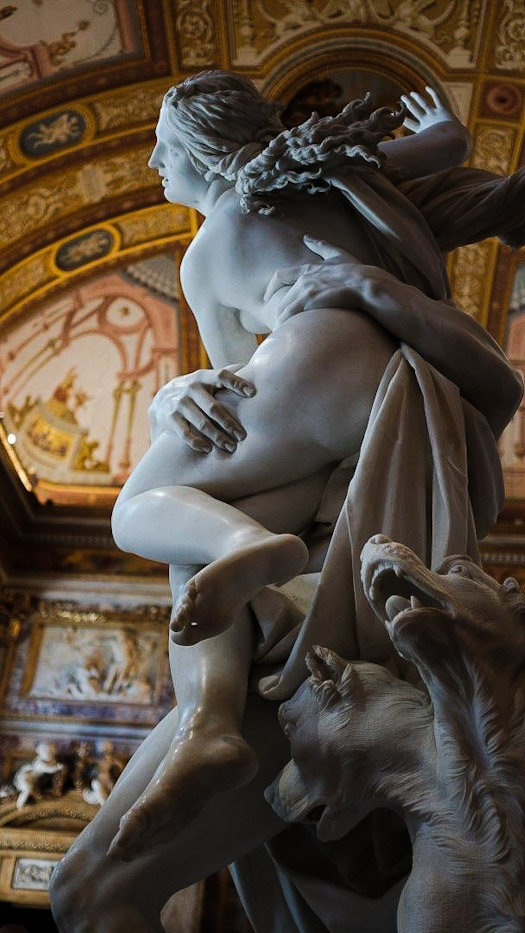
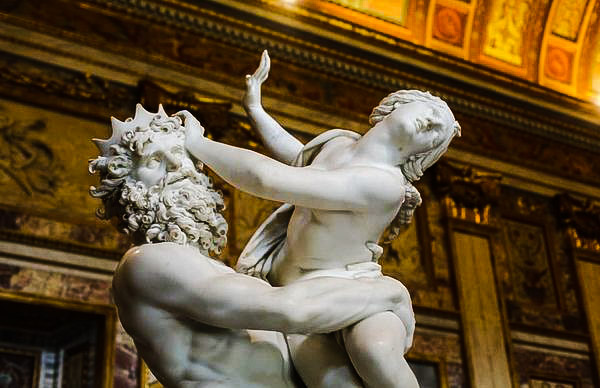
Spring then returned to the earth and would do so every year when Persephone returned to her mother. To further show her goodwill toward mankind, Demeter gave another of Celeus’ sons, Triptolemus, the first grain of wheat and lessons on how to plow and harvest. With this knowledge, the man traveled the world spreading agriculture. Bernini created The Abduction of Proserpina between 1621 and 1622. Although this sculptor born in Naples was only 23 years old at the time, he was already successful as a rising artist. St. Peter’s Basilica, his architectural masterpiece, would not be completed until 40 years later; however, Bernini was already very popular thanks to four of his most famous works: David; Aeneas, Anchises and Ascanius; Apollo and Daphne; and of course, The Abduction of Proserpina. With a height of 2.25 meters, the piece is carved in Carrara marble, a material from Tuscany historically used by ancient Roman builders and later by Renaissance and Mannerist artists. The softness of this high-quality marble was ideal for Bernini’s style, since he "prided himself on being able to give marble the appearance of flesh." And he certainly achieved it.
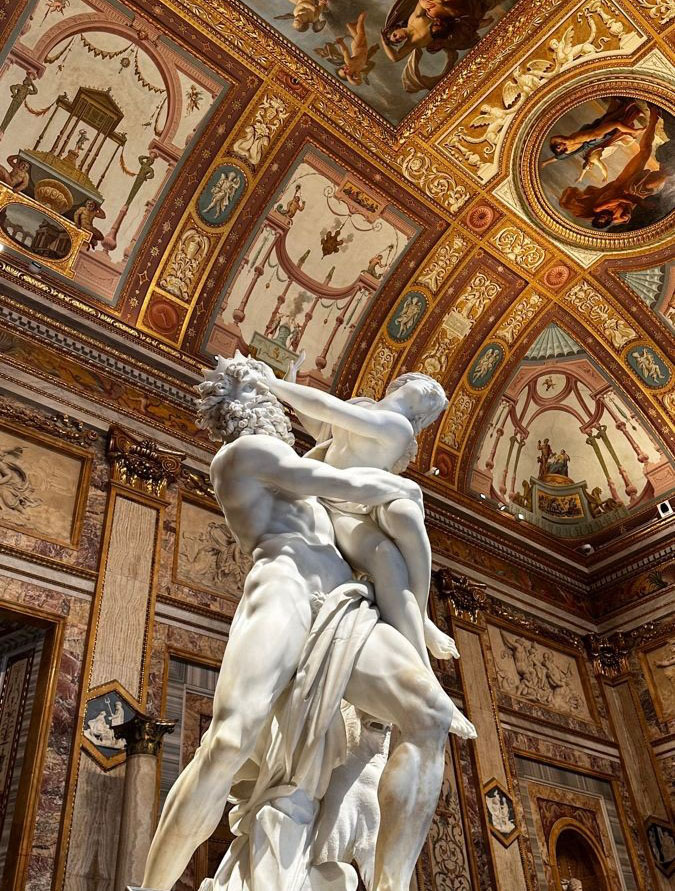
THE ARTWORK
The Abduction of Proserpina
Gian Lorenzo Bernini
1621–1622
Material: Carrara Marble
Baroque
Location: Borghese Museum