

In a gallery of the Metropolitan Museum of Art sits a naked man on a rock, biting his fingers. Around him, four boys cling to his body and plead for something no father should ever have to hear. He does not look at them. He looks elsewhere, at a point that exists only inside his head, as he decides whether hunger is stronger than love. The scene comes from a tower in Pisa, from a century of betrayals, and from one of the darkest cantos ever written.
The Count Who Had It All
Ugolino della Gherardesca was one of the most powerful men in thirteenth-century Pisa, a city of merchants and sailors that contested Genoa's control of the Mediterranean. He was a count, heir to an ancient family, and for years he pulled the strings of Pisan politics, switching sides whenever it suited him. Pisa was torn between Guelphs and Ghibellines, the two factions that divided half of Italy, and Ugolino, born into the latter, found it useful to draw close to the former.
In 1284 the Pisan fleet was crushed by the Genoese at the Battle of Meloria. It was such a brutal defeat that it marked the beginning of Pisa's decline as a maritime power. Ugolino, who commanded part of the fleet, was accused of having withdrawn from the battle and of betraying his city. Dante would further accuse him of handing Pisan castles over to enemy cities. Even so, the count survived politically, and by 1288 he was running Pisa almost as he pleased.
That was when he made his gravest mistake: trusting a man of the Church. Archbishop Ruggieri degli Ubaldini presented himself as his ally. But the city had had enough, and Ruggieri, who knew how to read the mood of the people, turned them against the count. In July 1288 a mob rose up, Ugolino was arrested, and the door of his life slammed shut. He himself would later tell, in Dante's hell, that he had trusted Ruggieri and that this was the beginning of everything.
The Tower of Hunger
Ugolino did not fall alone. Locked up with him were two of his sons, Gaddo and Uguccione, and two of his grandsons, Anselmuccio and Nino, known as il Brigata. They were shut into a tower in Pisa, the Gualandi tower, which popular memory would from then on rename the Tower of Hunger.
There is a detail worth keeping in mind. History speaks of two sons and two grandsons. Dante, however, calls them all sons and makes them young and innocent, almost children. Carpeaux, centuries later, followed Dante, which is why the marble shows four boys and not two sons and two grandsons.
What happened inside is known to us because Dante has Ugolino himself tell it, in Canto 33 of the Inferno. It is a first-person account, slow and chilling, that begins with a dream.
One night, before dawn, Ugolino dreamed of a wolf and its cubs fleeing across a mountain. They were hunted by lean, trained and eager hounds, led by a huntsman who was, in the dream, Archbishop Ruggieri. After a short chase, sharp fangs tore into the flanks of the wolf and its young. Ugolino woke before daybreak and heard his sons weeping in their sleep. They were asking for bread.
Then he heard something else. Down below, at the foot of the tower, someone was locking the door. They would never open it again. Ugolino looked at his sons without uttering a word. It was the hour when their food was usually brought, and the food did not come.
The whole day passed, and the night, and no one opened the door. When at last a ray of light slipped into the cell, Ugolino saw in four faces the reflection of his own, and bit both his hands in sheer anguish. The boys saw him, and thought he did it out of hunger. They rose suddenly and said to him, in words that Dante left written forever: "Father, we will suffer much less if you eat of us. You clothed us with this wretched flesh, and now you may strip it from us."
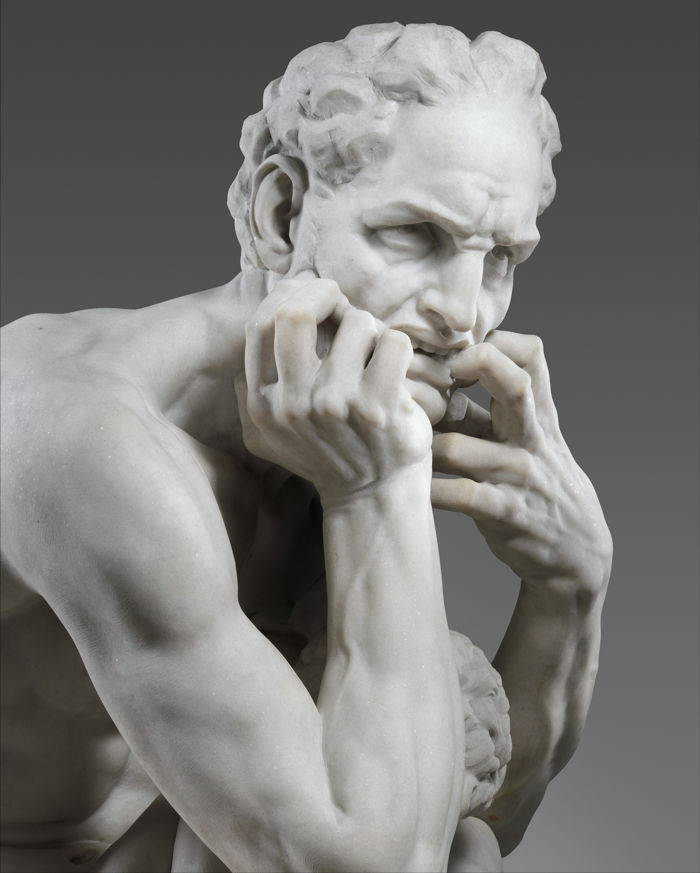
That is the scene Carpeaux sculpted. A father biting his fingers, and sons offering themselves as food.
Ugolino calmed himself so as not to sadden them further. For that day and the next, they all fell silent. On the fourth day, Gaddo, one of his sons, threw himself at his feet with his arms outstretched and said: "My father, why do you not help me?" He died right there, at his feet.
The others fell one after another, between the fifth day and the sixth. Ugolino watched all three fall, one by one. Already blind, he crawled groping over each of the bodies. For two days he called out to his dead sons, with the absurd hope that one of them might answer. None did.
And then comes the line that has haunted readers for seven centuries: "Then, more than grief, hunger had the power." Dante does not clarify what he meant. It may mean that hunger finished off Ugolino, that he died of starvation after his sons. It may mean something far worse: that necessity ended up overcoming grief and that the father did what the boys had offered. The question never had an answer. There is no historical evidence that it happened, and Dante, with cruel mastery, left it open.
What Did Ugolino Do to Deserve This Punishment?
For Dante, Ugolino was no mere martyr. He was a traitor, and traitors to their homeland occupied a very particular place in hell: Antenora, the second zone of the ninth circle, a lake of ice where the damned are fixed up to their necks, freezing forever.
When Dante finds him there, Ugolino is not alone. He shares the same hole in the ice with another damned soul, and is devouring him from the back of the neck, like someone gnawing a bone. He lifts his mouth from that "fierce meal," wipes his lips on the hair of the head he chews, and tells his story to the visitor. The other damned soul is Ruggieri, the archbishop who locked him away.
The scene has a perfect cruelty. The man who, in the tower, perhaps did not dare to eat his sons, spends eternity gnawing the skull of the man who condemned him to that hunger. And yet Dante does something unsettling: he condemns Ugolino as a traitor, but gives him the floor to tell of his pain. At the end of the tale, the poet erupts against Pisa: "Ah, Pisa, shame of the peoples." He calls for the islands of Capraia and Gorgona to move and block the mouth of the Arno, so that the river drowns every one of her inhabitants. Even if Ugolino was guilty of treason, he says, they should never have crucified his sons like that, innocent as they were by their tender age.
The Sculptor Who Carried It Into Marble
Almost six centuries later, a young French sculptor became captivated by that story. Jean-Baptiste Carpeaux, born in Valenciennes in 1827, won the Prix de Rome in 1854 and settled in Italy, where contact with the work of Michelangelo marked him forever. There, around 1858, he conceived the idea of sculpting Ugolino and his sons.
His life was a hard one, with troubles of health and spirit, and perhaps that is why he understood better than others the pain he wanted to sculpt. He began with a plaster model, which he completed in 1861 and which is now kept in the Petit Palais in Paris. In 1862 he made a bronze version, which is in the Musée d'Orsay. And finally he carved the marble version, the most imposing of them all, which today is in the Metropolitan Museum of Art in New York.
Five Bodies and a Single Instant
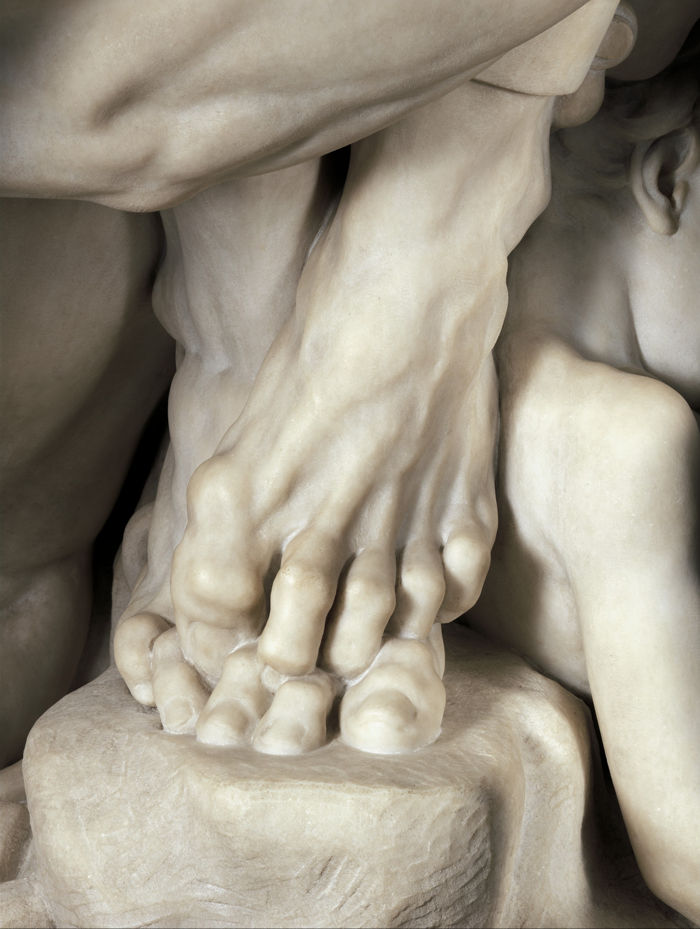
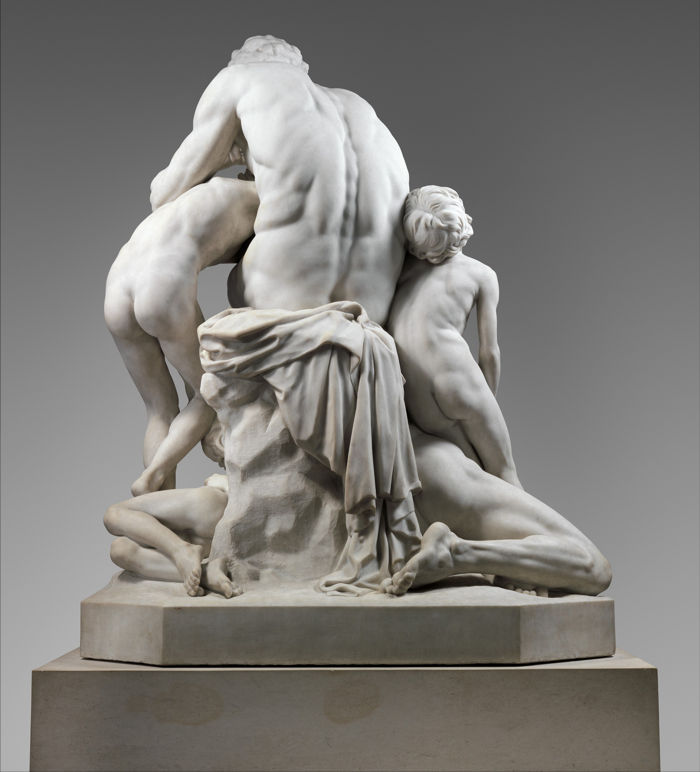
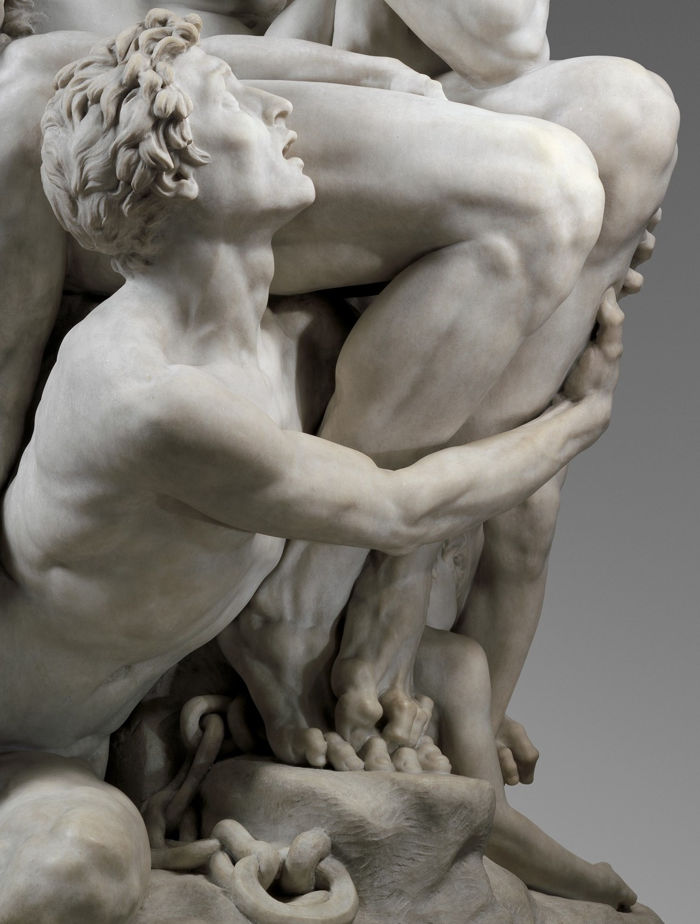
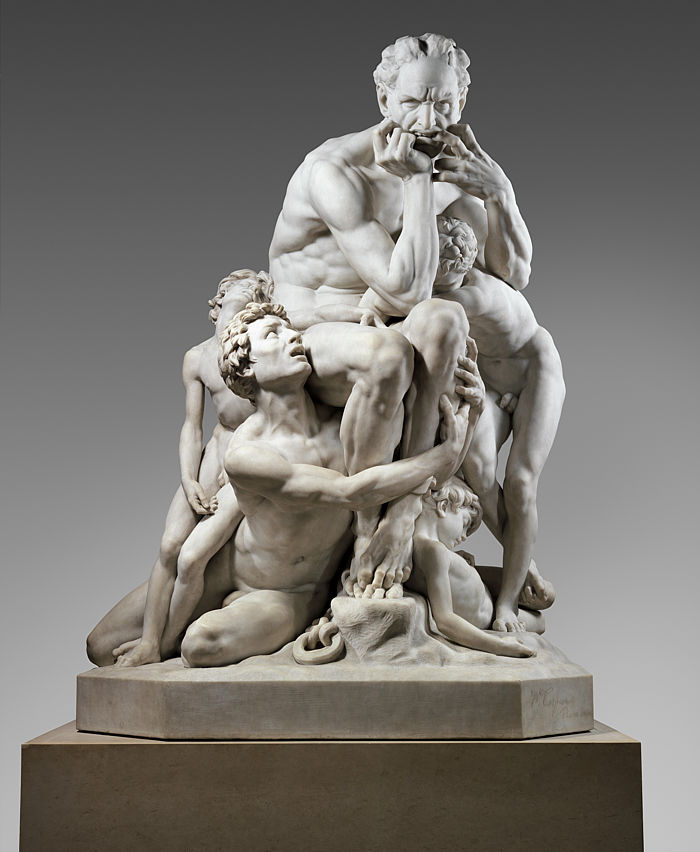
Carpeaux did not choose the moment of death or of torture. He chose the hardest instant: the one just before the father decides. Ugolino sits leaning forward, his feet one on top of the other. He bites his fingers and pulls his lip down with them. He rests his head in the palm of his hand. His gaze is lost in the distance, desperate, as if he were contemplating the consequences of his sins. It is a muscular body, despite the fact that he is starving. And even so, the sculptor makes his suffering visible in the curve of his spine and in the toes, twisted by agony.
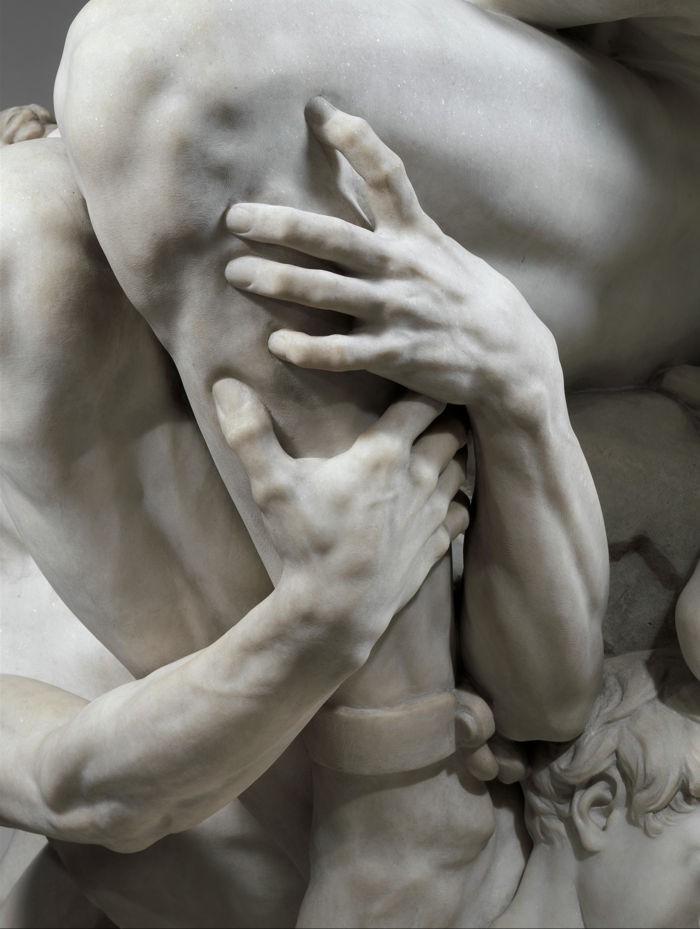
Around him, the four sons are in different states of suffering, and all of them beg for the same thing. The eldest seems the most energetic, and digs his fingers into the flesh of his father's leg to stress his plea. The second one on the right also holds him with both hands. The second youngest, on the left, sits on top of his older brother and has already lost almost all the energy he had left, his left arm resting on his father's leg. And below, on the right, is the youngest, the only one with a peaceful expression. And that peace is the worst of all, because he already seems dead.
The hardest thing to do in a sculpture is to tell a story, and Carpeaux succeeds. He sculpted skin, muscles and veins with extreme realism, and expressed very different emotions in each of the bodies. The more you look at the details, the more alive they seem. And while the sons cling to him, Ugolino ignores them. He is somewhere else, inside his own head, facing a question that the marble does not answer.
A curious detail: at the Metropolitan, the sculpture is located very close to the entrance of the Petrie Court Café. It is ironic that a work about hunger should be so close to a café. And nearby there is another work marked by hunger: Rodin's The Burghers of Calais, the bronze group showing six notables of the city of Calais who surrendered with nooses around their necks to save their besieged, starving city.
THE WORK
Ugolino and His Sons
Jean-Baptiste Carpeaux
1860
Marble sculpture
The Metropolitan Museum of Art, New York.