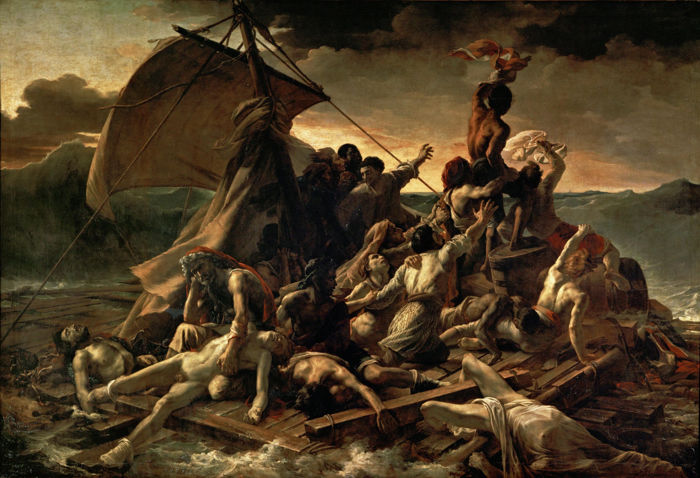


Despair is everywhere. The sea devours them. A small raft trembles beneath broken waves. A man clings on, his eyes wide with fear. A mother holds her child tightly. One arm still reaches out. This is not a fictional scene. It is the central image of one of the most brutal and modern paintings of the 19th century: The Raft of the Medusa, by Théodore Géricault. A work that does not merely depict a shipwreck, but political failure, the incompetence of power, and the extreme fragility of human beings when civilization disappears.
1816: The Shipwreck France Wanted to Forget
In 1816, the French frigate Méduse set sail for Senegal. France had just regained the colony after Napoleon’s fall and the Bourbon Restoration. The ship’s captain was chosen not for experience, but for political loyalty. He was an aristocrat who had not sailed in over twenty years. The decision was an act of state nepotism.
The result was catastrophic.
The ship ran aground off the coast of Mauritania. There was no heroic storm or glorious battle: there was incompetence. Unable to evacuate everyone using the available lifeboats, an improvised raft about twenty meters long was built. Approximately 147 people were abandoned there: soldiers, sailors, and civilians.
The officers and privileged passengers occupied the lifeboats. The raft was tied to them… but soon the rope was cut.
Survivors surrendered to fate.
Thirteen Days in Hell
The raft drifted in the open sea. Without sufficient food, without drinking water, without direction. The sun burned during the day. The cold bit at night. Salt opened wounds in their skin. Hunger and thirst began to break down not only bodies, but morality.
There were mutinies. There were murders. There were suicides. And finally, there was cannibalism.
After thirteen days, when the ship Argus found the raft by chance, only fifteen people were still alive.
The scandal shook France. The tragedy became a symbol of political corruption and institutional abandonment. And a young painter, only 27 years old, decided that this story should not be softened or turned into a decorative scene.
Géricault: Painting the Uncomfortable Truth
Théodore Géricault did not choose a classical myth or a biblical scene. He chose a contemporary, uncomfortable, politically explosive event. He researched obsessively: interviewed survivors, studied corpses in the morgue, built a scale model of the raft in his studio, and analyzed decomposing bodies to understand how death alters anatomy.
He wanted truth. Not invented heroism.
In 1819, he presented The Raft of the Medusa at the Paris Salon. The canvas was enormous, nearly five meters wide. The viewer does not observe the scene from a distance: you are inside it. You are on the raft.
A Composition That Pulls You In
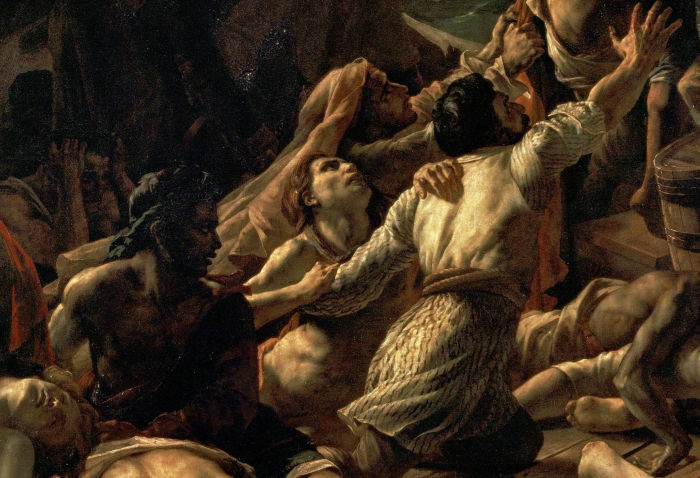
The painting does not show the moment of the shipwreck or the final rescue. It shows the in-between moment. The cruelest one. When they still do not know whether anyone will see them.
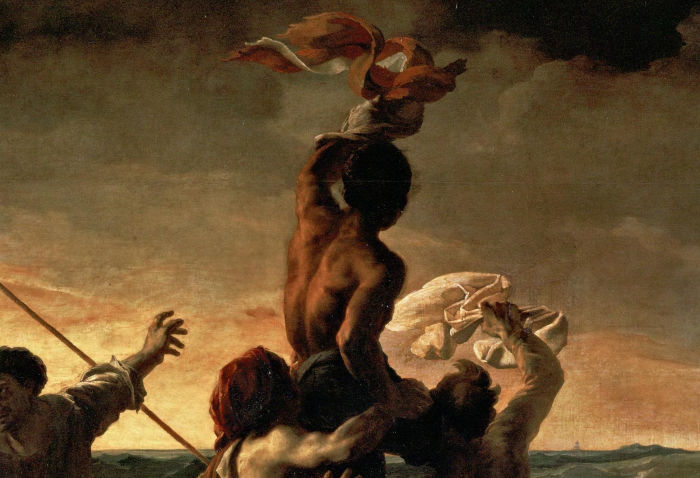
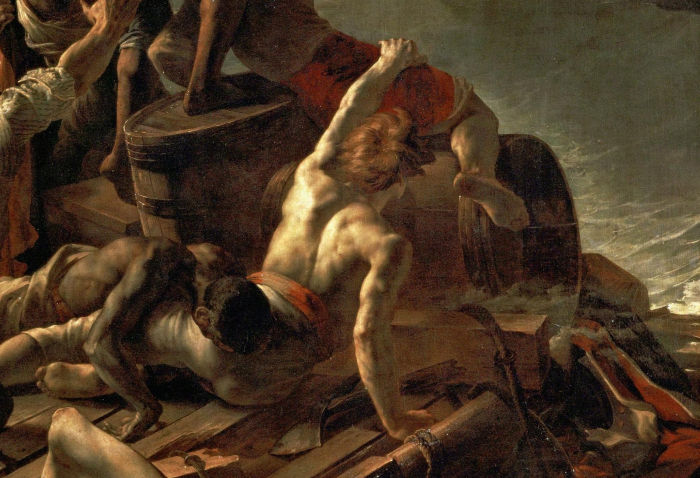
The structure is pyramidal and dynamic. At the base, the dead and dying bodies. Pale flesh, lifeless limbs, physical defeat. Above them, the survivors still fighting. And at the peak, a man waves a cloth, signaling to a tiny ship on the horizon.
One arm still reaches out.
That ascending diagonal represents the minimal hope that still survives. But the horizon is uncertain. The ship is barely visible. There is no guarantee of salvation.
Despair is everywhere.
Human Details That Hurt
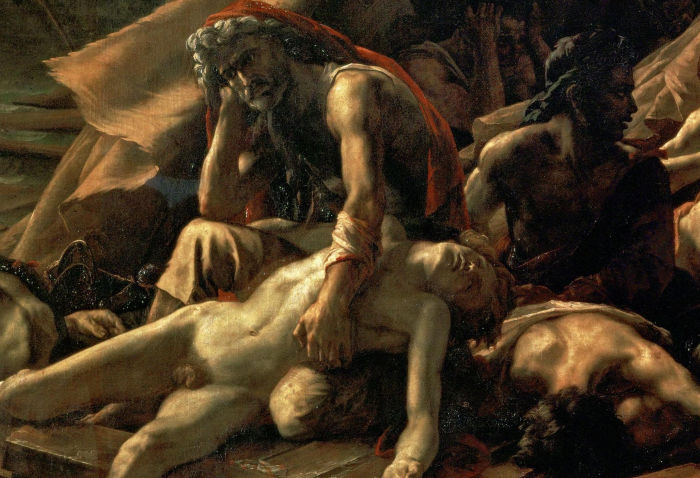
A man clings to the wood, eyes bulging in terror. Another holds the lifeless body of his son, inevitably recalling Christian iconography that here loses any promise of redemption. A mother protects her child as if her embrace could stop the ocean.
There are no classical heroes. There are exhausted bodies. Skin stretched by hunger. Muscles contracting in fear.
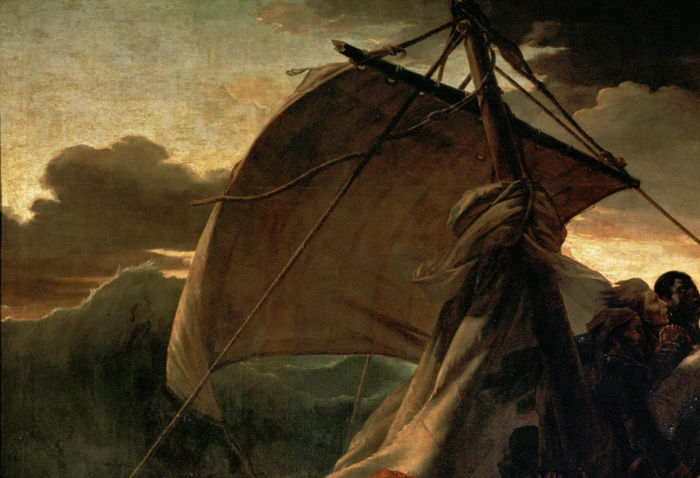
The sea is not romantic blue. It is thick, greenish, heavy. The waves are not decorative: they threaten. Every wave threatens them.
The sky offers no comfort either. It is turbulent, unstable. The light strikes the bodies as if examining them. It is not divine light; it is clinical, almost forensic.
Romanticism, Without Idealization
The work belongs to Romanticism, but not to sentimental romanticism. There are no picturesque ruins or tragic heroes posing elegantly. There is real flesh. There is political suffering. There is accusation.
Géricault transforms Romanticism into something modern: the artist as a critical witness to power.
The painting was controversial. Some considered it obscene. Others saw it as a revolutionary masterpiece. Over time, it became one of the most powerful images in Western art.
Politics, Power, and Abandonment
What makes this work even more forceful is its context. It was not an inevitable natural disaster. It was the result of human decisions. Of misplaced privilege. Of incompetence protected by power.
The raft is not just floating wood. It is a metaphor for the State when it abandons its people.
The painting forces the viewer to ask an uncomfortable question: who cut the rope?
Because someone cut it.
The Modernity of Despair
Two centuries later, the image remains relevant. Forced migrations, fragile boats, people drifting between political borders and real seas. The painting does not belong only to 1816. It belongs to any moment when a group of human beings is left to their fate.
That explains its permanence. It is not just art history. It is collective memory.
When you look at The Raft of the Medusa, you are not simply observing a past tragedy. You are confronted with the question of how much a life is worth when power decides it is worth nothing.
The Final Impact
The cold bites. Hope fades.
But at the top, at the apex of that human pyramid, one body still rises. One arm still reaches out. That gesture summarizes the entire work: the instinctive struggle to live even when everything suggests death is more likely.
That is what makes this painting more than a historical representation. It is the visual anatomy of despair… and at the same time, the minimal anatomy of hope.
When you stand before this monumental canvas, you are not facing a simple maritime scene. You are facing painted evidence that art can denounce, disturb, and force us to look at what we would rather ignore. The raft is still floating. And we are still watching it.
THE ARTWORK
The Raft of the Medusa (Le Radeau de la Méduse)
Théodore Géricault
Year: 1818–1819
Technique: Oil on canvas
Dimensions: 491 × 716 cm
Location: Louvre Museum, Paris (France)