

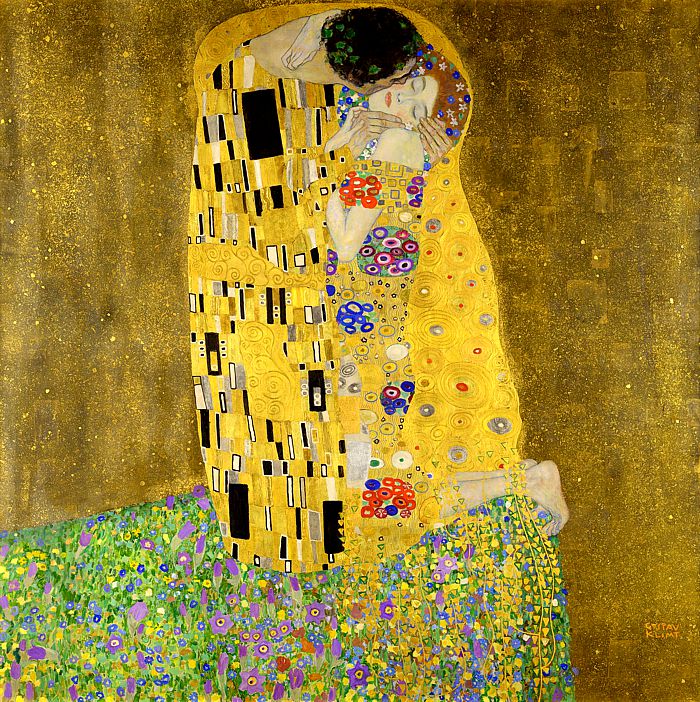
The Kiss is an oil painting with added gold and silver leaf by the Austrian Symbolist painter Gustav Klimt. Its German title, Liebespaar, means: Lovers. It is considered a masterpiece of the early modern period, an icon of Jugendstil — Viennese Art Nouveau — and is regarded as Klimt’s most popular work.
What the painting does not say, but shows
Before speaking about technique or history, something happens when you stop in front of this painting. Or in front of a screen, in one of those moments when an animated image brings it back to life.
He hesitated for years. She waited. Not for the kiss, but for his decision.
At the edge of the precipice, he wraps her in gold. As if true love needed to be protected from the world in order to exist. She closes her eyes, not in pleasure, but in relief. At last.
This is the secret heart of The Kiss: it is not a scene of overflowing passion. It is the portrait of waiting. Of someone who finally arrives, and of someone who can finally release the weight of uncertainty.
Klimt painted what is rarely named: the moment when love stops being a promise and becomes certainty.

The painting
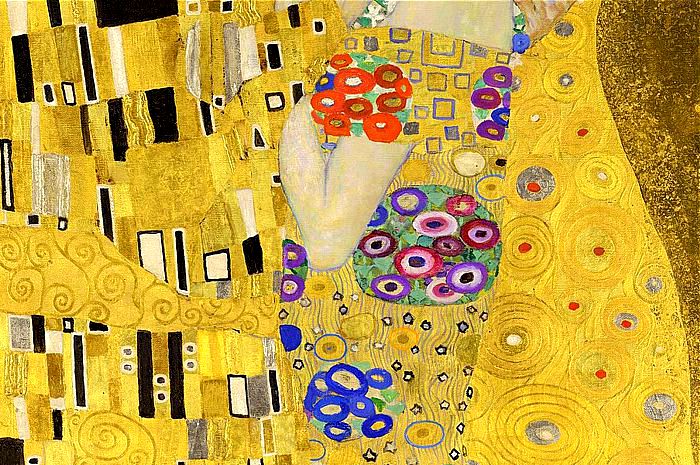
The painting depicts a couple embracing in a field of flowers. The man leans over the woman, and she, pressed tightly against him, waits for his kiss. The male figure is characterized by square and rectangular forms, while the female figure is dominated by soft lines and floral motifs.
A golden halo surrounds the couple, who seem to have shaken off earthly weight and transported themselves into an infinite, almost sacred sphere.
Klimt represents the couple enclosed in intimacy, while the rest of the painting dissolves into flat, brilliant and extravagant patterns. The pattern has clear links with Art Nouveau and the organic forms of the Arts and Crafts movement. At the same time, the background evokes the conflict between two-dimensionality and three-dimensionality intrinsic to the work of Degas and other modernists.
Gold as language
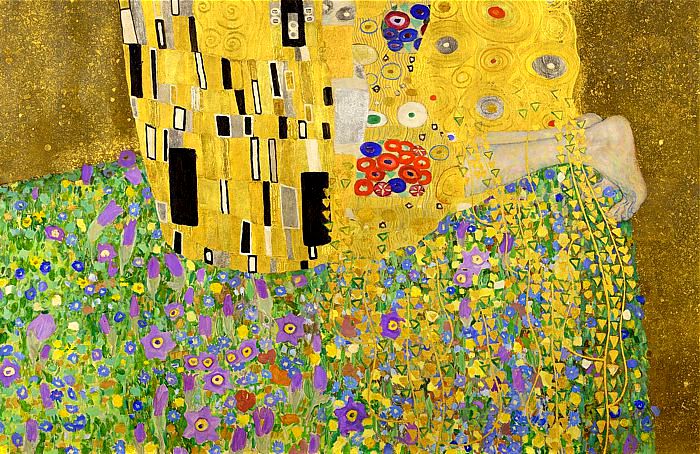
Paintings like The Kiss were visual manifestations of the spirit of the fin de siècle because they capture a sense of decadence conveyed through opulent and sensual imagery. But gold in Klimt is not decoration: it is an argument.
The use of gold leaf recalls medieval paintings with "golden backgrounds" and illuminated manuscripts, earlier mosaics, and the spiral patterns in the garments recall Bronze Age art and decorative tendrils seen in Western art long before the classical era.
Klimt learned from the mosaics of Ravenna, which he visited in 1903. Those fragments of glass and gold that had survived centuries marked him deeply. In The Kiss, the gold does not shine because of wealth: it shines because Klimt wanted to say that this moment is eternal. That this embrace belongs to all times.
Who is she?
There have been numerous attempts to identify the woman portrayed in The Kiss. Suggested candidates include Klimt’s lifelong companion Emilie Flöge, but also Adele Bloch-Bauer. The well-proportioned facial features of the subject reveal similarities with many of the women portrayed by Klimt, but ultimately they cannot be attributed unequivocally to any particular person.
Emilie Flöge was for decades his companion, his muse and perhaps his most enduring love, although the exact nature of their relationship remains a mystery. Klimt was a man of multiple passions; dozens of lovers and several unacknowledged children have been attributed to him. But with Emilie it was different. She knew him completely, with both his greatness and his shadows.
Perhaps that is why the female figure in The Kiss has no name. Because Klimt painted the love he wanted to have, the love he struggled to choose, the love that exists when one finally dares.
"It is not only a painting about love. It is a painting about the courage to love."
The symbolism of the position
There is a detail that few people notice at first glance: she is kneeling at the edge of a flowered precipice. Beneath her feet, the ground ends. He leans toward her from solid land. And yet, she appears calmer.
This tension is not accidental. Klimt places the woman at the literal edge of the known world. One step further and she would fall. And still, she closes her eyes. She trusts. She surrenders not from weakness, but from a strength that only exists once fear has been overcome.
The man, by contrast, bends toward her. He abandons his verticality, his geometric rigidity. To reach her, he must yield something of himself. The kiss, then, is not possession: it is encounter. Two worlds leaning toward each other in the only instant when both decide the same thing.
The moment the painting entered the world
When Klimt first presented the painting to the public in 1908, it was purchased — still unfinished — directly from the exhibition of the Austrian Gallery. The reaction was immediate. Vienna, a city in the midst of intellectual and artistic upheaval, recognized in that image something it did not know it needed to see.
It was the year of the Kunstschau, an exhibition that brought together the most revolutionary Viennese art. Klimt organized it with his closest collaborators. The Kiss was the central piece, literally and in every sense. It hung like a secular altar in a city that had begun to question its own certainties.
This painting represents the centerpiece of the world’s largest collection of works by Gustav Klimt, housed at the Austrian Gallery in the Upper Belvedere Palace in Vienna. Today, more than a century later, the lines to see it remain long. People come from every corner of the world, they stop, and something happens.
Because there are works that explain art. And there are works that explain something about ourselves. The Kiss belongs to the latter.
THE ARTWORK
The Kiss
Gustav Klimt
Year: 1907–1908
Technique: Oil on canvas
Style: Symbolism
Size: 180 cm × 180 cm
Location: Österreichische Galerie Belvedere, Vienna, Austria