

There are universal images that form part of our collective history, and one of the most iconic is undoubtedly Leonardo da Vinci's The Vitruvian Man. This illustration, repeated and reinterpreted throughout the centuries, is much more than a simple drawing: it is a symbol of the intrinsic connection between art, science, and philosophy. Created around 1490, this work reflects not only Leonardo's insatiable curiosity but also his commitment to the search for perfection and the universal laws that govern both the human body and the universe.
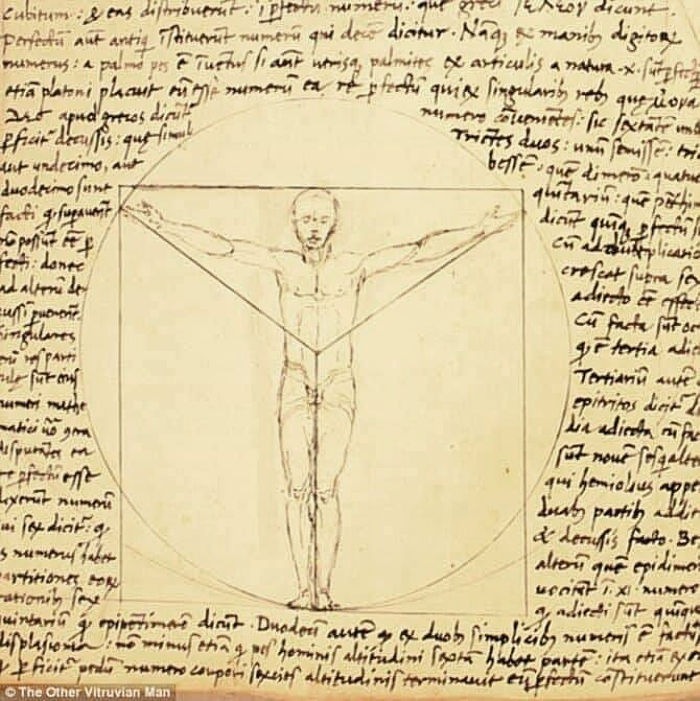
The Vitruvian Man is a visual representation of the text by the Roman architect Vitruvius, whose work De Architectura explored the ideal proportions of the human body and its relationship to the classical orders of architecture. For Vitruvius, the human figure was a perfect model of proportion and symmetry, a micro-representation of the cosmos. Leonardo, fascinated by this idea, undertook a detailed study that combined anatomical observation with mathematical and geometric concepts.
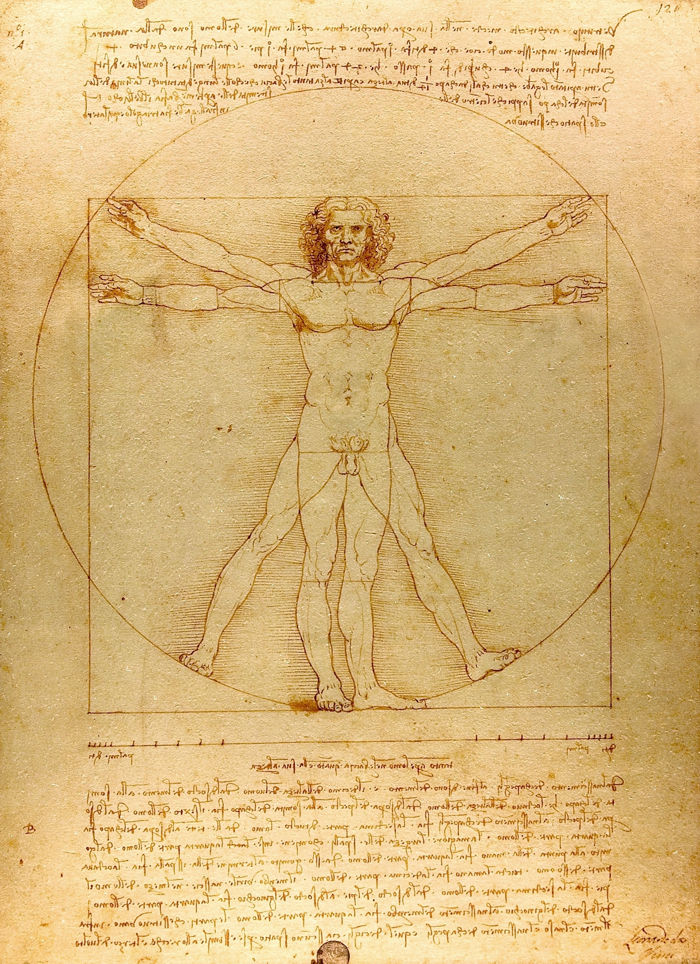
The drawing shows two human figures superimposed in slightly different positions, inscribed within a circle and a square. These geometric shapes symbolize the divine and the terrestrial: the circle represents the heavens, the infinite, while the square denotes stability and the tangible. For Leonardo, the ability of the human body to fit into both shapes was a demonstration of the microcosm theory, which held that the human being reflected in its design the same laws that structure the universe.
One of the most intriguing features of The Vitruvian Man is Leonardo's mirror writing, used in the annotations accompanying the drawing. This style of script, which appears reflected in a mirror, was typical of Da Vinci's personal notebooks. It is believed that Leonardo used it as a way of encrypting his ideas, ensuring that only those curious or patient enough could decipher them.
Leonardo's text adapted and expanded upon the proportions described by Vitruvius, including his own observations based on his anatomical studies. Among the most notable annotations are rules such as:
- Four fingers make one palm.
- Four palms make one foot.
- Twenty-four palms make a complete man.
- The distance from the navel to the floor is equal to half the height of the man.
These proportions are not just a mathematical exercise, but a philosophical exploration of the intrinsic harmony between the human body and the natural world.
The Golden Ratio and Sacred Geometry
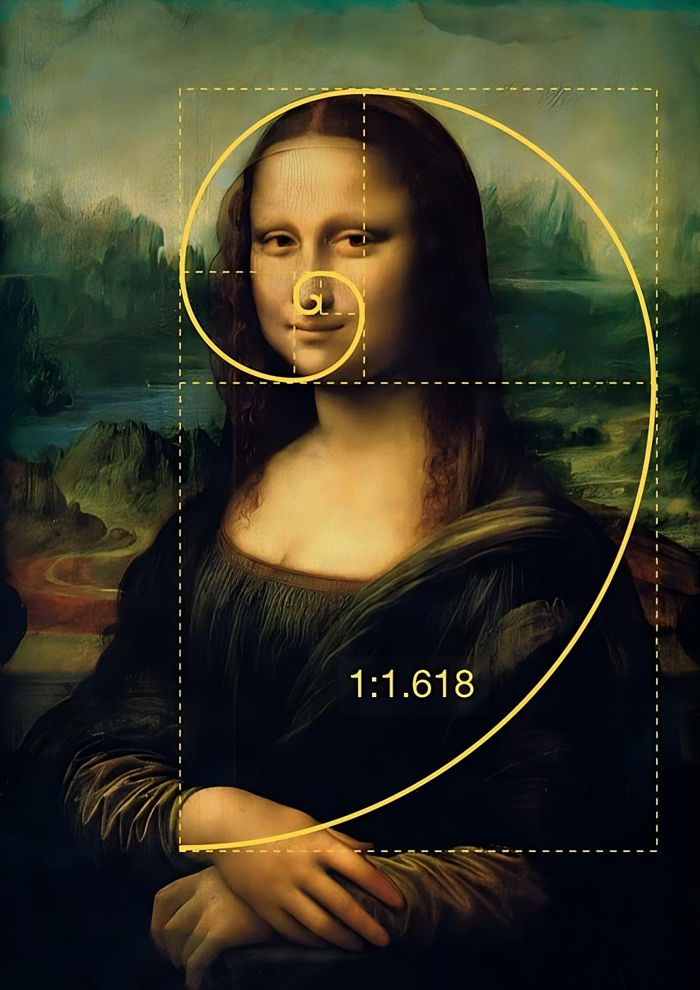
The influence of the Golden Ratio (Phi, $\Phi$), also known as the divine proportion, is evident in Leonardo's work and in his conception of The Vitruvian Man. This number, related to the Fibonacci sequence, appears consistently in nature, art, architecture, and design. From the shapes of seashells to the proportions of the human face, the Golden Ratio is a constant that reflects the underlying order in the world's apparent chaos.
In The Vitruvian Man, the arrangement of the limbs and the placement of the navel as a geometric center reflect this perfect proportion. Leonardo did not just illustrate Vitruvius' theories; he integrated them into his own framework of thought, which combined art, science, and spirituality.
Sacred Geometry, a tradition that attributes symbolic meanings to specific shapes and proportions, is also present in this work. For Leonardo, geometry was not just a mathematical tool, but a way of understanding and representing the world. This approach is evident in his other works, such as The Last Supper and The Mona Lisa, where the proportions and compositions reflect a carefully studied balance and an obsession with mathematical perfection.
A Symbol of Humanist Renaissance
The Vitruvian Man is not merely an anatomical study; it is a philosophical statement that encapsulates the spirit of the Renaissance. In this era, the intellectual movement of Humanism placed the human being at the center of knowledge, seeking to reconcile faith and reason, and exploring man's place as the measure of all things (Homo Mensura).
Leonardo da Vinci was a true Renaissance man, one who combined seemingly disparate disciplines to create something entirely new. The Vitruvian Man is a perfect example of this integrative vision. Through this drawing, Leonardo not only explored human proportions but also reflected on man's place in the universe and his relationship with natural laws.
Today, The Vitruvian Man is much more than a sketch in one of Leonardo's notebooks; it is a universal symbol. It represents the human pursuit of knowledge, balance, and connection with the world around us.
The drawing remains a subject of study, not only for its aesthetic beauty but also for the mathematical and philosophical secrets it holds. Researchers have analyzed the proportions and rules of composition, seeking to unravel the precise relationship between the human body and universal laws. There has been much debate about why the two figures (that of the circle and that of the square) do not share the same center: the navel is the center of the circle, while the groin is the center of the square. This subtle difference underscores the difficulty of perfectly reconciling the geometric ideal with anatomical observation, a dilemma that only Leonardo's mind was capable of representing so eloquently.
Observing this work, it is impossible not to feel admiration for the mind behind it. Leonardo da Vinci managed to combine science, art, and spirituality in a way that continues to resonate centuries later. His Vitruvian Man is not just a representation of human proportions, but also a reminder of our capacity to connect with something larger than ourselves.
The Vitruvian Man is much more than an iconic drawing; it is a deep exploration of the relationship between art, science, and nature. Through this work, Leonardo da Vinci invites us to reflect on the universal proportions that unite us as human beings and our connection with the cosmos.
Like its creator, this illustration is a bridge between disciplines, uniting the physical world with the metaphysical, the earthly with the celestial. In The Vitruvian Man, we find not only a symbol of the Renaissance but also an eternal reminder of our quest for balance, knowledge, and transcendence.