

Hecate, the Greek goddess of three faces, is a truly special figure who defies the logical and structured order of the ancient cosmos. Unlike the Olympian gods who have clearly defined domains, she moves in the shadows of transitions. Specifically, she does not fit into the Greek order at all because she is the very embodiment of change. The lunar phases, the paths that cross, the doors and thresholds represent this principle of constant mutation that the goddess unwaveringly enforces in her own way.
She is a singular goddess because she has no direct opponents nor does she engage in the typical bedroom or power squabbles of the other gods; on the contrary, she is deeply valued and recognized by all of them. Even the powerful Zeus held an almost reverential respect for her, allowing her to retain her powers over the land, the sea, and the sky—a sovereignty she inherited from her ancestors, the Titans. But Hecate does not fit into the conventional distribution of roles either. She arrived in Greece from the wild lands of Caria, in Asia Minor, as the goddess of the night and of the moon in all its forms. She is the lady of magic, of crossroads, and of those liminal moments where the past dies and the future is yet to be born.
The Mistress of the Paths and the Power of Change
Throughout the centuries, Hecate's image has undergone transformations as radical as those she herself represents. Crossroads are her natural territory, the place where her three-faced statues (called *hecataia*) were placed. In ancient times, a crossroads was not just a physical location, but a sign that something unknown was imminent. Hecate represents the power and the ability to change oneself; she teaches us that change is not something that happens to us, but a principle of life that we must learn to navigate.
In addition to the roads, Hecate zealously guards the thresholds and gates between worlds. In the daily life of a Greek family, her presence was essential at the doors and gates of houses to protect the home from wandering spirits. In this sense, she shares a fascinating similarity with the Roman god Janus, the two-faced one, who also presided over beginnings and endings. However, Hecate adds a darker and deeper nuance: she not only watches the entrance but also knows what lurks in the darkness outside.
From Mother Goddess to Queen of Witches
It is curious to observe how Hecate's origin in Anatolia placed her as a benevolent and powerful mother goddess. However, upon crossing into Greece, her nature became more mysterious and linked to the occult. Her cult spread in secret, far from the great public temples, in dark corners and during moonless nights. As a "magical woman," Hecate shares traits with the Egyptian Isis; both possess the keys to the underworld and the knowledge of words of power.
This connection with the realm of the dead is fundamental. Hecate is Persephone's guide during her annual ascent and descent to Hades, serving as a bridge between the world of the living and that of the shadows. She is the one who hears Persephone's cries when no one else can, proving that her hearing is tuned to frequencies that the other gods ignore. Therefore, she is in constant contact with mortals and deities who lead a shadowy existence in Hades, as we have already recounted on several occasions in Life is Art.
The Lunar Triad: Maiden, Mother, and Crone
The principle of eternal change is evident in her triple nature. Hecate is often confused with the moon itself, or as she was poetically called, "the sun of the night." Her presence is divided into three spheres of influence: in the sky she is Selene (the full moon), on earth she is Artemis (the virginal huntress), and in Hades she is Persephone (the queen of shadows). This triad represents the three phases of a woman's life: the Maiden (potentiality), the Empowered Woman (fulfillment), and the Wise Crone (knowledge and death).
In the oldest representations from Asia Minor, Hecate appeared enthroned and surrounded by lions, symbols of her dominance over wild nature. However, over time, those lions disappeared from the iconography, giving way to a more human but no less disturbing image.
The Evolution of an Image: From Beauty to Frenzy
In the classical period, the goddess was shown young and beautiful, carrying torches to illuminate the nocturnal paths. It was later, in the time of Socrates, that the figure of the triad was definitively consolidated in art. Imagine three young women standing back to back, forming a total surveillance column that leaves no blind spots. In their hands they originally held fruits, torches, and an amphora—symbols of provision and illumination.
With the passing of the centuries and the arrival of the medieval and Renaissance era, Hecate's attributes became much darker. Snakes appeared in her hair or hands, daggers to cut the threads of fate, ropes to bind wills, and keys to open the doors of forbidden knowledge. It was at this point that the goddess definitively became the patroness of witches and sorceresses.
The Frenzy of Jusepe de Ribera
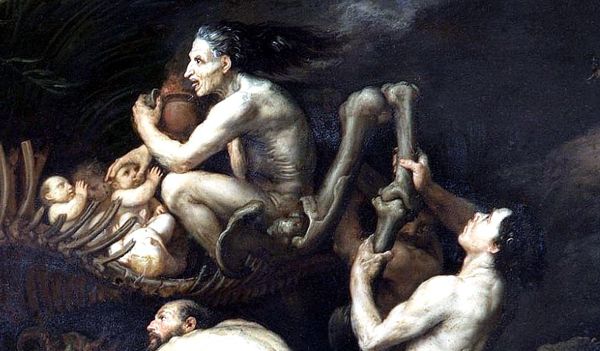
The work we share today is an exceptional and strange piece within the catalog of Jusepe de Ribera, "Lo Spagnoletto." It is believed to belong to his early period, before 1620, when the artist was exploring the limits of Tenebrism and the influence of other masters. Ribera, although born in Spain, developed his genius in Italy, absorbing both the strength of Caravaggio and the detail of the Northern schools.
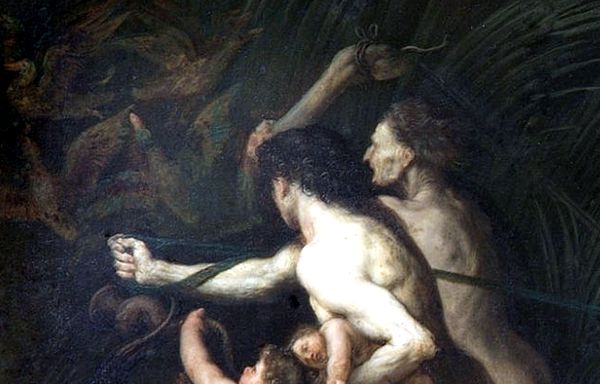
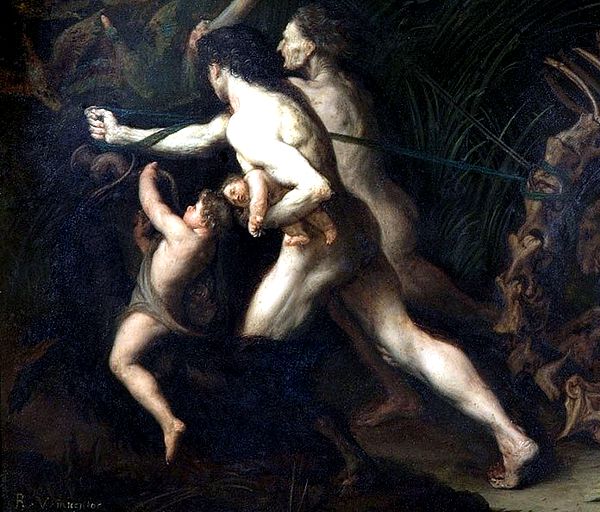
This oil on copper is an exact copy of an engraving by Agostino Veneziano, but Ribera gives it a much more disturbing life and atmosphere. The choice of support (copper) allows the skin tones to have an almost sickly luminosity, typical of Flemish influence. The work represents a procession of witches to the Sabbath, but the central figure is none other than a representation of Hecate in her most destructive and magical facet.
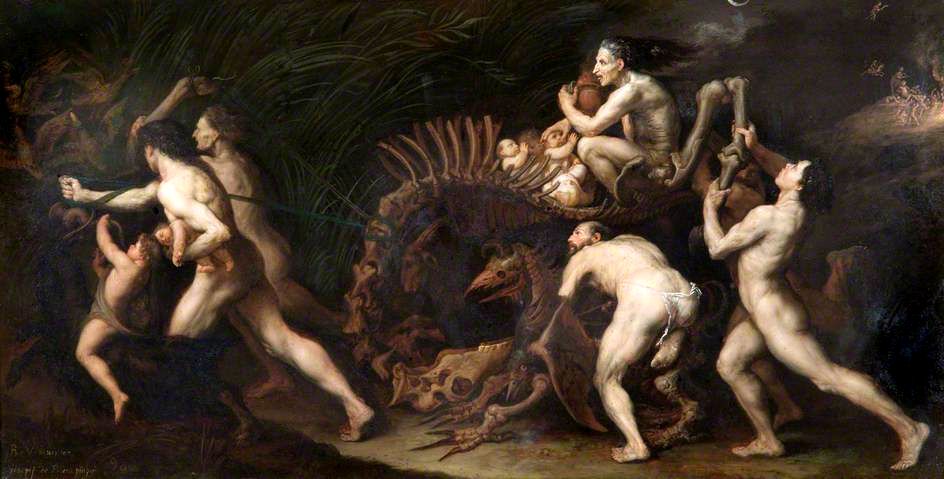
In the painting, we see the central figure mounted on the skeleton of a monstrous creature, an image that evokes the mastery of magic over death and decay. Behind her, an entourage moves in a mad frenzy of intertwined bodies, torches, and dark rites. It is not the serene Hecate of the Greek crossroads, but the Hecate who has been filtered by centuries of fear of the unknown and the persecution of witchcraft.
Hecate Today: The Return of the Goddess
Today, the figure of Hecate is experiencing a renaissance. In a world changing at breakneck speed, the goddess of transitions resonates strongly. She reminds us that being "between two worlds" or at a "life crossroads" is not a state of weakness, but a place of immense creative power. She is still there, holding the torch in the darkness, reminding us that to be born again, we must first accept the chaos of change.
If you ever find yourself in a moment of your life where you don't know which path to take, remember Hecate. She will not tell you which direction to choose, but she will give you the necessary light to see the obstacles and the key to open the door you decide to cross.
THE WORK
Witches' Sabbath (Procession of the Witches)
Jusepe de Ribera (Attributed)
Circa 1619-1620
Technique: Oil on copper
Dimensions: 34.3 cm x 65.5 cm
Location: Apsley House Collection, London