

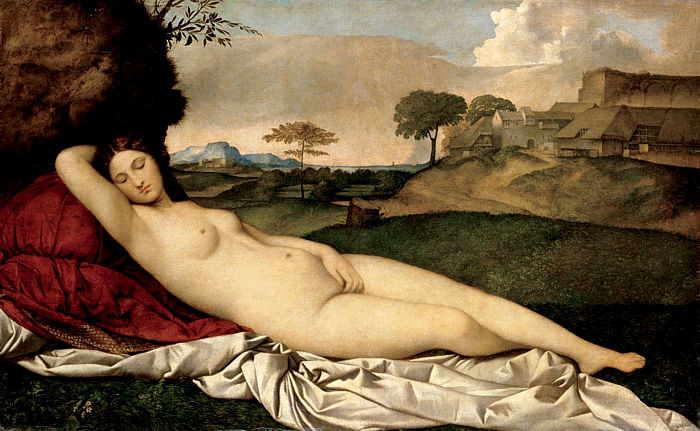
Sleeping Venus is a sensual and sumptuous work of art attributed to both the Venetian genius Titian and his master, Giorgione. Considered one of the first full-length female nudes ever painted in Venice, this representation of the goddess of love has been described as one of the most beautiful and enigmatic reclining nudes in universal art history.
Although he died tragically young from the plague, Giorgione was a defining figure in the High Renaissance movement. Little is known about his life: there is no clear documentation of his personal preferences or techniques, and there are hardly any records of who may have commissioned his works. However, his legacy is immense. Giorgione was responsible for a radical shift in the Venetian art scene, moving from being a brilliant student of Bellini to becoming the creator of an atmospheric and poetic style that prioritized feeling over rigid drawing.
Giorgione's works, such as The Tempest or The Sunset, already showed his interest in landscapes charged with mystery where nature seems to have its own soul. In Sleeping Venus, this concept reaches its maximum expression: the goddess is not simply placed upon the field, but seems to emanate from it, in a perfect harmony between flesh and earth.
Involuntary Collaboration: Giorgione and Titian
Titian was a devoted pupil and collaborator of Giorgione until the latter's death in 1510. It is known that Giorgione had begun working on his Venus around 1507, painting the main form of the figure and the luxurious silk and velvet sheets in which she is wrapped. After succumbing to the plague, the work remained unfinished in his workshop.
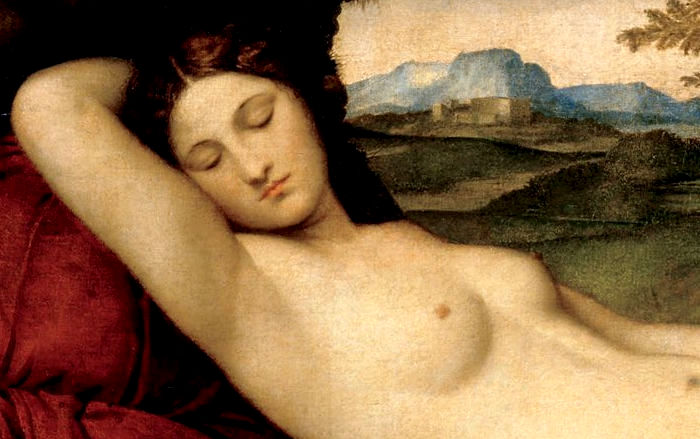
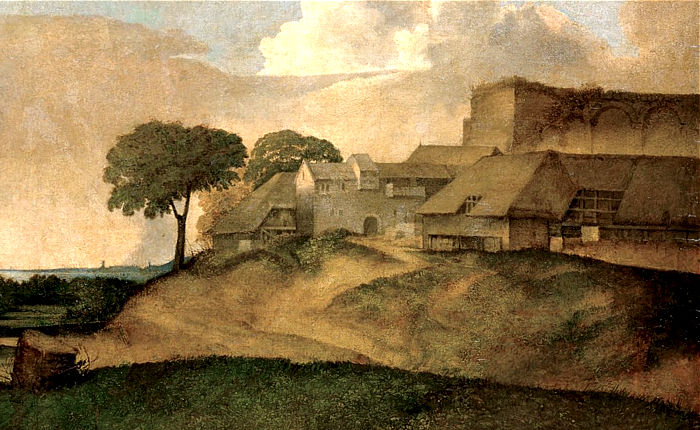
In general, critics accept that Titian finished the piece by painting the landscape in the background (with those hills that so closely resemble his native Cadore) and a cherub at the goddess's feet that was originally part of the composition. However, an X-ray analysis carried out in the 20th century revealed a shocking secret: the cupid painted by Titian was erased during a later restoration because it was in such poor condition that it was decided to cover it with the landscape. This detail changes the perception of the work, as originally Venus was not alone in the field, but accompanied by the symbol of desire.
Symbology and Nature: The Body as Landscape
What makes this painting revolutionary is the visual rhyme between anatomy and the environment. The curves of Venus's body almost exactly mimic the rolling, lush hills of the landscape behind her. Her raised elbow reflects a mountain peak, while the curve of her hip blends into the softness of the horizon. This technique seeks to convey that female beauty is an extension of nature's fertility.
Venus's pose suggests a sensuality that is not aggressive. Being asleep, the goddess is unaware that she is being observed; there is no active search for the viewer's pleasure. Her closed eyes protect her from the male gaze, allowing her to inhabit a space of introspection and absolute peace. Her right hand cradles her head in a gesture of total rest, while her left hand rests gently on her lap, a gesture that some historians interpret as a representation of "self-complacency" or simply as a symbol of instinctive modesty.
Hidden Curiosities: The Enigma of Identity
One of the lesser-known curiosities of this work is that, unlike other paintings of the time, there are no obvious divine attributes (now that the cupid is gone). If it were not for the traditional title, this woman could simply be a Venetian courtesan or an idealized bride. It is believed that the work was commissioned by Girolamo Marcello to celebrate his marriage, which would explain why the figure combines the purity of marriage (the white sheets) with the passion of fertility (the open landscape).
Furthermore, the use of color in the sheets is purely Venetian. The contrast between the satin white and the deep red peeking out from below is not accidental: it represents the balance between chastity and burning desire. Titian, in finishing the work, applied glazes that gave Venus's skin a warmth that seems to pulse, something Giorgione started but his disciple brought to technical perfection.
Lasting Impact: From the Odalisque to Olympia
Sleeping Venus established the canon of the reclining nude, a pose that was later repeated in Titian's own famous Venus of Urbino, although with one fundamental difference: the Venus of Urbino is no longer in nature nor asleep; she is in a bedroom and stares directly at the viewer, breaking the fourth wall.
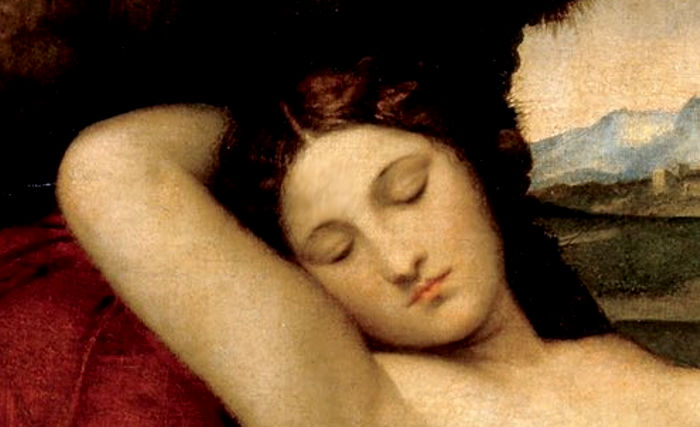
This format, also known as the odalisque pose, was the "safe" way artists painted women for centuries. By titling these figures as mythological goddesses, painters avoided censorship from the Church and society, justifying eroticism under the veil of classical culture. Artists like Bronzino, Artemisia Gentileschi, and Velázquez used this structure for their own interpretations of beauty.
However, Giorgione's legacy reached its breaking point in the 19th century. In Ingres's Grande Odalisque, the pose is stylized to the point of unreality, while Manet used it in the most subversive way possible in his Olympia. Manet took the exact composition of Giorgione and Titian's Venus but stripped the woman of any divine aura. His Olympia was a real woman, a Parisian courtesan looking at the viewer with shameless frankness, claiming her sexuality and destroying the myth of the passive, sleeping goddess.
The Eternal Dream
Undoubtedly, these iconic pieces were influenced by Sleeping Venus. The lasting impact of how Giorgione and Titian captured this moment of vulnerability remains one of the greatest influences on nude painting. The work is not only a triumph of Venetian aesthetics but a reminder that art is capable of stopping time. Venus remains there, caught in her eternal dream, reminding us that the deepest beauty is that which does not need to be aware of itself to dazzle the world.
THE WORK
Title: Sleeping Venus
Artists: Giorgione and Titian
Style: High Venetian Renaissance
Year: circa 1507-1510
Technique: Oil on canvas
Location: Gemäldegalerie Alte Meister, Dresden, Germany