

There is something that changes when we learn the story behind Vincent van Gogh's sunflowers. They stop being simply flowers. They stop being that intense yellow we instantly recognize as his.
Because during those days in August 1888, while Vincent was painting in Arles, the sunflowers were tied to something much bigger: a house, a friend who had not yet arrived and the dream of turning that place into a refuge for artists. And all of this was written down in his letters.
A Yellow House in Arles
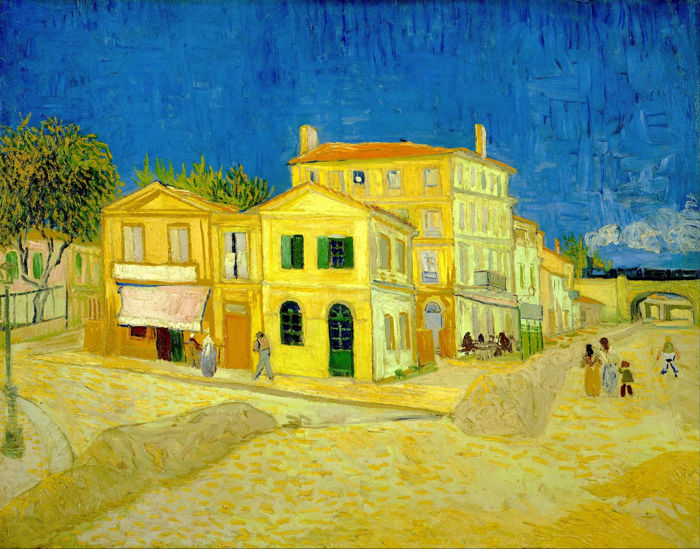
Vincent had come to Arles looking for light, color and a different way of working. There he rented several rooms in a house that would soon be known as the Yellow House.
But Vincent did not simply want a place to live. He wanted to share it. For a long time he had imagined a kind of community of artists. A place where painters could live and work together, far from the loneliness he considered so harmful to them.
And there was someone he especially wanted there. Paul Gauguin.
Van Gogh had long been insisting that Gauguin travel to the south of France. Theo, Vincent's brother and also an art dealer, would help financially to make it possible.
While he waited, Vincent began to prepare the house. And he chose sunflowers. Not by chance.
He wanted to decorate the rooms with a series of paintings that would form a set. He imagined large yellow bouquets against blue backgrounds, with narrow frames painted orange.
In a letter to Émile Bernard, written around August 21, 1888, Vincent spoke of his idea of decorating his studio with half a dozen sunflower paintings. He imagined them as a kind of stained-glass window. Intense yellows, broken yellows, different shades of blue.
The comparison is revealing: Vincent was not thinking of an isolated painting. He was thinking of an entire environment. He wanted color to fill the space.
And Then the Sunflowers Began to Grow
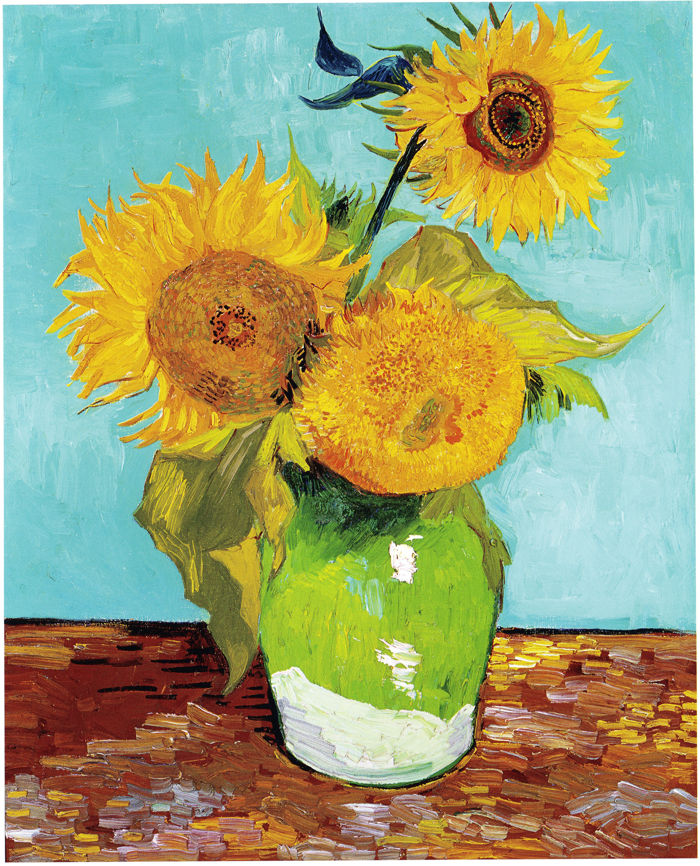
The most beautiful part of this story appears in the letters Vincent wrote to Theo. Vincent told him he was working simultaneously on three sunflower paintings. The first had three large flowers in a green vase, against a light background.
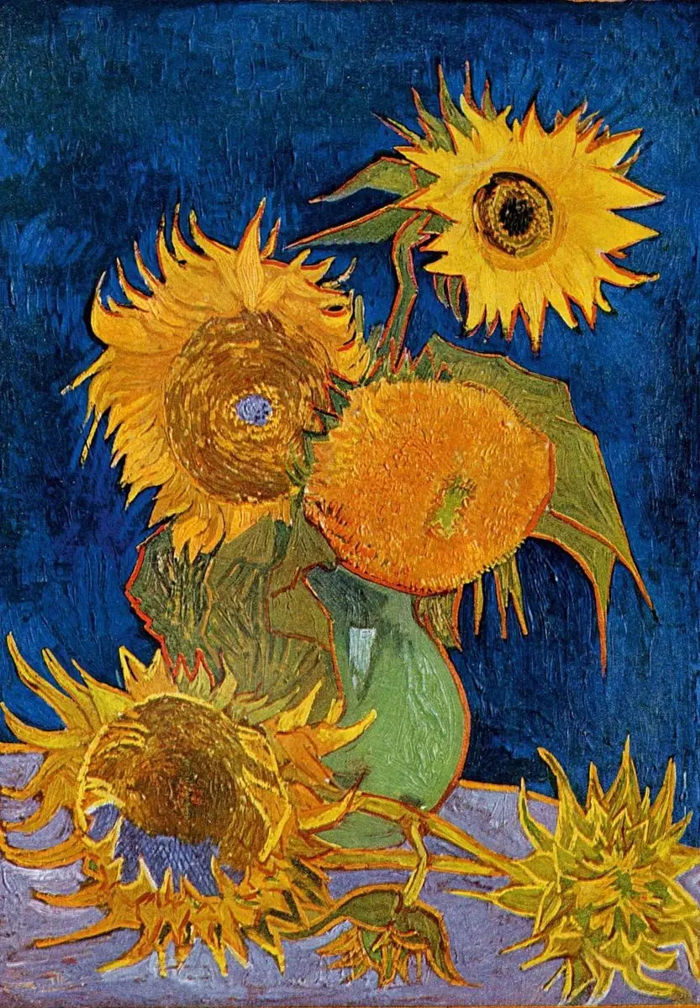
The second showed three flowers, another already wilted and a bud, against an ultramarine blue background.
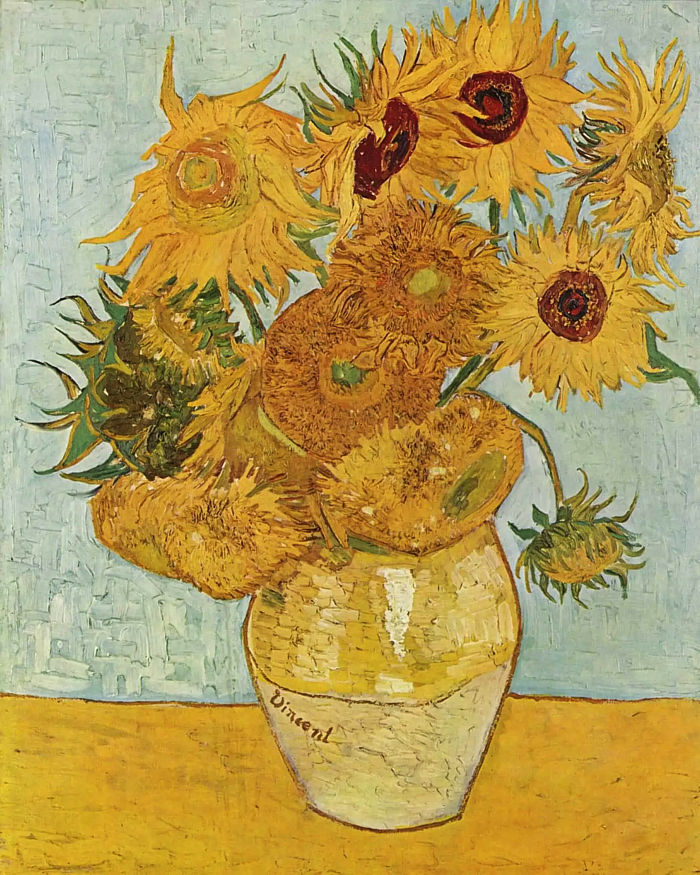
And the third was far more ambitious: twelve flowers and buds in a yellow vase.
But Vincent was not finished yet. In that same letter he told Theo that he would probably not stop there. He wanted to make a decoration for the studio he would share with Gauguin.
"Nothing but big sunflowers," he wrote. And he reckoned that, if he carried the project through, there would be around a dozen panels. The idea was for the whole set to become a kind of symphony of blue and yellow.
There is something almost cinematic about that letter. Vincent is working from dawn because the flowers wilt quickly and he needs to paint the whole set at once. While Theo is in Paris, Vincent is in Arles surrounded by flowers that lose their freshness by the hour.
And he paints.
The Fourth Painting
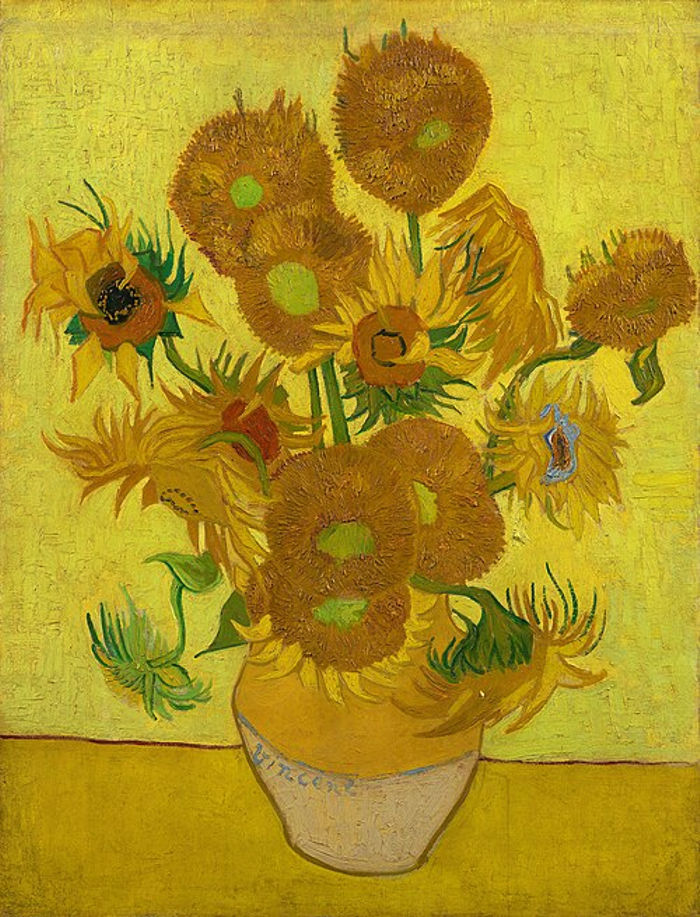
Two days later, Vincent wrote to Theo again. He was already working on the fourth painting of the series. This time there were fourteen flowers against a yellow background. It was a much larger composition and, according to Vincent, it produced a completely different effect.
He was no longer simply describing flowers. He was looking for a way to paint with greater simplicity, using the brushstroke to build the forms without resorting to unnecessary effects.
But there is something that matters even more. In that same letter, while talking about the fourth bouquet, Vincent returns to the subject of colors. One of the sunflower paintings had a royal blue background, and around the objects appeared a kind of halo produced by the contrast with the complementary color.
Everything was designed so that the sunflowers would not be merely yellow. They had to leap out from the surface. They had to fill the room.
And Vincent was completely immersed in the project.
"Like a Marseillais Eating Bouillabaisse"
There is a phrase of Vincent's that lets us imagine perfectly the state he was working in. He wrote to Theo that he was painting with the enthusiasm of a Marseillais eating bouillabaisse.
It is not the phrase of a man doing a calm still-life exercise. It is that of someone deeply enjoying what he is doing.
The sunflowers demanded speed because they wilted. But they also demanded concentration. Vincent wanted to harness that energy before it disappeared. And while the flowers withered in the vase, he tried to fix them forever on the canvas.
Perhaps that is why it feels so strange to look at those paintings today. We know we are seeing flowers that were cut, placed in a vase and painted quickly. But in the paintings they seem almost eternal.
The dry petals, the twisted stems, the open flowers and those already beginning to lose their life were turned into color.
The Sunflowers Were for Gauguin
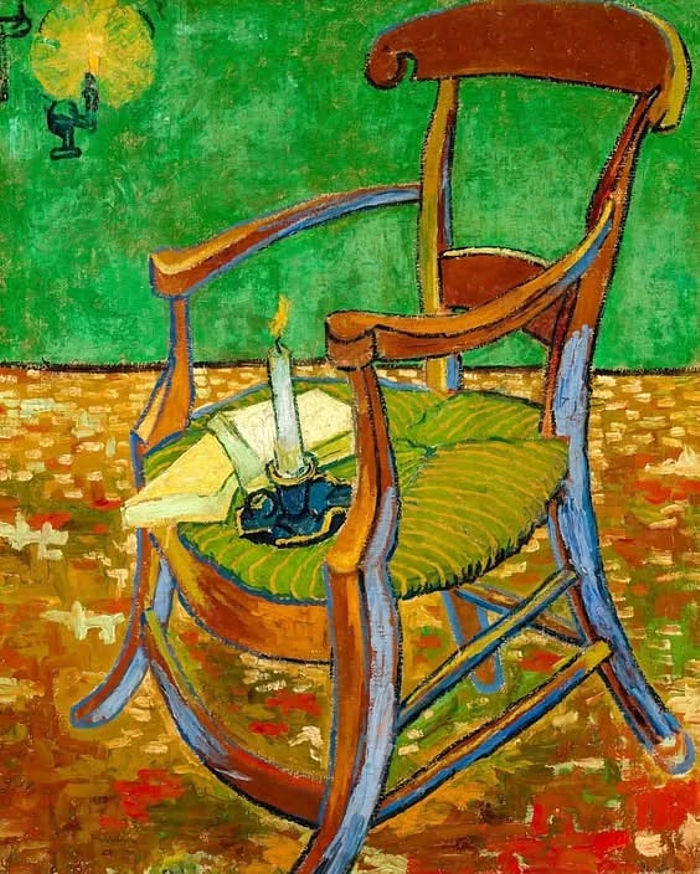
Vincent was not doing all this only for himself. He wanted Gauguin to feel at home in the Yellow House. The paintings were to be part of the decoration of the place where they would live and work.
Vincent even remembered a large sunflower he had seen in a floral decoration in a Paris restaurant. That image had stayed in his memory. Now he wanted to make something similar, but in his own way. Much bigger. Much more intense. Much more yellow.
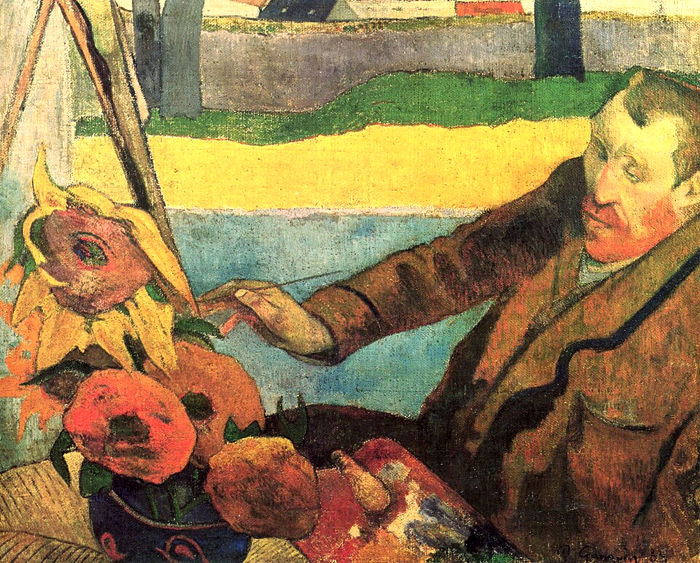
When Gauguin finally arrived in Arles, in late October 1888, he found a house that Vincent had prepared with him in mind.
The project of that artistic community would not last long. The two men had very different personalities and ways of understanding art. They worked together for a while, but the arguments grew until Gauguin ended up leaving.
Vincent's dream of turning the Yellow House into a community of artists turned out to be much shorter than he had imagined. But the sunflowers remained.
The Painting That Became a Symbol
Van Gogh painted sunflowers again after that first series. In January 1889 he made new versions, among them the one now held by the Van Gogh Museum in Amsterdam.
By then the sunflowers were no longer simply part of the decoration he had imagined to welcome Gauguin. They had become one of the most recognizable images in his painting. And Gauguin had been impressed by them.
The series ended up holding a special place within Vincent's artistic identity. The Van Gogh Museum itself notes that, in 1889, Vincent took up the motif again and that the versions of the sunflowers went on to become true icons of modern art.
But perhaps the most interesting thing is to go back to the beginning. To that moment in August 1888 when Vincent was still preparing the house. He was still waiting for Gauguin. He still thought they could live and work together. And he still had in front of him a bouquet of flowers that was wilting far too fast.
First there were three. Then another small group. Then twelve flowers and buds. And finally fourteen flowers filling a large vase against a yellow background. The bouquet grew while Vincent built his dream.
That is why Van Gogh's sunflowers can be seen in a different way. They are not only a celebration of yellow. They are not only one of the most famous images in the history of art.
They are the trace of a moment when Vincent believed he could build a place to share art with another painter. A yellow house. A room full of light. Gauguin arriving from the north. And walls covered with flowers.
For a brief moment, all of it seemed possible. Vincent painted it yellow.
THE ARTWORKS
Vase with Three Sunflowers, 1888
Vase with Three Sunflowers, a Wilted Flower and a Bud, 1888
Vase with Twelve Sunflowers, 1888
Vase with Fourteen Sunflowers, 1888
The Yellow House, 1888
Gauguin's Chair, 1888
Vincent's Bedroom in Arles, 1888
Van Gogh Painting Sunflowers - Paul Gauguin, 1888
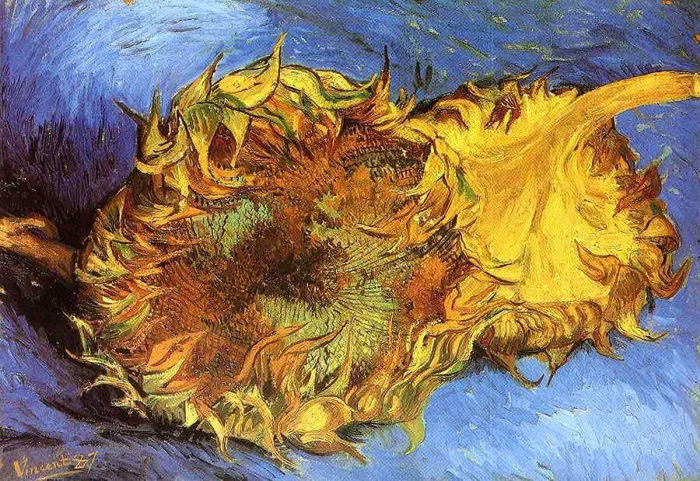
Two Cut Sunflowers, 1887