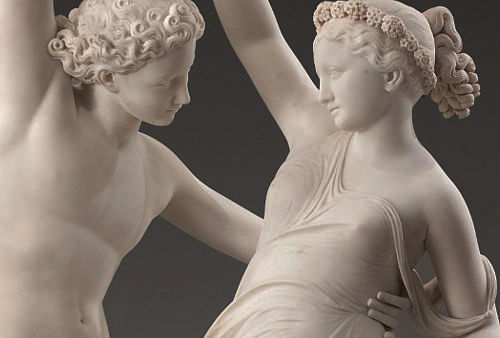


On other occasions, we have published works that speak of Psyche and Cupid. Today we bring you this series of paintings by William-Adolphe Bouguereau that represent different moments of the myth. Psyche was the youngest daughter of the King of Anatolia; her great beauty was so famous throughout the kingdom that men adored her as a new Aphrodite, forgetting the altars of the true goddess. This involuntary cult sparked the wrath of the deity of love, who could not allow a mortal to compete with her radiance.
Aphrodite ordered her son Cupid to punish her, by making her fall in love with the most vile and monstrous being on earth. However, fate had other plans. The oracles ordered that Psyche be taken to the forest, tied to a rock, and abandoned so that a horrible monster could take charge of her. But the West Wind, Zephyrus, by order of a Cupid who had become enchanted by her beauty after accidentally pricking himself with his own arrow, swept her away.
Once safe, Cupid made her his wife. They lived in an enchanted palace where Psyche was surrounded by gifts and riches, but with an unbreakable prohibition: she could not see his face. Cupid visited her only under the mantle of night, so she did not know she was joined to the god of love himself. After a while, loneliness overcame her, and she asked permission to invite her sisters. Cupid accepted but warned of the danger. Her sisters, moved by a poisonous envy, convinced her that her husband was a monstrous serpent that would eventually devour her.
Psyche, curious and terrified, lit a lamp while he slept. Upon seeing Cupid's divine beauty, her hands trembled and a drop of boiling oil fell on the god's shoulder. Cupid, feeling betrayed by the lack of trust, fled in disappointment, abandoning Psyche in a world that suddenly turned gray and empty.
Aphrodite's Tasks and the Descent into Hades
Desperate to regain her love, Psyche went to see her mother-in-law, Aphrodite. The goddess, with that resentment that deities sometimes hold toward those who threaten their status, entrusted her with a series of impossible tasks. She thought the young woman would die in the attempt, but with the help of ants, reeds, and talking towers, Psyche fulfilled each challenge. The last task was the most dangerous: to go down to Hades to ask Persephone for a little of her beauty and bring it to Aphrodite in a closed box.
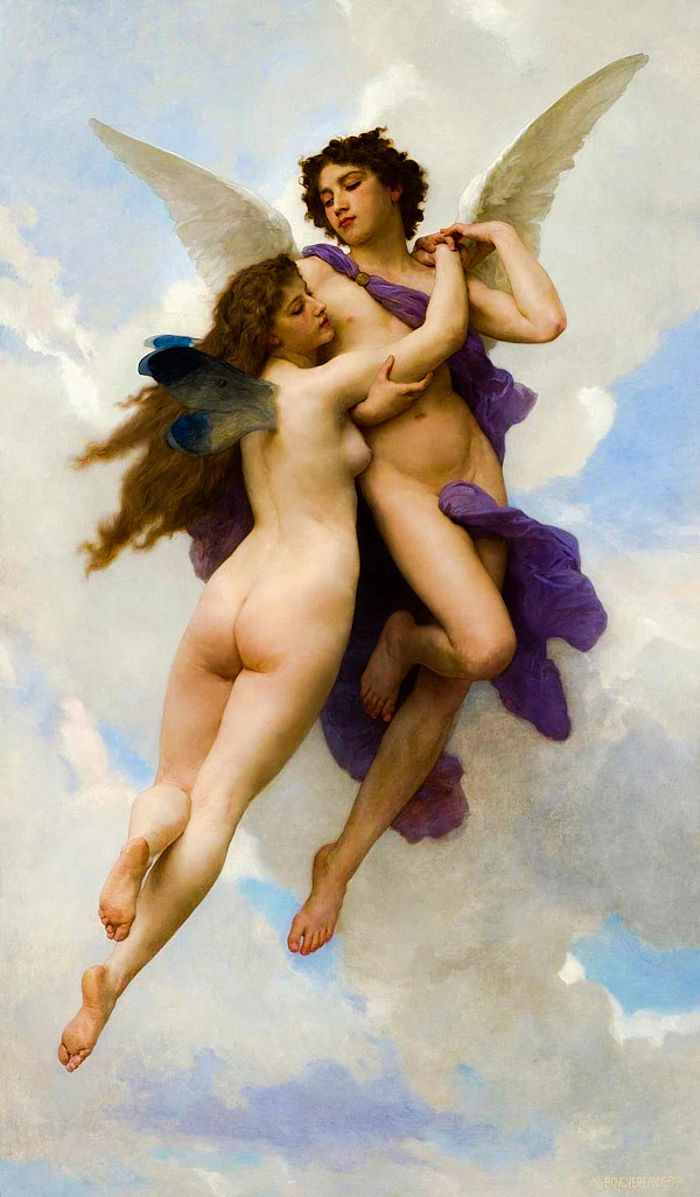
Psyche managed to obtain the chest, but before leaving the underworld, curiosity overcame her for a second time. She thought that if she took a little of that divine beauty for herself, Cupid would surely love her. However, upon opening the box, she found no beauty, but a "Stygian sleep": a narcotic vapor that plunges the dead into amnesia. Psyche fell into a deep, almost mortal sleep. Cupid, who had already forgiven her and followed her in secret, flew to her, removed the sleep from her eyes, and put it back in the box.
Finally, Zeus intervened. Moved by the young woman's perseverance, he granted her ambrosia to make her immortal. Psyche became the goddess of the soul. Aphrodite forgot her grudges and danced at the wedding of Eros and Psyche. From their union, a daughter named Hedone was born, the personification of sensual pleasure and delight, from which the word hedonism originates.
Psyche: The Breath, the Soul, and the Butterfly
The Greek meaning of *psycho/psyche* is "to blow." It is the breath exhaled by a human being upon dying. For the ancient Greeks, this breath represented life itself. When the psyche escapes the body, it leads an autonomous existence. They imagined it as an anthropomorphic and winged figure, a double of the deceased that went to Hades.
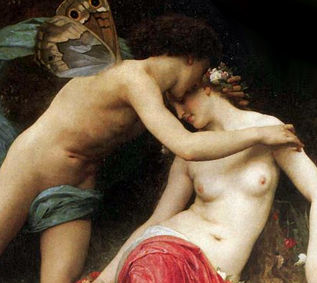
Homer told that the psyche flies out of the mouth as if it were a butterfly (which in Greek is also written *psyché*); for this reason, the butterfly is considered a psychopomp: a guide that conducts the souls of the deceased toward the afterlife. In Bouguereau's paintings, this symbolism is vital. Psyche often appears with delicate butterfly wings, distinguishing herself from Cupid's feathered and powerful wings.
Analysis of the Bouguereau Series
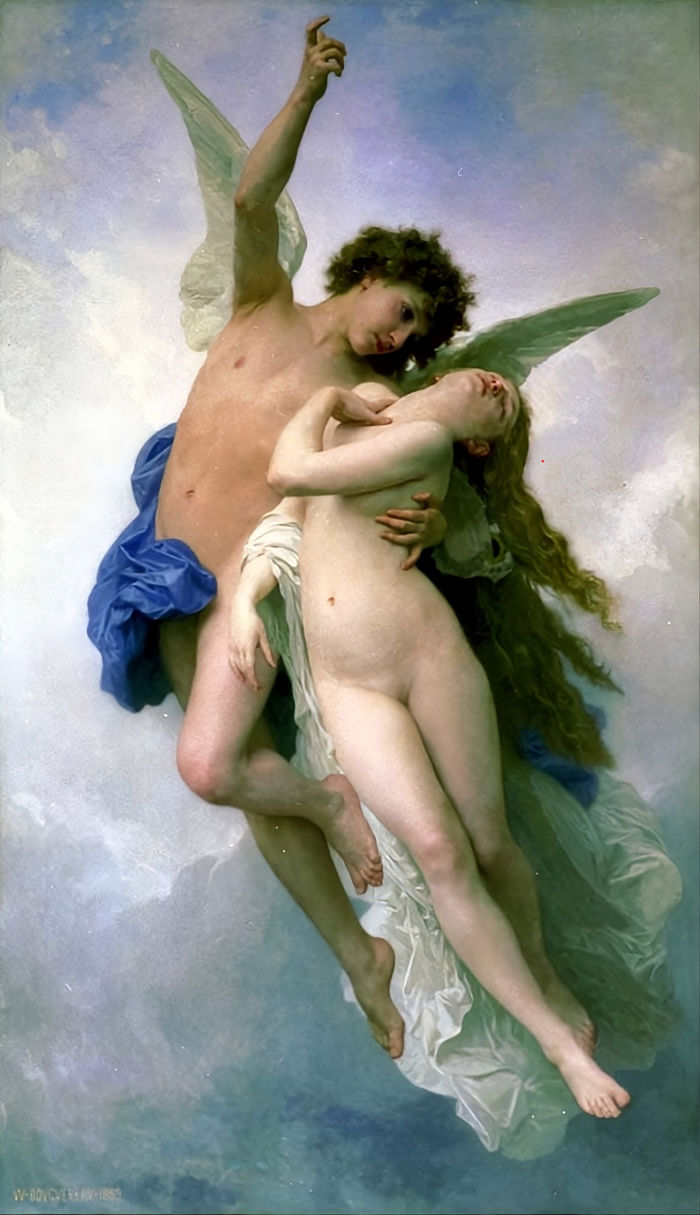
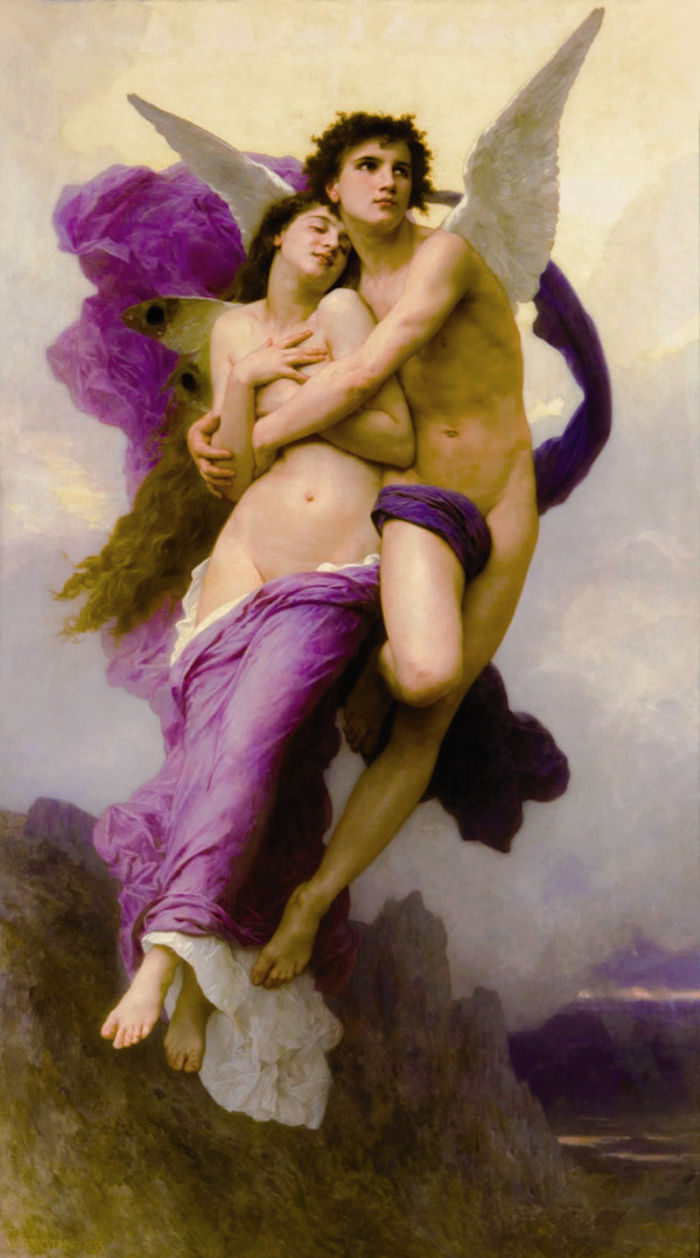
William-Adolphe Bouguereau was the leading exponent of French academicism. His technique is so perfect that the skin textures seem to emit heat. In "The Abduction of Psyche," we see Cupid clinging to the young woman's body, lifting her toward the realm of the immortals. Psyche's expression is one of total surrender; her butterfly wings shine with the promise of eternity. It is the representation of the soul being rescued by divine love.
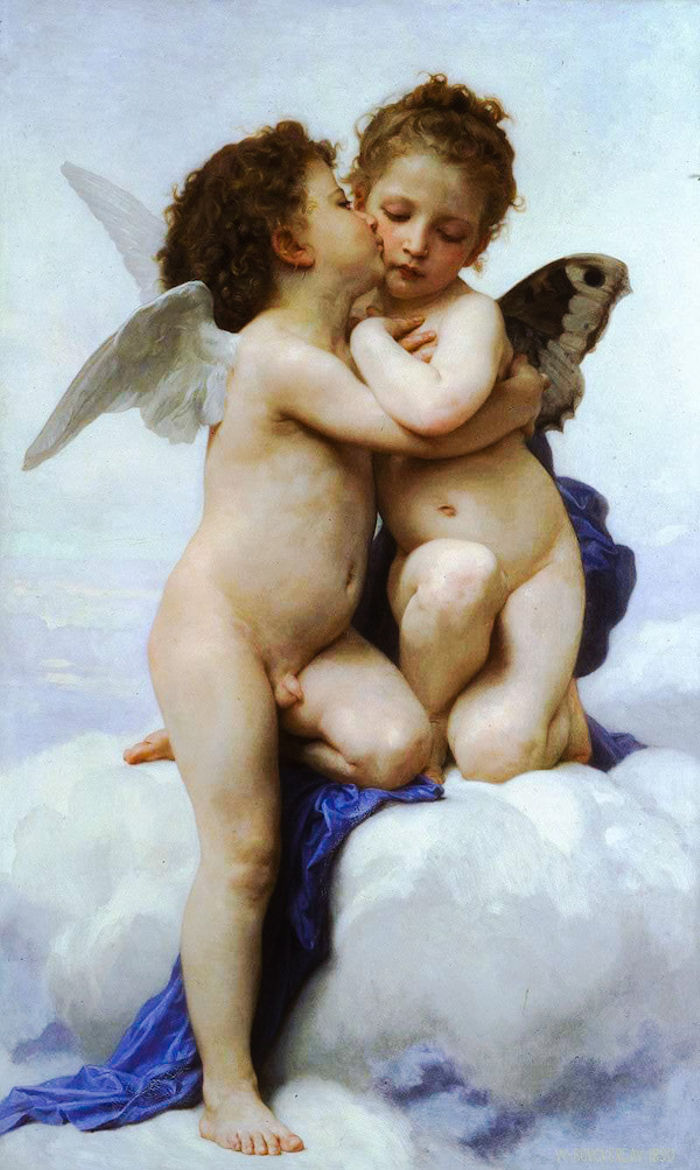
For its part, "The First Kiss" (L'Amour et Psyché, enfants) is perhaps his most popular work. Painted in 1890, it shows the two protagonists as children. It is an innocent and pure vision of the myth, where affection is not a destructive passion, but a heavenly tenderness. Bouguereau uses pastel colors and an ethereal background to emphasize that this moment occurs on a plane outside of human time.
The 1899 works, "Cupid and Psyche" and "Amor and Psyche," show the artist's mature style. The anatomical realism is amazing: every muscle, every shadow on the skin, and the softness of the clouds create a dreamlike atmosphere. Bouguereau did not just paint a myth; he painted the ideal of human beauty elevated to the category of the sacred.
THE WORKS
Cupid and Psyche
Artist: William-Adolphe Bouguereau
Year: 1899
Technique: Oil on canvas
Location: Private collection
Amor and Psyche
Artist: William-Adolphe Bouguereau
Year: 1899
Technique: Oil on canvas
Location: Private collection
The Abduction of Psyche
Artist: William-Adolphe Bouguereau
Year: 1895
Technique: Oil on canvas
Location: Private collection
The First Kiss (L'Amour et Psyché, enfants)
Artist: William-Adolphe Bouguereau
Year: 1890
Technique: Oil on canvas
Location: Private collection