

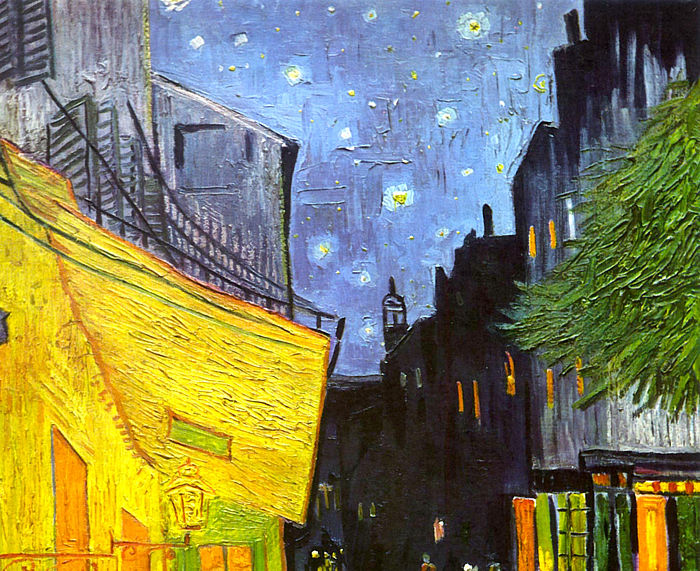
Vincent van Gogh's masterpiece, "Café Terrace at Night," is much more than a vibrant and dynamic representation of an outdoor night scene. Painted in Arles in September 1888, this piece contains one of the most serene and, paradoxically, mystically charged atmospheres of his entire career. With its vision of a relaxed spectator enjoying the charm of their surroundings without moral concerns, the painting encapsulates a simple beauty that hides a profound message beneath the gaslight.
Van Gogh, in his moments of contemplation, shared in his letters that "the night is more alive and more richly colored than the day," a philosophy deeply reflected in this piece. It was the first time Vincent dared to paint his iconic starry sky, a motif that would later become his personal signature. But what few know is that behind the facade of a French café lies a composition that mimics one of the most sacred scenes in Christendom.
Hidden Symbolism: The Last Supper in a Café?
One of the most striking and lesser-known aspects of this painting, which has gained relevance in recent analyses, is its direct allusion to Leonardo da Vinci's "The Last Supper." To understand this, we must remember Van Gogh's past: before becoming a painter, Vincent was a fervent preacher who wished to "preach the gospel everywhere," influenced by his father, a pastor in the Dutch Reformed Church.
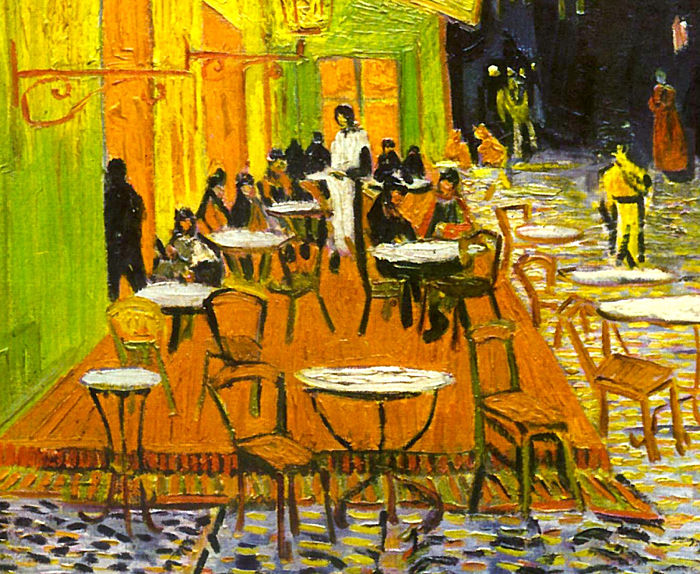
If we look closely at the central section of the terrace, under the yellow awning, we find a central figure with long hair, dressed in white, surrounded by exactly twelve individuals. Some are seated, others remain standing, but the arrangement clearly evokes the traditional iconography of Christ and his apostles. But the most chilling detail is the shadowy figure standing right in the doorway, slipping away into the darkness. Many historians see in this shadow the representation of Judas Iscariot leaving the gathering.
Furthermore, Van Gogh left almost imperceptible visual clues for the casual eye. If you look at the window frames surrounding the central white-clad figure, you will see that they form subtle crosses. Even in the background, a cross shines discreetly in the architecture, unifying the everyday scene with a spiritual dimension that Vincent never fully abandoned, despite moving away from the religious institution.
The Mystery of Color: A Night Without Black
The painting stands out for its abundance of color and visual complexity. The viewer's eyes wander through the steep edges of neighboring areas, where irregular shapes fit together like a puzzle design. This arrangement makes it difficult to divide the space into large objects and background themes, as distant and closer parts are equally distinctive.
An amazing technical curiosity is that, despite being a night scene, Van Gogh did not use a single drop of black paint. Instead, he used deep blues, violets, and dark greens to build the shadows. The yellow of the café contrasts violently with the blue of the remote street and the violet of the foreground door. This technique, known as complementary contrast, makes the yellow of the awning seem to glow with an almost divine light, reinforcing the idea of the terrace as a sacred refuge of light amidst the world's darkness.
Astronomy and Reality in the Place du Forum
Van Gogh did not paint this scene from memory, but "on the spot" (en plein air), something unusual for a night work due to the difficulty of seeing colors under gas lamps. Modern astronomers have analyzed the position of the stars on the canvas and confirmed that the arrangement of the constellations is exact for the night of September 16 or 17, 1888, in Arles. This proves that, even in his poetic and religious fervor, Vincent maintained a deep connection with the physical and scientific reality of his environment.
The design of the work plays with a fascinating geometry. The silhouette of the starry sky is key; it is an irregular shape that fits as the negative of the orange floor of the café. The elliptical tables scattered across the terrace seem to be an earthly reflection of the scattered disks of the stars in the firmament, suggesting a mystical connection between heaven and earth, between the divine and the everyday.
The Café That Survived Time
Interestingly, Van Gogh never signed this work, although he mentioned it with pride in three different letters to his brother Theo and his sister Wil. In its first public exhibition in 1891, the work bore the title "Café, le soir" (Café in the evening). Today, the spot where Vincent planted his easel still exists in the Place du Forum in Arles. It has been renamed "Café Van Gogh," and its facade has been restored to match exactly the yellow and orange colors that the artist immortalized over a century ago.
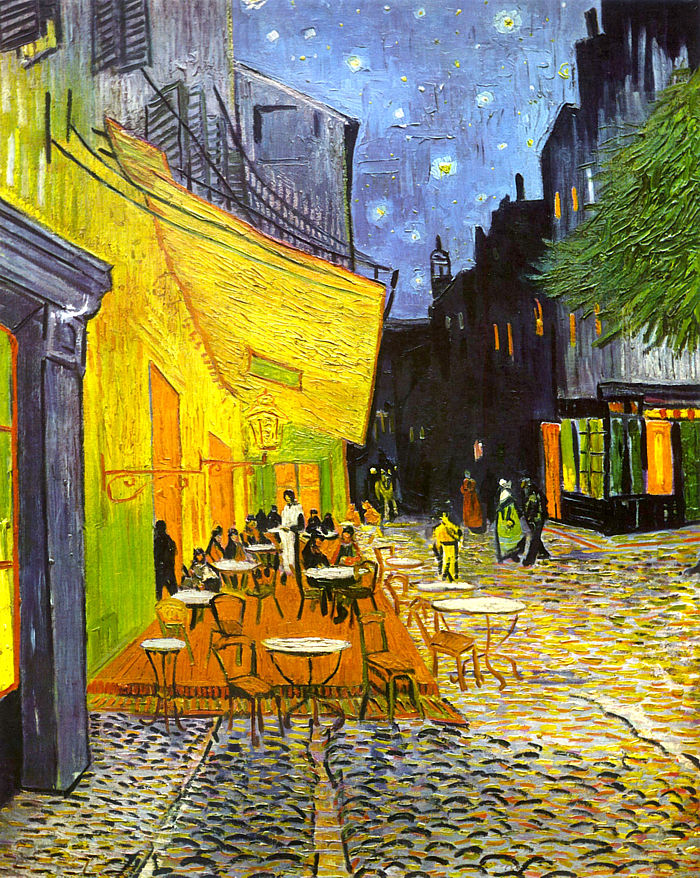
The work is not only a testament to his technical mastery but also a reflection of his ability to capture the poetic essence of life. Through his innovative use of color and hidden references to the Last Supper, Van Gogh invites us to experience the night not as a time of darkness, but as a vibrant canvas where even an ordinary café can be the stage for a sacred gathering.
THE WORK
Title: Café Terrace at Night (Place du Forum)
Artist: Vincent van Gogh
Year: 1888
Technique: Oil on canvas
Style: Post-Impressionism / Cloisonnism
Location: Kröller-Müller Museum, Otterlo, Netherlands