

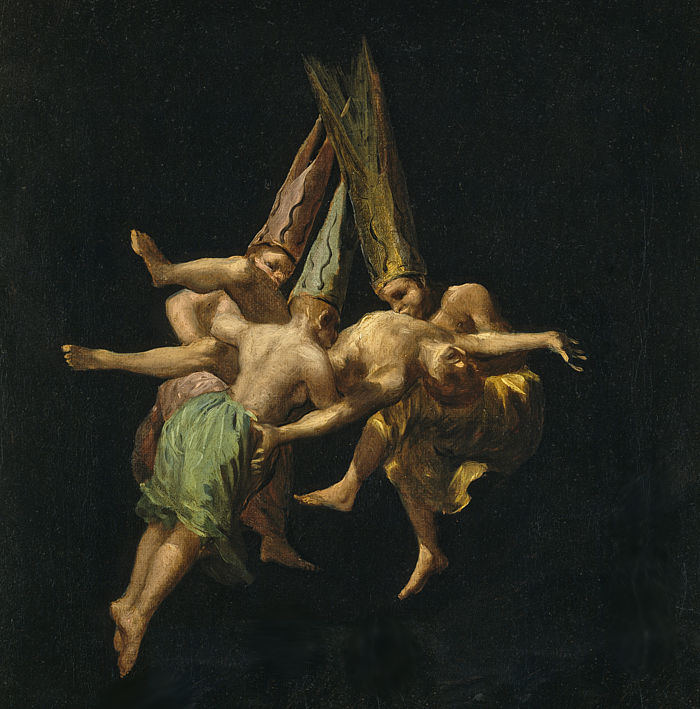
Imagine entering a duke’s pleasure palace only to be confronted with one of the most disturbing visions in Spanish art. It is not a hunting scene or an idyllic landscape; it is three semi-naked men floating in a suffocating void while they devour a victim who seems to have lost all hope. This is the essence of Witches' Flight, a work where Francisco de Goya decided that true terror does not come from the beyond, but from the darkness that dwells within the human mind.
Painted between 1797 and 1798, this piece belongs to a series Goya titled "Compositions on Witches' Matters." It was a direct commission for the Dukes of Osuna, intended to decorate their El Capricho palace. What is fascinating is that Goya, instead of offering a pleasant decoration, delivered a visual autopsy of superstition. For the Aragonese genius, witchcraft was not a supernatural phenomenon, but the symptom of a sick society that preferred myth over reason.
The Anatomy of Fear: The Witches and Their Corozas
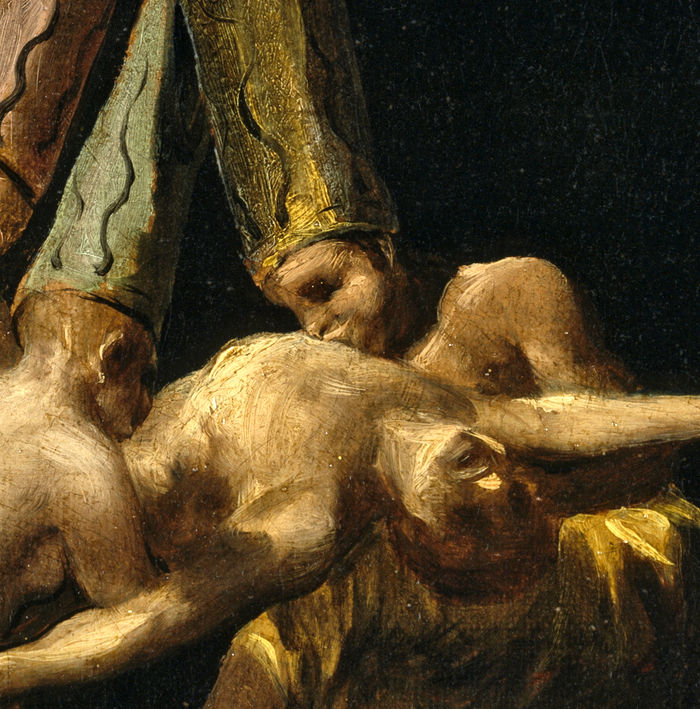
In the center of the composition, three male figures rise into a dense and dark air. They hold aloft a person whose anatomy seems to fade away, surrendered to martyrdom. But the detail that truly chills the blood is the hats worn by these supposed witches: they are "corozas." These pointed hoods do not belong to the world of magic, but to the Spanish Inquisition.
They were the garments of shame that prisoners had to wear in "autos de fe" to be publicly humiliated. By placing these attributes on the flying executioners, Goya launches a devastating accusation: the real monsters devouring the people are those who use faith and punishment as tools of social control. Fear, in the hands of institutions, becomes a predator that rises over the heads of the ignorant.
The Triumph of Silence: Those Who Refuse to See
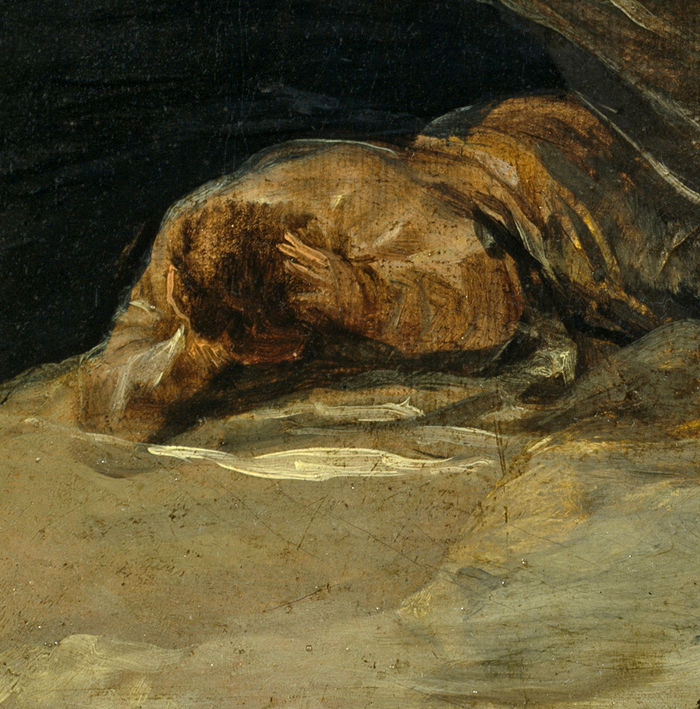
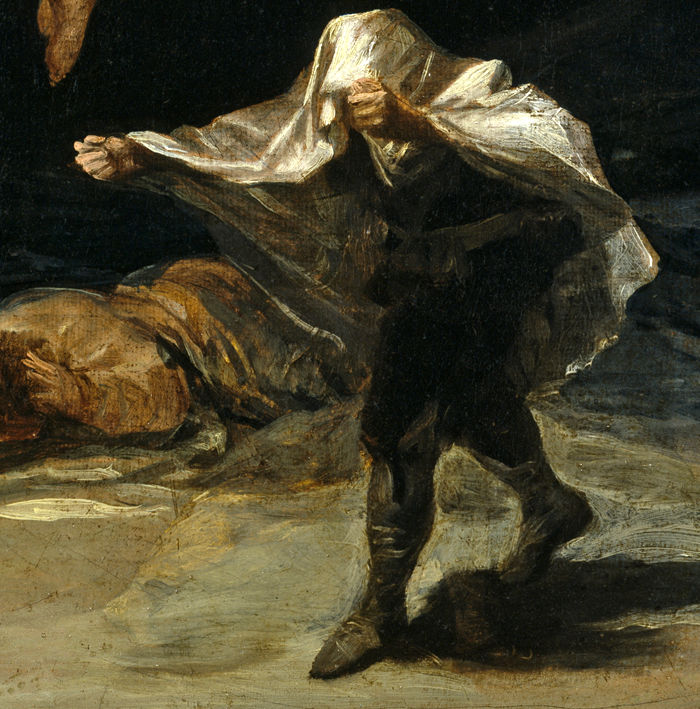
While the horror takes place in the heights, at the bottom of the painting the reaction of the witnesses is almost as terrifying as the flight itself. Goya presents us with two types of cowardice. One of the men covers his ears, refusing to hear the victim's screams or the truth of what is happening. The other covers himself completely with a blanket, walking blindly toward nowhere.
This is the portrait of popular fear. The figure covering himself makes the "higa" gesture with his hands, an ancient amulet to protect against the evil eye. Goya, a man of the Enlightenment, subtly mocks this reaction: while men lose themselves in superstitious gestures and shut their senses, the executioners continue to feast. The painting tells us that silence and voluntary blindness are the best allies of tyranny.
The Donkey: The Guardian of Stupidity
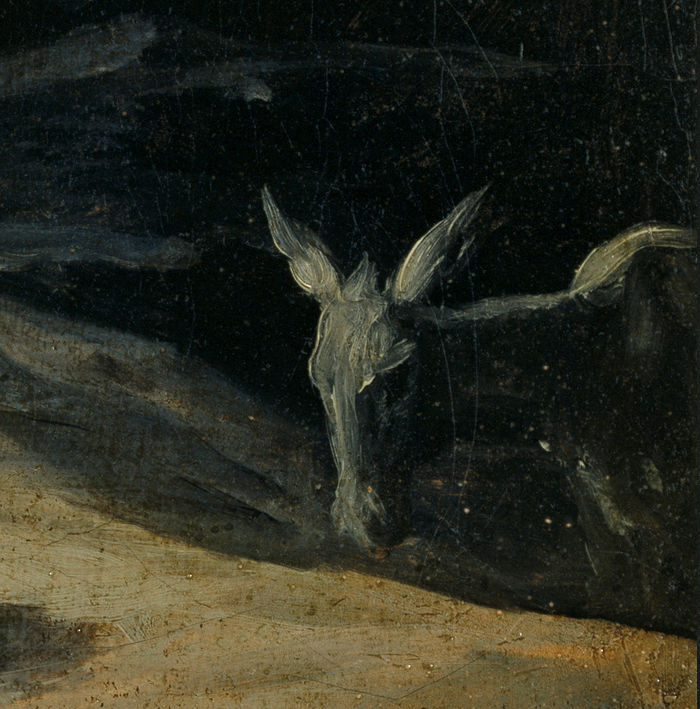
In a corner of the canvas, silhouetted against a desolate horizon, a donkey appears. For any other painter of the time, it would be a decorative element of rural life. For Goya, it is a recurring symbol representing blind ignorance and a lack of critical thinking. The animal remains impassive, oblivious to the drama occurring just a few meters away.
The donkey does not move because it does not understand, and in that lack of understanding lies the power of monsters. Goya uses the figure of the donkey as a constant reminder that superstition and fanaticism can only thrive in lands where education is not cultivated. If the people do not wake up, if they continue to be like that donkey that looks without seeing, the witches with corozas will never stop flying.
A Dreamlike and Revolutionary Aesthetic
Technically, Witches' Flight is a masterpiece of chiaroscuro. The background is a black void, an absolute nothingness that makes the illuminated figures appear to jump out of the painting. There is no landscape to distract us, only the physical and almost tactile presence of the witches' skin and the violent contrast of the lights.
Goya breaks with classical harmony to create a dreamlike atmosphere, a space where the laws of physics seem suspended by the force of the collective subconscious. It is a painting that is not only seen, but felt in the gut. The use of color is sober, almost monochromatic in some areas, accentuating the feeling that we are witnessing something forbidden, a dark secret unearthed from the walls of El Capricho to warn us about ourselves.
Final Reflection: When Reason Sleeps
To contemplate this painting is to face an uncomfortable mirror. Goya warned us that the sleep of reason produces monsters, and Witches' Flight is the graphic representation of that violent awakening. The monsters are not creatures of the underworld; they are constructions of our own fear, of our lack of information, and of our tendency to shut our eyes in the face of injustice.
Today, centuries later, Goya's witches continue to fly over any society that prefers the comfort of superstition over the effort of truth. In the end, the question the artist leaves us with is simple but terrifying: are we the victim in flight, or are we the donkey that stays watching while everything happens?
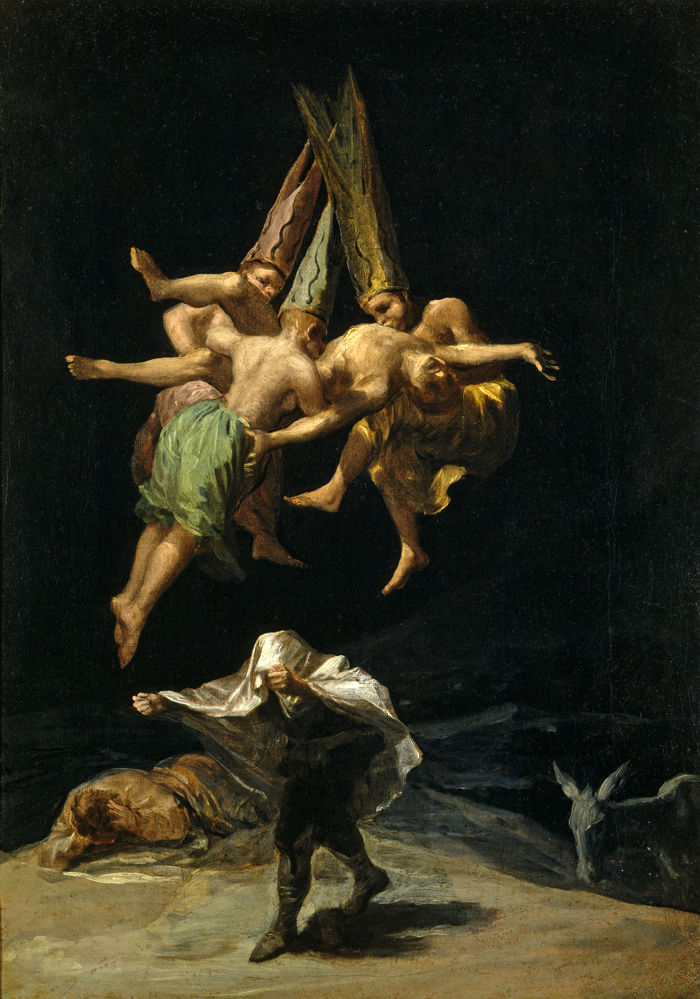
THE WORK
Title: Witches' Flight (Vuelo de Brujas)
Artist: Francisco de Goya y Lucientes
Year: 1797-1798
Technique: Oil on canvas
Style: Romanticism / Dreamlike Painting
Location: Museo del Prado, Madrid