

Before diving into the list of monsters, feats, and impossible journeys, we must clear up a doubt that has confused art and history lovers for centuries: Are we talking about Heracles or Hercules? The answer is simple yet revealing. Heracles is his original Greek name, which ironically means "Glory of Hera." Hercules is simply the Roman adaptation of the same hero.
The curious thing is that Hera, the queen of the gods, was not exactly his protector, but his greatest enemy. Heracles was the fruit of one of Zeus's many infidelities with a mortal, Alcmene. Hera, consumed by jealousy, haunted the hero from his birth. It was she who, in an induced fit of madness, caused Heracles to commit the most terrible crime of his life: murdering his own wife and children. Upon awakening and seeing the massacre, the hero sought redemption. The Oracle of Delphi gave him the answer: he had to place himself at the service of his cousin Eurystheus, the king of Mycenae, and complete ten labors (which ended up being twelve) to purify his soul and reach immortality. Thus began the most famous saga in classical mythology.
1. The Nemean Lion: An Impenetrable Hide
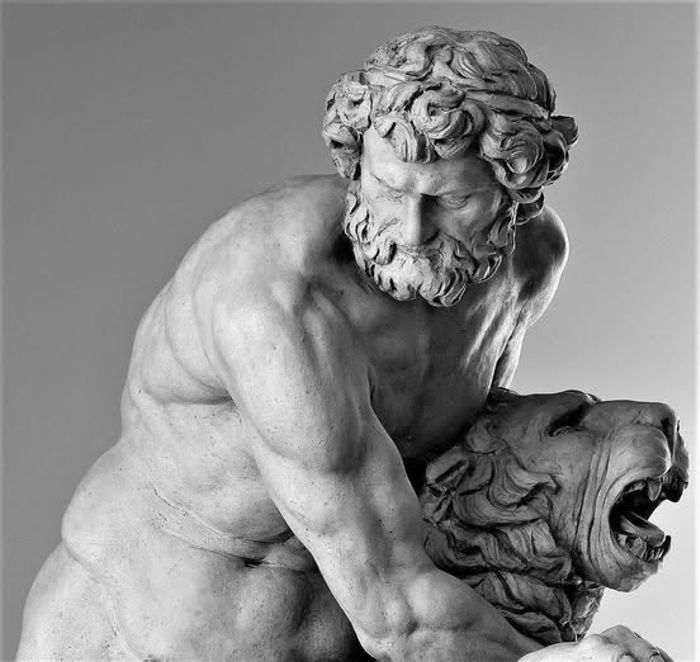
Eurystheus's first assignment seemed like a death sentence. In the forests of Nemea lived a lion whose skin was so thick that no weapon of bronze or iron could pierce it. Heracles tried to shoot arrows at it, but they bounced off as if hitting a rock. Realizing that brute force was his only option, the hero cornered the beast in its cave and, after a hand-to-hand struggle that made the earth tremble, strangled it with his bare hands.
But the job didn't end there. Eurystheus wanted proof. Heracles tried to skin the animal, but no knife worked. It was then that he used the lion's own claws to cut the hide. From that day on, the hero wore the lion's skin as armor and its head as a helmet, becoming the iconic image we all recognize in classical sculpture.
2. The Lernaean Hydra: The Terror of a Thousand Heads
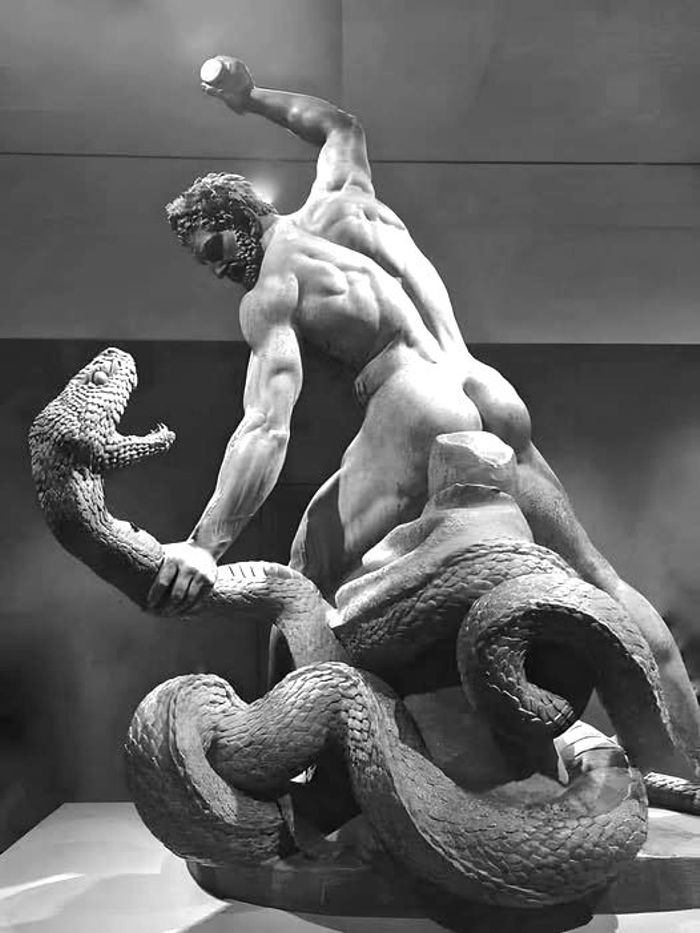
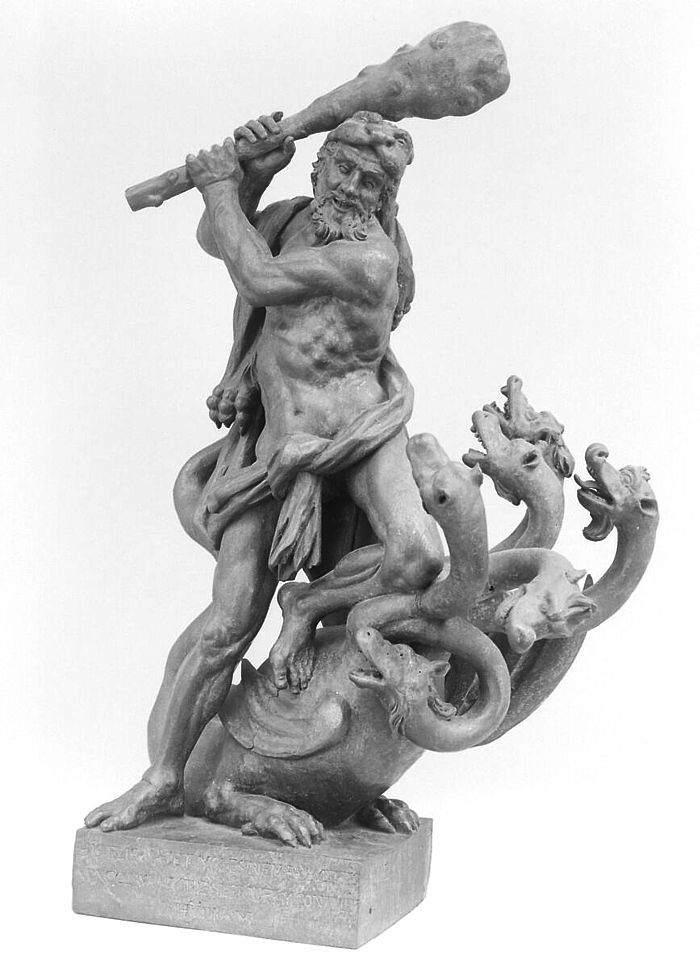
In the swamps of Lerna lived a multi-headed water monster with poisonous breath. This task turned out to be a logistical nightmare: every time Heracles cut off one head, two more sprouted in its place. Additionally, Hera sent a giant crab to bite the hero's heels during the battle.
Heracles asked his nephew Iolaus for help. While the hero cut off the heads, Iolaus burned the necks with a torch to cauterize the wounds and prevent the heads from regrowing. Finally, Heracles crushed the Hydra's immortal head under a giant rock and dipped his arrows in the monster's poisonous blood, obtaining a lethal weapon he would use in the future. Eurystheus invalidated this labor, claiming he had received help, forcing him to perform more tasks.
3. The Ceryneian Hind: The Test of Patience
Not all labors involved killing. The Ceryneian Hind had bronze hooves and golden antlers, and it was so fast it could outrun an arrow in flight. Furthermore, it was sacred to Artemis, so Heracles could not wound it without unleashing the goddess's fury.
The hero pursued it for an entire year across Greece and beyond. Finally, he managed to capture it when the animal stopped to drink. Upon meeting Artemis and Apollo, Heracles humbly explained that he was doing it by mandate of the oracle and for the redemption of his sins. The goddess, moved, allowed him to take the hind alive on the condition of releasing it afterward.
4. The Erymanthian Boar: Capture in the Snow
Eurystheus then ordered the capture of a giant boar that was terrorizing the region of Erymanthus. It was a beast of colossal strength. Heracles, using his wit, chased the boar toward the peaks of the mountains covered in deep snow. The animal, heavy and tired, became trapped in the snow, allowing the hero to easily chain it.
It is said that when Heracles arrived in Mycenae with the boar on his shoulder, Eurystheus was so terrified that he hid inside a bronze jar, an image frequently repeated in Greek pottery to mock the king's cowardice compared to the hero's courage.
5. The Augean Stables: Wit Over Strength
This labor was a humiliation designed by Eurystheus. King Augeas had thousands of head of cattle, and his stables had not been cleaned in thirty years. The smell and filth were unbearable. Heracles had to clean them in a single day.
Instead of using a shovel, the hero used nature. He made breaches in the stable walls and diverted the course of two nearby rivers, the Alpheus and the Peneus. The water rushed through, washing away all the filth in a matter of hours. Once again, Eurystheus invalidated the task because Heracles had asked Augeas for payment (which the king later refused to give), adding more weight to his penance.
6. The Stymphalian Birds: Arrows and Rattles
In Lake Stymphalus lived fierce birds with bronze beaks, wings, and claws, which shot their feathers like arrows and devoured men and crops. The forest was so dense that Heracles could not enter to find them.
The goddess Athena intervened by giving him bronze rattles (krotala) made by Hephaestus. The hero climbed a hill and shook them with such a din that the birds flew off in terror. While they were in the air, Heracles used his perfect aim and his poisoned arrows to shoot them down one by one, freeing the region from the plague.
7. The Cretan Bull: The Origin of the Minotaur
Heracles traveled to the island of Crete to capture the bull that Poseidon had sent to King Minos. This animal was the same one that, after a series of dark myths, would become the father of the Minotaur. The bull wandered freely, sowing chaos.
Heracles wrestled with the animal, mastered it by the horns, and rode it across the sea back to Mycenae. Eurystheus wanted to sacrifice it to Hera, but the goddess rejected the gift because it came from Heracles, so the bull was released and ended up wandering to Marathon.
8. The Mares of Diomedes: A Diet of Human Flesh
Diomedes, King of Thrace, fed his four wild mares the flesh of strangers who arrived in his lands. The animals were so fierce they had to be chained to iron mangers.
Heracles defeated the king and, in an act of poetic justice, fed the mares the body of their own master. Upon eating Diomedes' flesh, the mares immediately became tame. The hero brought them before Eurystheus, who finally consecrated them to Hera.
9. The Belt of Hippolyta: Diplomacy and Treachery
Eurystheus's daughter wanted the magic belt of Hippolyta, the queen of the Amazons. Heracles traveled to Themiscyra expecting war, but Hippolyta, admiring the hero's deeds, agreed to give him the belt peacefully.
Hera, furious that the task was so easy, disguised herself as an Amazon and spread the rumor that Heracles wanted to kidnap the queen. A bloody battle broke out in which Hippolyta died, and Heracles had to fight his way out to escape with the prize, lamenting that divine betrayal had ruined a peace agreement.
10. The Cattle of Geryon: A Journey to the End of the World
To steal the red cattle of the giant Geryon, Heracles had to travel to the ends of the known world (near present-day Cadiz). Geryon was a being with three bodies and three heads, protected by a two-headed dog named Orthrus.
During the journey, the sun's heat was so intense that Heracles, enraged, shot an arrow at the god Helios. The god, far from punishing him, admired his courage and lent him a giant golden cup to sail across the ocean. Heracles killed Orthrus, the herdsman, and finally the three-bodied giant, driving the cattle back to Greece. On this trip, it is said he split the mountains to create what we know today as the Strait of Gibraltar (the Pillars of Hercules).
11. The Apples of the Hesperides: The Weight of the Heavens
Since Eurystheus had invalidated two labors, Heracles had to perform two more. The first was to obtain the golden apples from the garden of the Hesperides, a gift from Gaia to Hera. The problem was that no one knew where the garden was.
After wrestling with Nereus to obtain the location, Heracles reached the Titan Atlas, who held the sky on his shoulders. Heracles offered to carry the firmament if Atlas went for the apples (as only a god or relative could enter the garden). Atlas agreed, but upon returning with the apples, he did not want to take back his burden. Heracles pretended to agree but asked Atlas to hold the sky for a moment while he adjusted a pad on his shoulders. When the Titan took the weight, Heracles picked up the apples and left.
12. Cerberus: Descent into Hell
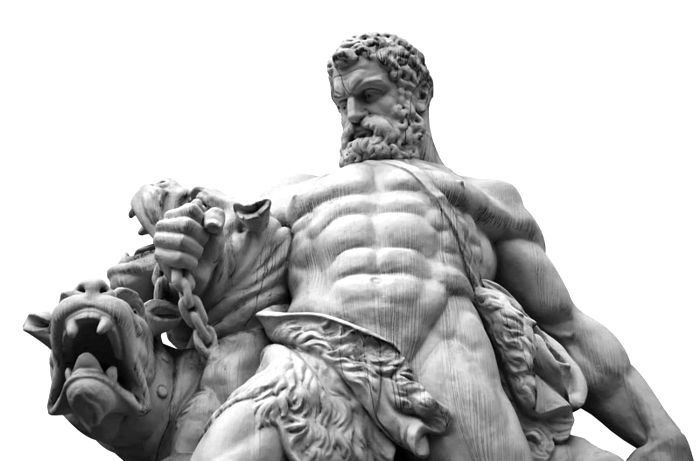
The last labor was the most impossible of all: capturing the three-headed dog that guarded the entrance to the Underworld, Cerberus. Heracles descended into Hades and spoke with the god of the dead.
Hades agreed to let him take the dog on one condition: he had to master it without using weapons. Using only his superhuman strength and his lion skin, Heracles slightly choked the three heads until the animal surrendered. When he brought the monster before Eurystheus, the king was so frightened he hid in his jar again. Heracles finally returned the dog to Hades, having completed his redemption.
The Hero's Legacy
The 12 labors of Heracles are not just stories about monsters. They represent the human struggle against the impossible, the triumph of will over fate, and the search for forgiveness. After fulfilling these tasks, Heracles not only cleared his name but became the protector of humanity. Upon his death, he was ascended to Olympus as a god, finally taking his place among the stars.
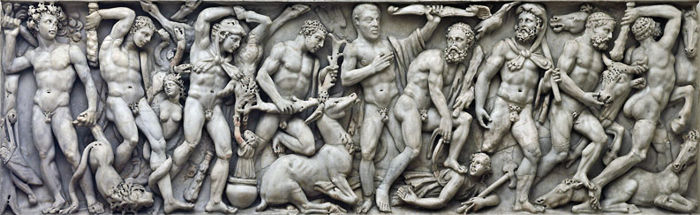
His image has inspired thousands of artists, from the reliefs of Greek temples to the grand paintings of Rubens or the sculptures of Canova. Heracles teaches us that no matter how heavy our burden or how many monsters we must face, there is always a path toward the light.